This might come as a surprise to anyone building an electronic collections of books. As technologies, and even computer operating systems evolve, older versions of e-books may become unreadable, possibly after only a decade or two. A certain amount of on-going reprocessing and reformatting is required to keep them up to date, and readable on newer devices:
For those of us tending libraries of digitized and born-digital books, we know that they need constant maintenance — reprocessing, reformatting, re-invigorating or they will not be readable or read. Fortunately this is what libraries do (if they are not sued to stop it). Publishers try to introduce new ideas into the public sphere. Libraries acquire these and keep them alive for generations to come.
I won’t go saying paper editions win out though. The world’s print books — even if they have a long shelf life, possibly spanning centuries — will eventually decay. Digital titles that are updated as time goes by will potentially be with us in many centuries time. There may be not too many paper books — aside from those in museum display cases — that will go that sort of distance.
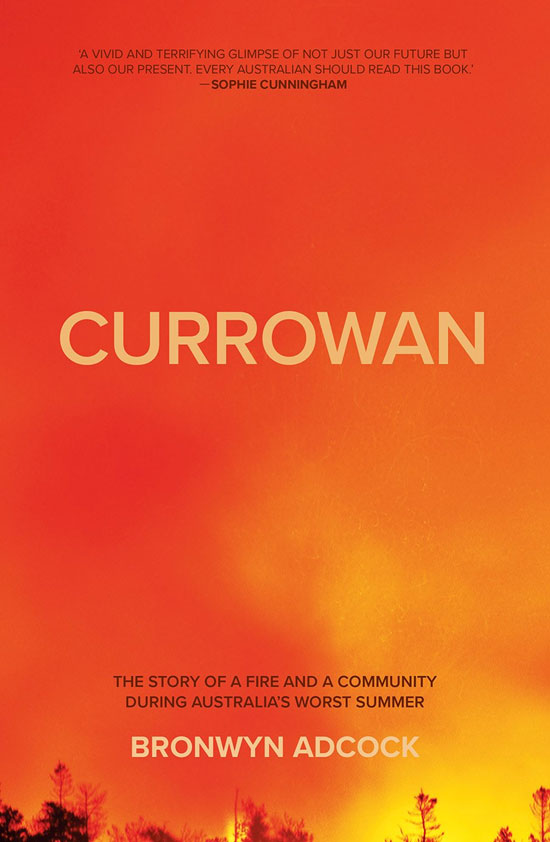
Currowan, by NSW based Australian journalist and writer Bronwyn Adcock, has been named winner of the 2022 Walkley Book Award. Published by Black Inc., Currowan is a harrowing personal account of a bush fire that burnt for seventy-four days on the NSW south coast in 2019.
The Currowan fire — ignited by a lightning strike in a remote forest and growing to engulf the New South Wales South Coast — was one of the most terrifying episodes of Australia’s Black Summer. It burnt for seventy-four days, consuming nearly 5000 square kilometres of land, destroying well over 500 homes and leaving many people shattered.
Bronwyn Adcock fled the inferno with her children. Her husband, fighting at the front, rang with a plea for help before his phone went dead, leaving her to fear — will he make it out alive?
In Currowan, Bronwyn tells her story and those of many others — what they saw, thought and felt as they battled a blaze of never-before-seen intensity. In the aftermath, there were questions — why were resources so few that many faced the flames alone? Why was there back-burning on a day of extreme fire danger? Why weren’t we better prepared?
Currowan is a portrait of tragedy, survival and the power of community. Set against the backdrop of a nation in the grip of an intensifying crisis, this immersive account of a region facing disaster is a powerful glimpse into a new, more dangerous world — and how we build resilience.
The Walkley Awards, which are presented annually, recognise excellence in Australian journalism.
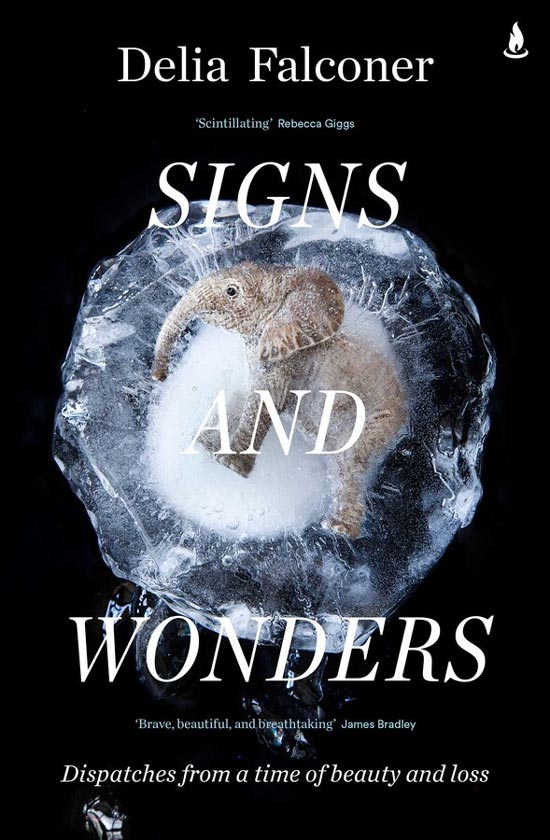
Building on Falconer’s two acclaimed essays, ‘Signs and Wonders’ and the Walkley Award-winning ‘The Opposite of Glamour’, Signs and Wonders is a pioneering examination of how we are changing our culture, language and imaginations along with our climate. Is a mammoth emerging from the permafrost beautiful or terrifying? How is our imagination affected when something that used to be ordinary — like a car windscreen smeared with insects — becomes unimaginable? What can the disappearance of the paragraph from much contemporary writing tell us about what’s happening in the modern mind?
Scientists write about a ‘great acceleration’ in human impact on the natural world. Signs and Wonders shows that we are also in a period of profound cultural acceleration, which is just as dynamic, strange, extreme and, sometimes, beautiful. Ranging from an ‘unnatural’ history of coal to the effect of a large fur seal turning up in the park below her apartment, this book is a searching and poetic examination of the ways we are thinking about how, and why, to live now.
The literary prize, often referred to as the Nib Award, was established in 2002, and principal sponsors are presently Mark and Evette Moran. The award recognises excellence in literary research, and is open to Australian works of any genre, fiction or non-fiction.
If we really are witnessing the demise of social media, then Apples, trailer, the 2020 debut of Greek filmmaker Christos Nikou, might offer a glimpse of this brave new world. Of course some people will find the scenario familiar, but others — those who grew up with a parent’s smartphone constantly in their hand — might be left feeling disorientated.
Apples is set in contemporary Athens, the capital of Greece, where the world is in the grip of a pandemic that causes instant, and in many cases, permanent amnesia.
Recently widowed Aris (Aris Servetalis) is one of the virus’s victims. As he was carrying no identity documents at the time he lost his memory, Aris is taken to a hospital where he waits to be “claimed” by friends or relatives. Medical staff warn this may never happen though. His near and dear may have also succumbed to the disease, and no longer have any memory of him.
When it becomes apparent this is the case, Aris is placed on a program that gives patients a new identity and life. He is given an apartment and a living allowance, but must complete a daily task set by his doctors. Instructions are left on a cassette placed in his letterbox, which he listens to on a cassette player. He is also required to photograph his exploits, using a Polaroid camera.
Assignments variously include riding a bike, going to a horror film, and even crashing a car in a low-impact collision with a fence or a tree. The exercises are intended to help victims of the virus create new memories. While on one of his missions, Aris meets Anna (Sofia Georgovassili), herself a virus victim, and they begin to form a bond.
But nothing is quite what it seems to be in this world devoid of an internet, where people must interact in person, or call around to each other’s apartments if they wish to see each other. At times though it seems quite comforting. People appear to live normally, as if the advent of social media and the internet were a passing blip in history.
Could it be that straightforward though? Simply forget the internet — and anything else for that matter — both the convenient and inconvenient it has brought to the world? I doubt it, and so to, I think, do the protagonists in Apples.
It’s over. Facebook is in decline, Twitter in chaos. Mark Zuckerberg’s empire has lost hundreds of billions of dollars in value and laid off 11,000 people, with its ad business in peril and its metaverse fantasy in irons. Elon Musk’s takeover of Twitter has caused advertisers to pull spending and power users to shun the platform (or at least to tweet a lot about doing so). It’s never felt more plausible that the age of social media might end — and soon.
The question is, what do we do next, if we don’t have social media? Go back to meaningful face-to-face interactions? What do content producers, who enjoy self-publishing do? Print a zine? I’m not sure that social media is about to disappear, even if some of the bigger players are having some trouble. Still, Bogost makes some salient points.
As I’ve written before on this subject, people just aren’t meant to talk to one another this much. They shouldn’t have that much to say, they shouldn’t expect to receive such a large audience for that expression, and they shouldn’t suppose a right to comment or rejoinder for every thought or notion either.
People have been over-talking since people could first talk. Ditto expecting a large audience for their rants. Social media only amplified the voice of these over-talkers. On the upside, anyone we don’t want to listen to can easily be ignored, blocked. Try doing that to an over-talker you don’t want to listen to at a family gathering.
Social media might not be about to roll over and die, but it is at a turning point. Yet as Twitter’s implosion shows, people are not quite ready to walk away from connecting online. Membership of Twitter alternative, Mastodon, has spiked in recent weeks. Billing itself as a social network, rather than a social media service, it has become a sanctuary for people seeking a place where they can hear themselves think.
Presently there are few brands, and — better still — influencers, and possibly over-talkers, on Mastodon. That some servers, or instances, forbid commercial accounts, helps in this regard. Instances are either owner funded, or member supported, meaning they don’t need advertising revenue to survive. Perhaps this means there’ll be more signal and less noise, but only time will tell.
If social media is about content creation and publishing to the widest possible audience, then social networking is about forging more meaningful connections with those in your network. No doubt some will welcome the demise of certain social media channels, but if the migration to Mastodon is any indication, people are still looking to connect online with others, both known and unknown. Or maybe a whole lot of us simply want to be part of the next (sort of) big thing. Only time will tell.
Medical professionals are calling for more work from home mandates to combat the present surge in Covid infections in Australia. But the strain a new load of cases would impose on the health system is only one of their concerns. There is also the worry of an increase in instances of long Covid, something that becomes more likely, the more often someone is infected by Covid, says Dr Michael Bonning, NSW president of the Australian Medical Association.
“The risk of long COVID for everyone is really there and the more often you get infected, the higher your chances,” Bonning said. “[It doesn’t matter if] you’ve had it once and it was fairly mild.”
But Australian governments are reluctant to re-impose Covid mandates, saying Australians must take “personal responsibility” and “learn to live with Covid”. While this is true, I’m not sure Covid, as opposed to possibly the flu or common cold, is something we can really afford to live with, particularly if it leads to long Covid.
Long Covid, which can last for two months, some times longer, sees sufferers experience symptoms including extreme fatigue, cough, breathlessness, joint or muscle pain, chest pain, memory and concentration problems, and reduced appetite and weight loss, among other things. That’s not something to look forward to.
But then again, neither are lockdowns, or other restrictions. While they saw short term success, infection rates generally saw a decline, Covid returned once restrictions were removed. Covid has us in a bind. To live as normally as possible, free of Covid and long Covid, and restrictions, personal responsibility is one of the few options we have. But for “personal responsibility” to be effective, everyone has to do the right thing.
At its most basic, this means mask wearing where crowds are present, keeping up to date with Covid vaccinations, and isolating if infected. Covid is a slippery beast, and has had us marching to its beat for three years. The only real hope is an effective treatment is forthcoming, that will eventually eliminate the disease all together.
Workers at American publisher HarperCollins have been on strike since 10 November, as they attempt to negotiate their pay rates. While salaries at the company average US$55,000 — close to the average in America — many workers would be earning far less.
Publishing has for decades has been known for its low pay and overwhelmingly white staff. But workers at HarperCollins, the only member of the “big four” publishing houses to have a union, have had enough and authorized an indefinite strike. Work stopped at the downtown Manhattan offices on the sunny morning of 10 November.
Here’s hoping the workers and company can reach a fair deal.
Twenty-twenty-two must be winding down if “best books of the year” lists are beginning to appear.
The Best Books of 2022, from the New Yorker, is the first summary I’ve seen so far, though they add the crucial “for now” provision. After all, anything could happen in the next month and a half. It’s a pretty extensive list, and includes the fiction work of two Australian authors I could see, Cold Enough for Snow by Jessica Au, and The White Girl by Tony Birch.
Do you often recall events from your past? Things that happened days ago, or decades earlier? Do you frequently visualise your future? This could involve thinking about where you’ll be living in five years, or where you might be working in twenty years time.
It’s a phenomenon known as mental time travel, and if your mind wanders back and forth through time, you wouldn’t be the only one. While mental time travel may seem like a waste of time, mere daydreaming, there can be an upside. For instance, if enough people had a positive outlook on the future, the future may well become the place we hope it will be.
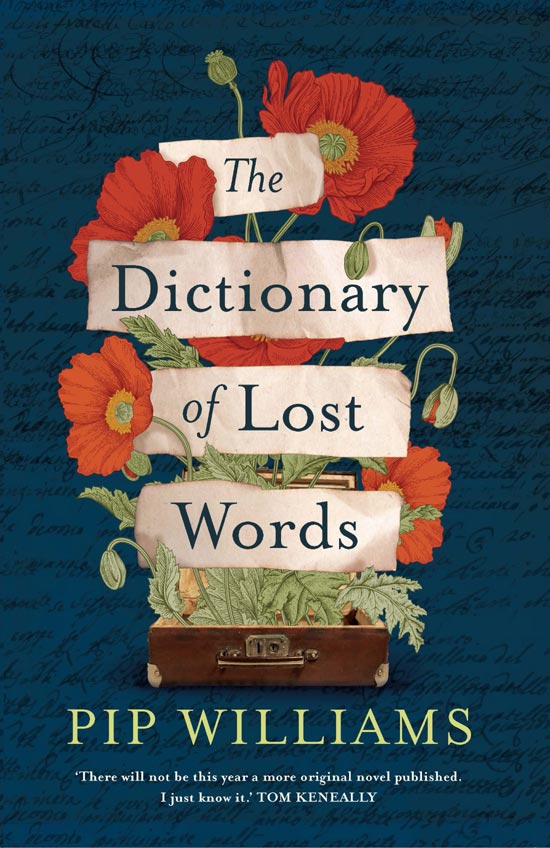
The Dictionary of Lost Words, the debut novel of Adelaide Hills, South Australia, based author Pip Williams, which I happen to be reading at the moment, is to be the subject of not one, but two separate adaptations.
And then this week Australian television producers Lisa Scott and Rebecca Summerton announced they had acquired the TV rights to the book, and were planning a six to eight part series. At this stage it remains unknown when the show will go to air.
Set with the publishing of the first Oxford Dictionary as a backdrop, The Dictionary of Lost Words, published in March 2020 by Affirm Press, recounts the story of Esme, the daughter of one of the lexicographers working on production of the dictionary:
Esme’s place is beneath the sorting table, unseen and unheard. One day, she sees a slip containing the word bondmaid flutter to the floor unclaimed. Esme seizes the word and hides it in an old wooden trunk that belongs to her friend, Lizzie, a young servant in the big house. Esme begins to collect other words from the Scriptorium that are misplaced, discarded or have been neglected by the dictionary men. They help her make sense of the world.
Over time, Esme realises that some words are considered more important than others, and that words and meanings relating to women’s experiences often go unrecorded. She begins to collect words for another dictionary: The Dictionary of Lost Words.