8 August 2023
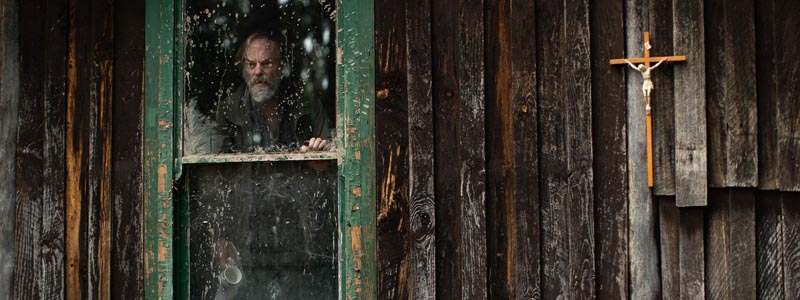
A scene from The Rooster, a film by Mark Leonard Winter.
The Rooster, trailer, is the debut feature of Australian actor turned filmmaker Mark Leonard Winter, starring veteran actor Hugo Weaving, and Phoenix Raei. The Rooster had its world premiere on Saturday 5 August 2023, at the Melbourne International Film Festival (MIFF). This sounds like a brooding, atmospheric, Australian feature not to be missed:
Dan (Raei, Below, MIFF Premiere Fund 2019; Clickbait) works in a remote police outpost in regional Victoria, but when a childhood friend is discovered dead following an incident at the local high school, his judgement and credentials are thrown into question. Consumed with guilt and suspended from the force, Dan decides to camp out in the forest, where he encounters a cranky jazz-listening, shotgun-toting, ping-pong-obsessed misanthrope (Weaving, Lone Wolf, MIFF Premiere Fund 2021; Measure for Measure, MIFF Premiere Fund 2019). At first transactional, this bond soon becomes transformative for the broken men. But, surrounded by trees, far away from any trace of civilisation, is everything really as it seems?
I’m still looking for details about a wider theatrical release for The Rooster, but it will screen several times during MIFF, between now and Sunday 13 August 2023.
8 August 2023
A children’s book titled You and the Universe, written by late British physicist and cosmologist Stephen Hawking, will be published in March 2024:
The new book is based upon a 2018 partnership Hawking’s family had with the European Space Agency, along with the Greek composer Vangelis (“Blade Runner”, “Chariots of Fire”, “Cosmos: A Personal Voyage”.) The message used words adapted from Hawking’s book for adults, “Brief Answers to the Big Questions” (Bantam, 2018), set to music by Vangelis.
The book is co-written by Hawking’s daughter, Lucy, and illustrated by Li Xin. You and the Universe asks readers to imagine themselves as time travellers heading towards the future, and to work together to ensure the future will be a place free of the ravages of climate change.
4 August 2023
Indie Blog, is a blogroll website by Andreas Gohr, akin to ooh.directory and feedle, but with a slight difference. Instead of searchable lists, Indie Blog takes visitors to a random post from one of the websites on their directory. You mightn’t know where you’re going, but that’s half the fun.
4 August 2023
How many hours of sleep are lost, each night, across the world, to the likes of Facebook, TikTok, Twitter/X, Instagram, and (maybe) Threads? Too many to count, I’m guessing.
But there may be a panacea, by way of, ironically, the same tech companies who developed these sleep depriving products. Legal Lullabies (how about that domain name, hey?), from the TLDR-Institute (The Lazy Data Research Institute), takes the terms of service (TOS) of tech companies and converts them to a sleep inducing lullaby. Reading lengthy TOS sends me to sleep, during the middle of day, when I’m wide awake, so they’d surely work a treat late at night.
4 August 2023
The Live Music Archive, part of the Internet Archive, contains close to a quarter of a million entries, dating back to 1959. The chances of tracking down recordings of live performances by your favourite artists and bands are therefore probably pretty good.
3 August 2023
London based film writer Manuela Lazić, writing for The Guardian:
If the internet has paved the way for the devaluation of cinema via streaming platforms, it has also done the same for film criticism. The democratising effect is undeniable, but so is the cheapening one, literally and figuratively. With so many more people writing about cinema online, fees for reviews have fallen to shockingly low levels and the expertise supposedly required of film critics has been forgotten – knowledge of the film history and good writing skills are less and less valued.
Once, many years ago, during a regrettable stint working in the corporate sector, I was called into division wide meeting by my boss. The CEO, whom my boss reported to directly, wanted to conduct a staff survey. The CEO was — so he said — keen to learn what people thought about working at the company. My boss was clearly terrified at what might be said, and sought to steer our thinking.
“I think it’s great of the CEO to offer us this opportunity to speak our minds, and accordingly, I think we should be positive,” he said, trying, but failing, to sound as matter-of-fact as possible. Whether he missed my colleagues and I side-eyeing each other, or only pretended to, I don’t know. My frazzled boss though was able to rest easy. A few days later it was announced the survey was being delayed, and that was the last anyone heard of it.
But the takeaway was clear. When asked to offer honest feedback, always be complimentary.
Ten years ago, I was being invited to film preview screenings left, right, and centre. I was, according to a marketer at one of the promotions agencies I was “partnering” with, an influencer. But I wasn’t an influencer, and I certainly wasn’t a film critic, even though I wrote a bit about some of the films I saw. What I did have though was a website, the content of which, at the time, ranked quickly and well, on certain search engines.
There it was: I was an asset. If I were to write about a film, chances were the review would be near the top of the search results. Now if only I could write positively about that film. Perhaps the excitement, the extravaganza, of being at the local premiere, where food was abundant, the alcohol flowed, and the stars were in attendance, would entice me to say something nice. Well, sometimes it worked, sometimes it didn’t. But I can’t say I didn’t enjoy the hoopla of it all.
Generally though, I heard little back from the agencies, regardless of what I wrote. It was apparent, from my web stats reports, that some of them looked, but that was all. A bad write up didn’t see me struck off the invite list. But times have changed it seems. All a would-be influencer cum film critic can expect today when being asked to review a film, is a free ticket to the show. Gone is the red carpet, the bubbly, and the assorted “free” gifts. Gone also are tickets to the next event, if a favourable social media post is not forthcoming.
An incentive, if ever there were one, to be complimentary, and positive.
And that’s it. That’s the way film reviews roll in the third decade of the twenty-first century, particularly where the big budget blockbusters are concerned. Experienced film critics seem to no longer be part of the process, or if they are, their thoughts are relegated to the fringes where few paying cinema-goers venture. Social media, and influencers, and a world where negative reviews never see the light of day: what a boon that’s been for the blockbuster film industry.
1 August 2023
A few days after Twitter rebranded as X, company owner Elon Musk announced the X interface would be permanently switched into dark mode. In the usual course of events, dark mode allows users of a website or app to temporarily swap light coloured backgrounds for darker ones.
It’s a feature intended to make looking at screens a little easier on the eyes in low light situations. Such as a dark bedroom, or heaven forbid, while at the movies.
In a tweet (if that’s what they’re still called) posted on Thursday 27 July 2023, Musk said dark mode is “better in every way”. Well, dark mode is better in some circumstances, but not all, and not all of the time either. For some people, far from being helpful, dark mode can present all sorts of difficulties.
I doubt Musk was interested in the comfort of X users though. The call to permanently plunge X into dark mode was probably more to do with the dark mode interface matching the black and white colours of the new X logo.
But the next, day news came that X was backtracking on the dark mode proposal. To a degree. In a follow-up tweet, Musk said light mode will still be available, “but the default will be dark”.
I flicked the email app on my laptop into permanent “dark mode” a year or two ago, and while I find it easier to view in the evenings, it just doesn’t feel right during daylight hours. Of course I could switch back to normal mode at any time, and no doubt there’s an option to automatically toggle light and dark modes anyway, if only I went looking.
If Musk’s intention, with his talk of a permanent dark mode, was to turn the conversation towards X, and away from, say, Threads, it looks like he succeeded, if only for a while. We can only wait to see what the next thing will be.