
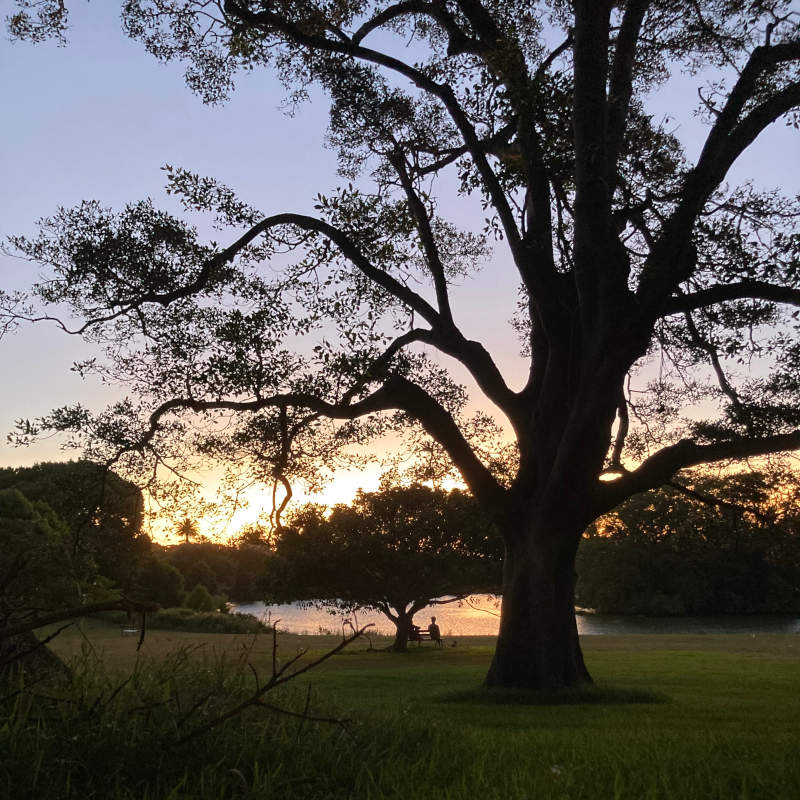
Not really a lake, it’s actually one of the ponds in Centennial Park, Sydney, Australia, taken at around sunset in mid December 2024.
18 December 2024
Not really a lake, it’s actually one of the ponds in Centennial Park, Sydney, Australia, taken at around sunset in mid December 2024.
18 December 2024
As a kid I loved the Tintin books. Although they might today be called a product of their time, I aspired to be like the intrepid boy-reporter, who seemed to do very little reporting. I have the red hair, and I write a blog so… Plus, I did write a few articles for a newspaper once. Sometimes people refer to me as a journalist (not always for flattering reasons however…).
So maybe I kind of, sort of, ended up like Tintin.
Anyway, the Tintin stories are among a batch of well-known cultural artefacts (could I refer to the Tintin comic books that way?) entering the public domain in 2025. The final, completed, story in the series, Tintin and the Picaros, was published in 1976, and creator Hergé died in 1983, meaning only some earlier Tintin works will enter the public realm for now.
But it makes me wonder. If the boy-reporter were still with us, would he still be writing for a newspaper? Or might he have capitalised on his considerable profile, and launched his own online publication. A super-famous blog. Such are the things I stay up late at night thinking about.
17 December 2024
The last few years have been bad for both producers and consumers of coffee. Extremes of weather in growing regions has resulted in diminishing coffee bean harvests, which has in turn pushed up prices. This is a topic I’ve been covering for a while here now, but it seems coffee is only going to get more expensive going forward:
On Wednesday, the price for Arabica coffee, the world’s most popular variety, hit its highest level in nearly 50 years, with a pound of beans (453.6 grams) listed in New York for US$3.20 ($5.02). The all-time high was US$3.38 ($5.30) for a pound of Arabica beans in 1977 due to snow destroying swathes of Brazil’s plantations.
16 December 2024
In the same way the brain structures of introverts and extraverts differ, the same can be said for voracious readers of book as opposed to those who struggle finish books. This according to Mikael Roll, professor of phonetics, at Sweden’s Lund University.
The structure of two regions in the left hemisphere, which are crucial for language, were different in people who were good at reading.
It seems to me there is no stock-standard issue brain, they’re as varied as we are.
13 December 2024

We’re twelve days out from the big one, and high in the silly season, as the brevity of recent posts here may allude to. Otherwise, the major highlight has to be the annual announcement of the PANTONE colour of the year. As I wrote two years ago, this was a big deal during my web design days. Well, a somewhat big deal, as we were always on the lookout for new colour inspiration.
Anyway, the PANTONE colour for 2025 is Mocha Mousse 17-1230. Mocha Mousse. I can’t decide if that’s a dessert, or a hair product. Whatever, I’m liking it. Here’s how PANTONE describe the hue:
Simple and Comforting: A Soft, Warming Brown. With its sophisticated, earthy elegance, PANTONE 17-1230 Mocha Mousse can stand alone or serve as a versatile foundation, enhancing a wide range of palettes and applications—from minimalist to richly detailed designs—across all color-focused industries.
To whip up some designs featuring Mocha Mousse in your favourite graphics editor, here are some common colour generating codes. The HEX code is #9e7a68. If Red, Green, and Blue is your thing, use these values: R = 158, G = 122 B = 104. On the CMYK colour model, go C = 31%, M = 47%. Y = 49%, K = 18%. For the HSB colour system, go H = 20°, S = 34%, B = 62%.
12 December 2024
I’m not sure if this horror re-imagining, trailer, of the Y2K “bug” will have a cinematic run in Australia, or is going straight to streaming.
Two high school nobodies make the decision to crash the last major celebration before the new millennium on New Year’s Eve 1999. The night becomes even crazier than they could have ever dreamed when the clock strikes midnight.
With dire fears of road traffic signals failing, ATMs crashing (causing some people to keep cash on hand), and aeroplanes falling out of the sky at midnight, on the first of January 2000, what more would you want in a horror story?
Those who came in post 1999, can read more about the Y2K bug here, but here’s a quick summary of the problem:
Many programs represented four-digit years with only the final two digits, making the year 2000 indistinguishable from 1900. Computer systems’ inability to distinguish dates correctly had the potential to bring down worldwide infrastructures for computer reliant industries.
Apparently some organisations spent up big trying to fend off the bug, although some IT experts felt the money could’ve been put to better use. In late 1999, I was having some weird computer (think clunky desktop with bloated monitor with an actually pretty small screen) problem (of a Windows nature, not Y2K), and had a computer fix-it guy come around and look at it. The issue was resolved, but I ended up being auto-subscribed to the fix-it people’s monthly newsletter.
Out of politeness, I read the first few newsletters they sent, before unsubscribing. In the February, or maybe March 2000 edition, they did a “recap” of their clients’ Y2K bug experiences. The fix-it people claimed many, many, organisations had averted catastrophe, thanks to their efforts. Unfortunately, or conveniently, as the case may be, not one of these organisations wished to talk publicly about how the fix-it people had saved them from certain doom. Of course.
In late 1999, I launched a Y2K bug inspired Neocities-like version of disassociated, here’s a screen grab. See them bugs in the lower right hand corner, hey? I picked up on the idea of traffic signals failing, and roads choked full of cars, trapped amid the chaos. Notice also the news box. They were ubiquitous on personal websites of the day; a design trend. Today the whole site is a news box.
Mooney’s movie might make for a great glimpse of the world, and the internet, in late 1999 though.
11 December 2024
Henrik Karlsson worked for several years at an art gallery in Denmark. The work seems more varied, and entrepreneurial, than some of us might think:
Ie. you don’t say, “This is my job and that thing is outside my area”—no, if the value you are trying to promote requires you to go outside your role and learn new skills and politick to get the authority to go ahead: then that is your job.
10 December 2024
The details are pretty scant at the moment. So far the flu-like disease killed close to one-hundred-and-fifty people in the south west of the Democratic Republic of the Congo, in November.
Infected people had flu-like symptoms including high fever and severe headaches, Remy Saki, the deputy governor of Kwango province, and Apollinaire Yumba, the provincial minister of health, said on Monday.
Whether the illness is contained and dealt with, or spreads further, remains to be seen. It sounds nasty though, whatever it is.
9 December 2024
At some point in 2025, Australians under the age of sixteen will no longer be able to operate social media accounts. I thought up to high school age, about thirteen, seemed sensible, but lawmakers decided otherwise. Anyway, I imagine the new regulations will require, eventually, those of us sixteen or over, to verify, or certify, that we are of the correct age.
With Instagram (IG), I’ve been a member since 2011. So unless I joined up when up when I was four years old, age verification seems pointless for long standing accounts. But not necessarily. There are situations where accounts may have changed hands. A page — or more specifically, a username — once established by a person of adult age, may now belong to someone under the age of sixteen.
I don’t know how often it happens, but social media usernames or accounts, probably change ownership on at least some of semi-regular basis. I’m talking about personal pages here, not accounts run on behalf of a business or organisation. These would most likely change stewardship when the person, maybe a social media manager, previously looking after the page, leaves that role.
I receive a couple of requests per year from people asking if I could “transfer” my personal IG page to them. They probably like the account name. I politely decline the polite requests (I’ve had a couple of not so courteous… demands before). I can only imagine the pressure people with IG handles, such as, well John, must be under to relinquish their usernames, but I digress.
To prove though we are the right age to be using social media in Australia, will we need to scan our driver’s licenses, or passports, into an app? A sometimes, cumbersome, awkward process. Please try retaking the photo of your passport in a better lit setting. Hopefully not. Instead, writes Stilgherrian, at The Weekly Cybers, everything we need may already be on our smartphones:
According to The Mandarin, tests of Australia’s Digital Trust Service (DTS), run by driver registry peak body Austroads, have shown that the credentials already in digital wallets can be used to verify proof-of-age at point-of-sale transactions without needing additional personal data.
6 December 2024
This I wouldn’t mind seeing… a four hour documentary about Renaissance age artist and polymath Leonardo da Vinci, by American filmmaker Ken Burns.
A 15th century polymath of soaring imagination and profound intellect, Leonardo da Vinci created some of the most revered works of art of all time, but his artistic endeavors often seemed peripheral to his pursuits in science and engineering. Through his paintings and thousands of pages of drawings and writings, Leonardo da Vinci explores one of humankind’s most curious and innovative minds.
I’m hoping this will be available, eventually, to stream in this part of the world, at the moment though even access to the trailer and preview clips seem to be blocked in Australia.