
Conquer your TBR with apps that read books in fifteen minutes
4 June 2024
Such apps don’t exactly read novels in fifteen minutes, but they scan through them, and produce relatively short summaries. Seems like cheating to me, don’t we read books to be taken along on a journey? Still, I imagine these apps have their uses.
Like, where were they when I was at high school? Especially when assigned to read Vanity Fair. With all respect to William Makepeace Thackeray. I did like the last chapter though. Ah! Vanitas Vanitatum!
RELATED CONTENT
books, literature, reading, technology
Five-thousand kilometre long cloud-band across Australia
3 June 2024
The Daily Aus (TDA), Friday, 31 May 2024:
Rain is forecast across 90% of the country over the coming days as a 5,000km ‘cloudband’ makes its way from WA‘s north to south-east Australia.
According to the Bureau of Meteorology (BOM), a ‘northwest cloudband’ is an extensive layer of air and moisture from over the Indian Ocean that can bring widespread rain to much of the country.
The cloud-band was not only extremely long, and also full to brimming with moisture. While rainfall remained constant throughout Saturday, there were some decidedly heavy downpours at times. These invariably came along just as we’d parked the car, and needed to cross a street to shelter, or while outside at some exposed mid-point between buildings.
We stopped at a cafe, a nice place, located in what was once a small warehouse, with an open ceiling with a corrugated iron roof. But we could barely hear ourselves speak at times, though during some of the showers, so heavy were they.
RELATED CONTENT
Guzman y Gomez goes to IPO, eyes burrito world domination
3 June 2024
I’m not exactly a fan of large-chain food and beverage outlets. But Sydney based Mexican cuisine fast food restaurant Guzman y Gomez, AKA GYG (to me, anyway) is not quite large-chain. Not at the moment, though there are near to two-hundred stores in Australia, sixteen in Singapore, and a handful in Japan, and the United States.
But a successful IPO might see them coming to a location near you, should you currently not reside in any of their catchment areas. At this stage, it is anticipated they will commence trading on the Australian Securities Exchange, on 20 June 2024. Of their burritos, my favourite items on their menu, I will say they make for a fulfilling meal.
I couldn’t say the same for the offerings from all large-chain fast food restaurants though.
RELATED CONTENT
Matt Adnate wins Archibald Packing Room Prize for Baker Boy painting
31 May 2024
Matt Adnate has been named the 2024 winner of the Archibald Prize’s Packing Room Prize, with his portrait of Indigenous Australian rapper Baker Boy, AKA Danzal Baker.
As the name suggests, the prize is awarded by the staff of the packing room at the Art Gallery of New South Wales (AGNSW), which administers the Archibald. Packing room staff, who are among the first to see each year’s Archibald entries, are usually more interested in the aesthetics — or, how much they like the look of a painting — rather than other of its aspects.
The Archibald Prize is awarded annually for Australian portraiture, and is one of Australia’s most prestigious visual arts prizes. Participating artists can paint choose to paint any Australian subject, so long as they have some sort of celebrity status.
For the all the buzz the Packing Room Prize generates, check today’s AGNSW Instagram reel, it is derided by many artists who consider it the kiss of death. To date, no winner of the Packing Room Prize has ever gone onto win the Archibald Prize itself.
The work of this year’s fifty-seven finalists, who were also named today, is impressive, but I’m going to go out on a limb, and suggest history may be made this year. I wouldn’t be surprised if Adnate’s work takes out the top prize. Not long to wait until we find out though, the Archibald winner will be announced next Friday, 7 June 2024.
RELATED CONTENT
Archibald Prize, art, Australian art, Baker Boy, Matt Adnate
Happy birthday WordPress, twenty-one and going strong
30 May 2024
I’m a bit late to the party, but such is life in the twenty-first century. The other day WordPress (WP), the CMS that powers disassociated turned twenty-one (Facebook link)*.
I’ve been on-board since 2007. You’ll only find a handful of posts from those days though, I rebooted my website in 2021, after taking a slightly longer than expected four-year hiatus. The original WP blog (not to be confused with my original website which debuted in 1997) had over ten-thousand posts, many of them quite short.
When I returned in September 2021, so many of those posts had dead links, I decided the best way to deal with the problem was to start again. I deleted the old database, and started a new one. But I have been, ever so gradually, restoring certain posts from 2017 and before.
All sorts of other CMSs were there, or have emerged since 2007, but I decided to stay with WP. It might too powerful for my pretty simple needs, and I am not in with Gutenberg, but I decided to stay with what I knew. That way I can focus on what’s really important, and that’s writing.
So, happy belated twenty-first birthday WP, and thanks. Here’s to whatever comes next.
* yes, a Facebook post. I couldn’t find a write-up celebrating the illustrious milestone on the WordPress website, or even Automattic, the WP developers. Er, but surely posting on FB defeats the purpose?
RELATED CONTENT
blogs, history, technology, writing
If Starbucks gives you lemon lattes, go co-work at McDonalds
29 May 2024
Craig Meerkamper, writing at Spacing, laments the apparent demise of the once omnipresent commercial third place, a kind of neutral zone between home and work, such as a cafe, where people gather. Or where remote workers can set up shop for the day.
Coffee houses are one of the earliest examples of ‘Third Places,’ a term popularized by urban sociologist Raymond Oldenberg, who described them as “public places on neutral ground where people can gather and interact. In contrast to first places (home) and second places (work), Third Places allow people to put aside their concerns and simply enjoy the company and conversation around them.” More than that, Third Places are essential to community-building because they bring people together within a shared space who may otherwise remain in more disparate social circles.
Meerkamper cites the recent renovation of a large-chain coffee shop, where he used to work remotely, as an example. The once numerous tables where people could sit are gone, and the shop has been transformed into what he describes as “a one-room mobile pickup lane”.
Yecch. As if there were little enough incentive to visit the large-chain coffee shop in question. From the photos posted by Meerkamper, the renovation — to be blunt — looks hideous. The operators said one goal of the revamp was to improve accessibility for people with mobility constraints, which appears to be the case, but that seems to be the only plus.
But a whole bunch of matters are raised here. Do coffee shop operators have an obligation to provide office space for remote workers? Ditto, other organisations, such as large shopping centres, from where — as chance would have it — I wrote this post. Libraries even.
Further, what does the revamped setting say about us as a society? Meerkamper writes that tables have been replaced by a narrow bench running along a windowless wall. Patrons can choose to sit down. And face a blank wall. But they won’t be doing that. They’ll be looking at their phones. In fact, the new seating arrangement seems perfect for that purpose.
Does this mean people no longer want to gather at coffee shops to socialise? Would they rather sit there and stare at their smartphones instead? Is that what the new look caters for? Is a coffee shop, of all places, encouraging this behaviour? Structures on which people can lean have also appeared. They’re something to rest against, while waiting, presumably, for takeaway orders.
That definitely doesn’t make for a place where you can hang out for any length of time. Is this, I wonder, something the pandemic has occasioned? Now that more people are working from home, and have become accustomed to it, is there a need for somewhere else to go, a third place? We order our coffee online, race out to collect it, then return home.
No sitting down at the cafe to read, or chat with a friend, anymore. Are these the types of changes places like Starbucks are allowing for, when they remodel their shops?
Starbucks operates a store in a shopping centre I regularly visit. The last time I went passed, it seemed to be business as usual. No renovation work appeared to be in progress. I noticed, through the picture windows adorning the front of the shop, that tables along the back wall were occupied, as usual, mostly by people with laptops.
Meerkamper’s article makes me wonder if the same thing will happen in Australia. It might, but there may be a contingency option for people seeking a commercial third place to work from.
We recently had to make an “emergency” food stop at a large-chain hamburger restaurant, in the west of Sydney. A niece desperately needed a chocolate sundae. We decided to go inside and sit down for a while. As we did, I couldn’t help noticing all the tables along the walls had power points, along with USB charger slots.
Looking around the room, just about every wall table sported a laptop. And none of these people appeared to be in any hurry to leave. A group of people at a nearby table had bought in a scanner, which they’d plugged into a power point, together with several photo albums.
It was clear they intended to stay several hours, as they digitised their photos. McDonalds as a co-working space, or what? Could this be a case of a door closing, and a window opening?
RELATED CONTENT
An art deco delight by night in the Sydney suburb of Randwick
29 May 2024
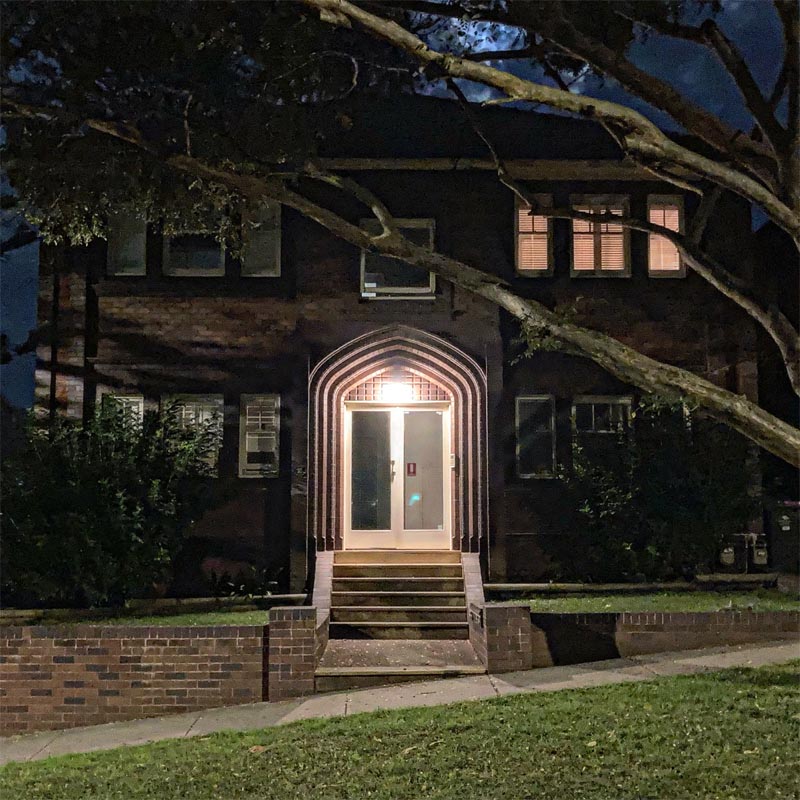
Randwick is a large suburb located about five kilometres south east of downtown Sydney, Australia.
It is home to the Prince of Wales hospital, Royal Randwick Racecourse, a thriving commercial and retail hub, large bus and light rail depots, the historic Ritz Cinemas, and arguably, the University of New South Wales (UNSW). Even though UNSW has its own post code, two sides of its sprawling complex border Randwick.
Randwick sounds like a bustling centre, and it is, but slip down a side street, and suddenly you’re in a whole other world: the quiet realm of suburbia. I walked passed this apartment building the other evening, and almost didn’t stop. But something made me do a double take. I’m not sure what it was.
Was it the neatly clipped grass verge sloping away down the street? The branches of a tree, partly lit by a nearby street light, splaying across the front of the building. The Moon trying to peek through clouds above the roof of the building. Or the welcoming glow of the lamp over the door.
Whatever it was, the scene before me had photo written all over it.
RELATED CONTENT
Creative environments, are they a place or a time, or both?
28 May 2024
Your mission, should you choose to accept it: write about creative environments. Let’s have a go.
A creative environment, as far as I can tell, is not necessarily a place. Not one I can put my finger on, at least. Nor is it a particular time. My creative ideas, if that’s what they can be called, arrive spontaneously. Without warning. My muse’s strikes are unpredictable, to quote Amelia.
I’d wanted to take part in Juha-Matti Santala’s creative environments themed blog carnival, since hearing about it at the beginning of the month. The first blog carnival I’ve participated in — since, I don’t know — 2008? Back in the day, blog carnivals were a great way to network, and discover the work of other writers and bloggers. With the return to the small web, personal websites, and blogs, gaining momentum, maybe they will be once more.
I feel like I’m constantly being creative. Be it devising solutions to problems at work, figuring out the best way to optimise the day, or writing here, it all seems a manifestation of creativity. It seemed then like an easy topic to write about. But with days left in May to act, and after weeks of futile brainstorming, this page remained blank.
Until yesterday, when as if by magic, the words took form at one of my hot-desking locations. With impeccable timing. Just as I wanted to pack up for a short break, take a stroll, and buy some lunch. But my thoughts were also on resuming my hot desk post-haste, before the afternoon grew too old, so I could indulge in another coffee.
I can’t then always be wholly sure what triggers my creativity, and subsequently leads me to my creative environment. On this occasion, it might have been the hint another cup of coffee was in my future. Or it could be the prospect of being mobile, and on my feet. I’m not sure about the coffee, but when it comes to walking as an incubator for creativity, the science is pretty definitive.
On some days when I start walking, the ideas almost instantly start flowing. Be that going home, strolling in the park, ambling about when we stay on the NSW Central Coast, or mall-walking at a large shopping centre, on what is a track spanning, by my estimations, two-and-a-half kilometres. But whatever the setting, solutions to problems begin presenting themselves.
Do that this way. Do this that way. I often stop, mid-step, to write something in my phone’s notes apps, or email myself a snippet of a thought I’ve had. But what a lot of us may not realise, is just how much goes into the mix, when it comes to being creative. There’s all sorts of stuff up in the air.
Random, scattered, diverse, subconscious, thoughts and feelings, swirling around, just waiting for the right moment to come along, and coalesce into a solution called creativity. And that eureka moment isn’t only a setting, a place, it’s also a time.
What that place is, I don’t always know. Ditto the time. Whatever, that’s my creative environment.
RELATED CONTENT
The search for the distant Planet Nine continues
27 May 2024
Weird stuff is happening out on the remote boundary of the solar system. Beyond the orbit of Pluto. You name it, it’s going on out there. Irregularities. Anomalies. Clustering of apsidal lines. Perihelia. And — saving the best for last — a surprising prevalence of retrograde Centaurs.
These anomalies include the apparent clustering of apsidal lines of long-period trans-Neptunian object (TNO) orbits, the alignment of their orbital planes, the existence of objects with perihelia extending far beyond Neptune’s gravitational influence, the highly extended distribution of TNO inclinations, and the surprising prevalence of retrograde Centaurs. Collectively, these irregularities hint at the existence of a yet-undiscovered massive planet, tentatively named Planet Nine (P9), whose gravitational influence sculpts the outer reaches of trans-Neptunian space (Batygin et al., 2019).
But this is nothing new. Astronomers have been aware of this activity for some time.
Many postulate this weirdness points to the existence of an — as yet — undiscovered, large-ish planet, out beyond the known planets of the solar system. Some incredible distance out beyond the known planets. Planet Nine, if it exists, is thought to be orbiting the Sun at an approximate distance of twenty times that of Neptune to the Sun.
The gravitational influence of Planet Nine, combined with its extreme distance from the Sun, is enough to interfere with what would otherwise be predictable orbits of the numerous TNO objects, of which Pluto is one.
Planet Nine sort of comes along and displaces — sweeps aside, perhaps — these TNOs. While the presence of a larger planet therefore appears to be the logical explanation for the various irregularities and anomalies witnessed in the outer solar system, scientists are yet to clap eyes the elusive body. Or even calculate its position mathematically, for that matter.
If Planet Nine is found, here’s hoping one of Earth’s space agencies dispatches a probe pronto to go and take a good look at it.
RELATED CONTENT
ICQ to close on 26 June 2024
27 May 2024
ASL?
Another artefact of the early days of the (mainstream) internet will soon be no more. Instant messaging service, ICQ, launched in 1996, will cease operating, as of Wednesday 26 June 2024.
ICQ (I seek you, get it?) allowed users to chat to pretty much anyone who let them. I can’t remember when I stopped using ICQ, probably over twenty-years ago, but it was a fun way to communicate with people, even if you had no idea — really — who most of them were.
About the last time I used ICQ, as I recall, was after chatting with someone who claimed to a software developer, somewhere in Western Europe. He, or she, or they, seemed quite pleasant to talk to on the one occasion we did, but soon after their account appeared to go inactive.
A few months later though, they began sending dire messages, warning me my computer had been infected by a virus that would destroy all the data on the hard drive.
As it happened, I bought a new computer a few weeks later, and having not used ICQ for some time by that point, decided not to install the application on the new device.
Like everything else from those early days, I’m sure the contemporary ICQ experience would be worlds removed from that of the late 1990’s. So, another one bites the dust. At least we still have Hotmail, and our personal websites. For now, anyway.
RELATED CONTENT