
Showing all posts about Australia
What happened to Problogger and Darren Rowse?
8 December 2025
A reader contacted me a few days after I mentioned blogging resource Problogger, and founder Darren Rowse, in a recent post. They were wondering if I knew anything about what’s happened at the site, or to Rowse himself, as no new content seems to have been posted since June 2024.
For those coming in late, Problogger was, or still is, one of the preeminent blogging resource sites, helping people who want to make money from writing online. The publication was launched by Melbourne based Australian blogger Rowse in 2004.
Despite being dated June 2024 though, some of the recent Problogger posts were actually much older. A few I looked at had — judging by the age of the comments — been written in 2008, and were re-posts. Evergreen content. But there was nothing — as far as I could see — indicating the site was taking either a temporary break, or ceasing operation all together.
It seems odd that a website with the profile of Problogger would suddenly fall silent, for no apparent reason. Of course long running single author blogs take breaks now and again, whether for personal or family reasons, or because the writer simply wants some time out.
Publishing content regularly is no small ask, as anyone who does so will tell you.
A look at the Problogger open-to-all Facebook page likewise revealed nothing. The last entry there, as of the time I type, is dated December 2024. The Twitter/X page however is a little more active, the last post I saw there (login may be required to view) was dated 18 November 2025.
But a Twitter/X post made on 15 April 2024 seems to answer the question of what’s become of both Problogger and Rowse: he’s now a church pastor, or at least is part time. As Rowse points out though, this is not exactly a new role, and was something he was doing prior to launching Problogger over twenty years ago. This might be him going back to his roots, perhaps.
I’m not sure what this means for the future of the Problogger website, given Rowse doesn’t appear to have said anything one way or the other as yet. There are still plenty of blogging related posts on his Twitter/X page, which might suggest Problogger will be revived sometime in the future. But until something official is said, Problogger readers will have to wait and see what happens.
On the plus side, even though posting seems to have paused, the website remains online, and content is still there to access. While it’s not quite my thing, it would still be unfortunate if twenty-plus years of information were to be taken offline.
As an aside, I also found out Rowse has been exploring how AI can be of use to religious leaders (Threads post). This might be of interest to people curious as to how religion and AI can intersect.
RELATED CONTENT
Australia, blogs, history, self publishing, technology, trends
AI slop named word of 2025 by Macquarie Dictionary
29 November 2025
The Australian dictionary’s word of the year committee were scathing, to say the least, of their pick:
We understand now in 2025 what we mean by slop — AI generated slop, which lacks meaningful content or use. While in recent years we’ve learnt to become search engineers to find meaningful information, we now need to become prompt engineers in order to wade through the AI slop. Slop in this sense will be a robust addition to English for years to come. The question is, are the people ingesting and regurgitating this content soon to be called AI sloppers?
I’d hoped Macquarie Dictionary would make IndieWeb their word for 2025. Enshittification, by the way, was the 2024 word of the year.
RELATED CONTENT
artificial intelligence, Australia, language, trends
Twenty-five must visit cinemas across Australia
15 November 2025
Flicks list of Australia’s twenty-five most beautiful cinemas is almost enough to tempt me back into going to film screenings instead of streaming from home.
Of those on the list, I’ve been to Golden Age Cinema and Hayden Orpheum Picture Palace. I used to practically live at the Ritz Cinema during my days as film blogger, and when I was based in that part of the world. Seems a lifetime ago now.
A surprise inclusion, at least to me, is the Chauvel Cinema. It definitely looks better to be in, than it is to be in. The seats were far from comfortable, as was the auditorium itself. Still, I liked my visits to the Chauvel, plus the second, smaller theatre, which is not pictured in the Flicks article.
The list makes for a great inclusion to a film-goer’s bucket list. I’d like to go to all of these places, especially Sun Pictures, in Broome, West Australia.
RELATED CONTENT
Non-existent but realistic looking Australian phone numbers for film and TV
5 November 2025
I don’t know how this works in other countries, but the Australian Communications and Media Authority (ACMA), a statutory authority that regulates communications and media services locally, has allocated a range of non-existent phone numbers for use in things like films and TV shows.
Actually, this is the first I’ve heard of these numbers, and have given little thought to those I see in a local movie or show. I’ve always assumed producers use numbers that appear to have obviously been made up, like maybe, 1234-5678, or something.
It’s a great initiative though, productions can make use of realistic looking Australian phone numbers even though they are fictitious. I imagine film and TV show makers outside of Australia can use the numbers as well, in the event they need an Australian phone number in their work.
RELATED CONTENT
Australia, film, film production, television
Vale William Munro, AKA Billy Wiz, Bondi Junction personality
22 October 2025
Some sad news. Billy Wiz, Sydney based Australian DJ, artist, author, cartoonist, and colourful character in general, died last week.
In recent years Billy operated a gallery — in the garden of his street level apartment, on Oxford Street, Bondi Junction — displaying his painting and illustration work, for passersby to peruse.
When in Sydney, we go to the bakery beside his apartment building, and would frequently see Billy deep in conversation with someone who was waiting for their coffee order.
The neighbourhood won’t be quite the same without Billy, who brought a sense of community to what often feels like a retail and commercial precinct. He was even happy to let customers of the bakery tether their dog’s leashes to his fence, while they went inside.
You can find out a bit more about Billy in this Media Man interview published in August 2003, and see some of his artworks on his Instagram page.
RELATED CONTENT
Michelle de Kretser, Rick Morton, among 2025 Prime Minister’s Literary Award winners
7 October 2025
de Kretser, who’s novel Theory & Practice (which I’m currently reading), and Morton’s book, Mean Streak, about the previous Australian government’s controversial Robobot debt recovery scheme, are respective winners of the fiction and non-fiction categories.
Others recipients, who were announced last Monday, 29 September 2025, include The Other Side of Daylight: New and Selected Poems, by David Brooks in poetry, and The Invocations, by Krystal Sutherland in young adult. See the full list of winners here.
RELATED CONTENT
Australia, Australian literature, literary awards, Michelle de Kretser, Rick Morton
The Sydney Science Fiction Film Festival, 3-5 October 2025
20 September 2025
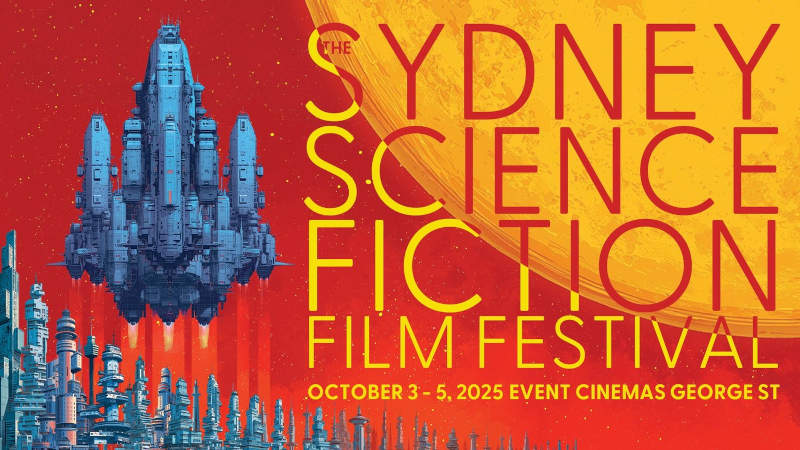
Running since 2020 I believe, this year’s Sydney Science Fiction Film Festival is on from Friday 3 October until Sunday 5 October 2025, at Event Cinemas, on George Street, in Sydney’s CBD. Eleven features will be screened, with many having their Australian premieres.
One title, The Eagle Obsession, trailer, a documentary directed by American filmmaker Jeffrey Morris, will have its international premiere at the festival.
Also known as The Eagle has Landed, the film explores travel to the Moon, both actual and imagined. William Shatner is among those appearing in the film, along with Barbara Bain and Nick Tate, who starred in 1970’s sci-fi TV series, Space 1999. Now I get the eagle reference…
The Sydney Science Fiction Film Festival Awards ceremony also takes place on the closing evening.
The spectacular banner for this year’s festival, as seen above, which is a futuristic representation of the skyline of Sydney’s CBD — spot the iconic Westfield Tower towards the left — was created by Australian filmmaker and artist Joshua Reed.
RELATED CONTENT
Australia, Barbara Bain, events, film, Jeffrey Morris, Nick Tate, science fiction, Sydney, William Shatner
Australian social media age verification laws: you might need to prove your age
20 September 2025
The Australian government has issued guidelines regarding proposed age verification regulations that come into effect this December.
While social networks will be required to “detect and deactivate or remove” the accounts of members under the age of sixteen, they will not need to verify the age of every last user. This would no doubt apply to instances where someone has been a long-time user of a social media channel, or it is apparent they are over the age of sixteen.
It sounds reassuring, at least on the surface, but the devil will be in the detail. It will be down to individual platforms to decide how they go about ascertaining a member’s age, rather than there being a standard, universal, process they must adhere to. Expect to see some under-sixteens fall through cracks, while a few over-sixteens get caught in the net.
RELATED CONTENT
Australia, social media, social networks, technology
Climate change making El Nino and La Nina harder to forecast
16 September 2025
Tom Saunders, writing for the Australian Broadcasting Corporation:
Thanks to climate change and a rapid warming trend in our oceans, the historical record and current analysis of the two Pacific phases has become contaminated. El Niño, the warm episode, is being falsely observed, while the cool state, La Niña, is at risk of going undetected.
The two well-known climate patterns have a significant influence on weather, either making Australian summers dryer and warmer, or wetter and not quite so warm. Of course the impact of both systems is not limited to Australia, but across the Pacific ocean, and beyond. It seemed like it was only a matter of time before climate change began to have impact on these weather patterns.
RELATED CONTENT
Australia, climate change, environment, weather
Long running Australian literary journal Meanjin closes December 2025
5 September 2025
The final issue of the eighty-five year old quarterly magazine, will be published in December. The Melbourne University Press, which funds the publication, says the decision to stop production of the journal was made on financial grounds.
A veritable potpourri of Australian authors have written for Meanjin in the past. The move, as one author says, will be a blow to the present and future of Australian literature.
RELATED CONTENT