
Showing all posts about current affairs
The Australian social media ban is also a ban on education
11 December 2025
American economist Tyler Cowan writes about the educational impact the Australian social media ban for people under the age of sixteen could have:
YouTube in particular, and sometimes X, are among the very best ways to learn about the world. To the extent that the law is effectively enforced, targeting YouTube will have a terrible effect on youth science, and the ability of young scientists and founders to get their projects off the ground will take a huge and possibly fatal hit. If you are only allowed to learn from the internet at age 16, you are probably not ready for marvelous achievements at age 18 or perhaps not even at 20. The country may become more mediocre.
No one learns solely from school issue textbooks anymore. Obviously there’s a lot of content on YouTube (and elsewhere of course) that isn’t suitable for all ages (or any age for that matter), but there are some truly valuable resources.
Kurzgesagt, whose educational videos I often link to, is but one example.
Cowan’s full article can be read at The Free Press with an account.
RELATED CONTENT
Australia, current affairs, education, social media, technology
The Australian social media ban may not achieve much
8 December 2025
Nathan Powell writing for Mumbrella:
A social media ban for under 16s will have six uncomfortable realities that policymakers will not tell you. But they matter, because they determine whether this decision actually protects young people, or simply creates new risks in new places.
This is the polarising issue in Australia in 2025. People are either ardently in favour of restricting social media access to people under the age of sixteen, while others think it’s a terrible idea.
Both sides have convincing arguments to support their view. I don’t need to be told there is a lot of rot on social media that no one at all should see.
I’ve been winding back my social media use. I removed the Facebook app from my smartphone a couple of months ago, and have barely missed it. I’m considering doing away with Threads. It becomes more like the present Twitter/X with each passing day.
Ditto Instagram. There I’d just login to the website every now and then to see what’s happening.
But it’s also known younger Australians, particularly those marginalised in some way, are able to seek support safely and privately through social media, something they’ll lose access to. There’s no doubt the ban is going to be to the detriment of some Australians under the age of sixteen.
RELATED CONTENT
Australia, current affairs, social media, technology
Sally Rooney books may be withdrawn from sale in UK bookshops
2 December 2025
The Irish author, whose titles include Intermezzo and Conversations with Friends, wants United Kingdom royalties from her novels, and any screen adaptations made there, to go to Palestine Action, a British pro-Palestinian organisation.
The British government however considers Palestine Action to be a terrorist group, and banned them earlier this year.
In sending Rooney royalty payments, her UK publishers, and the BBC, who co-produced the 2020 TV adaptation of Normal People, Rooney’s second novel, would be breaking terrorism laws. The author says this could result in her novels being withdrawn from sale in the UK.
RELATED CONTENT
books, current affairs, literature, novels, Sally Rooney
Blogs, a lot of them, millions of them, as agents for change
23 October 2025
Elizabeth Spiers, writing at Talking Points Memo:
The lesson for me, from the early blogosphere, is that quality of speech matters, too. There’s a part of me that hopes that the most toxic social media platforms will quietly implode because they’re not conducive to it, but that is wishcasting; as long as there are capitalist incentives behind them, they probably won’t. I still look for people with early blogger energy, though — people willing to make an effort to understand the world and engage in a way that isn’t a performance, or trolling, or outright grifting. Enough of them, collectively, can be agents of change.
As Spiers says, it might be possible to manipulate the CEOs of large media companies, but doing the same to a million independent publishers, may not be so easy.
RELATED CONTENT
blogs, current affairs, self publishing, trends
A train station comes to Woollahra NSW: there goes the neighbourhood
3 September 2025
Woollahra, a suburb in Sydney’s east, is soon to have a train station. At first pass that doesn’t seem like a big deal. But the story is as long as the rail line is winding. Proposals to build a station in the affluent suburb are over a century old.
Then, in the 1970’s, as the Eastern Suburbs train line, AKA the T4, was being constructed, foundations for a station were laid. But work came to an abrupt halt when residents, unhappy at the prospect of a train station in their backyard, succeeded in stopping construction.
The partly built station sits between the stations at Edgecliff, and Bondi Junction, where the T4 line presently* terminates, a kilometre or two from the beach at Bondi. But with the housing situation in Sydney reaching dire proportions, the NSW State Government has revived plans to build the station, and then construct much needed high-density residences in the vicinity.
News of the station, and apartment blocks, has no doubt come as a double blow to locals.
Woollahra is far from apartment building free — an array of beautiful art deco style medium-density residences span Edgecliff Road — and the prospect of high density blocks will be causing alarm to some. But the reality is Sydney needs more residences, and it is unreasonable to expect all of these be built “somewhere” in the west of the city.
Or “the western side of ANZAC Parade”, a quip sometimes uttered by those residing on the eastern side of ANZAC Parade. ANZAC Parade being a major roadway running from inner Sydney through to La Perouse, at the southern end of the eastern suburbs.
Some Woollahra residents will argue the presence of high-rise dwellings will be at odds with the “character” of the suburb. Woollahra is possessed of houses built in the nineteenth century, quiet tree-lined streets (one or two rather steep), boutique shops, and a village-like ambience. It is a place many people would like to call home. The building proposals will bring significant changes.
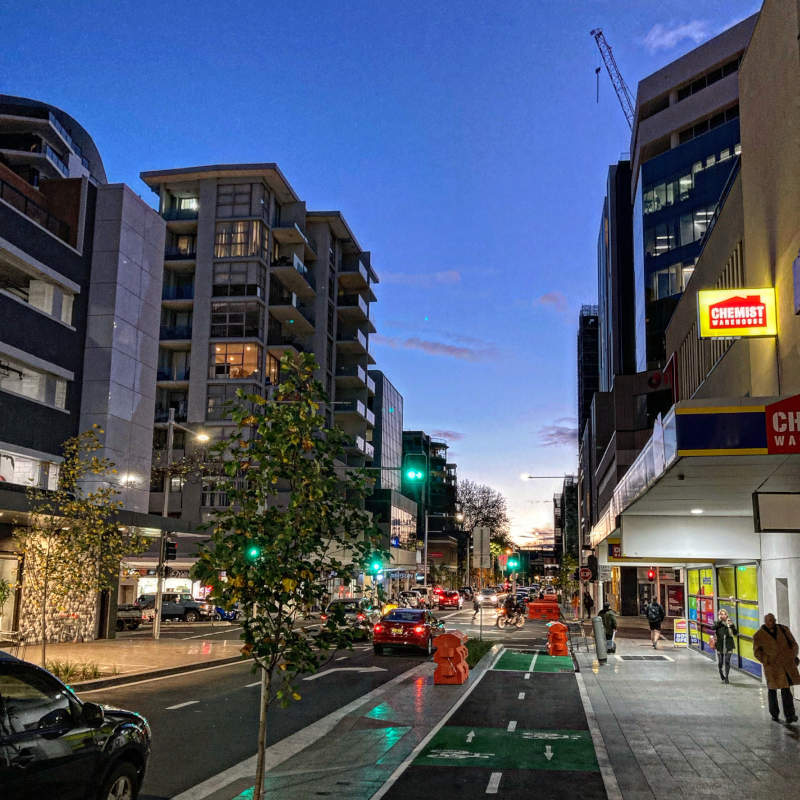
Spring Street, Bondi Junction, NSW, at dusk. Photo taken June 2021. Note the construction crane in the top right hand corner.
But such is life in the big city. Change is constant. Bondi Junction — where we stay when not on the NSW Central Coast — situated right next to Woollahra, has undergone a tremendous transformation in the last decade, particularly along parts of Oxford Street. While always a mixed commercial/retail and residential precinct, numerous high-density apartment blocks now line Oxford street.
Of course Bondi Junction, being a retail centre, and public transport hub, with the aforementioned T4 train line, and numerous bus services, seems an ideal place to build residences. That’s not to say everyone in Bondi Junction is happy with the prospect. Many feel the suburb has been over-developed. But again, housing shortages in the region have compelled governments to act.
Yet the “residential-isation” of Oxford Street, and surrounds, has not always been a bad thing. Bondi Junction is at once a quiet residential suburb, after the shops close, in the midst of a bustling commercial centre. People walk their dogs along Oxford Street in the evenings, a sight that would not have been seen ten years ago.
Despite this metamorphosis, perceptions of Bondi Junction have not changed.
Either within the eastern suburbs, or elsewhere in Sydney. As far as other residents of the eastern suburbs are concerned, the junction is “ugly”. Meanwhile people outside the eastern suburbs think Bondi Junction is full of rich snobs. But nahsayers of the junction are looking at the wrong suburb when identifying ugly, or seeking to point out “rich snobs”.
But I digress. I’m not saying high-density residential blocks in Woollahra, full of dog owners, will bring about any sort of catharsis to existing residents who are going to be subject to possibly decades of disruptive construction work. They had all of that in Bondi Junction, and will probably continue to, but the world did not end.
Whether we like it or not, high-density accommodation is one of the solutions to the shortage of housing, and is something everyone in Sydney needs to get used to.
* there were proposals to extend the train line to Bondi Beach, but residents rallied to oppose the idea.
RELATED CONTENT
Australia, current affairs, politics, Sydney, trends
There are more guns in Australia than before 1996 gun buy back
27 August 2025
Collectively Australians own four million guns, about twice the number held in 2001.
This despite strict gun ownership laws introduced following the 1996 Port Arthur massacre, bans on certain types of firearms, and a gun buyback program in 1996, which resulted in over six-hundred thousand weapons being destroyed.
Australians can still legally own firearms, but must satisfy a number of prerequisites to do so. These include showing a genuine reason for possession — which some people, farmers for example, might have — along with keeping guns stored securely when not in use.
Four million guns is a lot, and equates to about one gun for every seven Australians. While some people feel gun ownership is a right, and have no problem adhering to ownership laws, others in the community are concerned legally owned firearms might somehow fall into the wrong hands.
RELATED CONTENT
Young Australians not banned from social media, just delayed using it
26 August 2025
Australians under the age of sixteen will not be banned from having social media accounts, when laws change later this year. Instead, as the Australian eSafety commission points out, they’ll merely have to wait until their sixteenth birthday before being able to sign up for social media access:
It’s not a ban, it’s a delay to having accounts.
The incoming social media age-restriction laws will make students of semantics out of us all.
RELATED CONTENT
Australia, current affairs, social media, social networks, technology
Australians aged under sixteen banned from using YouTube
31 July 2025
The Australian government has decided YouTube will be made inaccessible to people under the age of sixteen. There had been thoughts the video platform might be spared, after the government decided to restrict access to the likes of TikTok, Facebook, and Instagram to younger Australians.
YouTube has recently been running a publicity campaign locally extolling their family-friendly credentials, in the hope they would not be effected.
I’m not in complete agreement with this decision. Obviously there’s all sorts of material on YouTube, but a certain amount has educational merit.
RELATED CONTENT
Australia, current affairs, politics, social media, technology
You might not be told you are the victim of identity theft
8 July 2025
An Australian woman, identified only as Sarah, writing for the Australian Broadcasting Corporation:
No-one told me my identity had been stolen. No-one told me that my drivers licence and my passport, two of the most crucial personal documents, were compromised and had been for years. I only found out when I applied online for an eSIM.
This is something that has long concerned me.
If my identity were stolen, would I even know, or only find out when it was too late? A credit check is one tool available to Australians that could help ascertain if you have been a victim. Credit reporting companies in Australia are obliged to provide a free consumer credit report every three months.
Mine showed everything to be in order, and as expected.
If someone has been able to obtain some sort of line of credit in your name, without your knowledge or permission, a credit report will hopefully bring that to your attention. If you’re outside of Australia, you ought to look into anti identity theft tools available in your jurisdiction.
RELATED CONTENT
Australia, crime, current affairs, law
Social media platforms, AI summaries, how we consume news in 2025
2 July 2025
Running since 2015, the Digital News Report, published annually by the University of Canberra, surveyed nearly one-hundred-thousand people globally, including about two-thousand Australians.
The key findings of the 2025 report are probably of no surprise to many of us. About twenty-five percent of people now source their news from social media platforms. Instagram and TikTok are the go-to platforms for news seekers aged eighteen to twenty-four.
AI is also making in-roads into the way people consume news, with nearly thirty-percent saying they like the idea of AI prepared news summaries.
When it comes to misinformation, seventy-five percent of Australians — the highest number in the world — expressed concerned about misinformation. Many are sceptical of influencers as a result.
Facebook and TikTok were identified as the biggest purveyors of misinformation. Encouragingly though, about forty-percent of people will turn to a “trusted news brand” should they be suspicious as to the veracity of a news story.
Here’s something else that’s interesting. Only about a quarter of Australians say they have received news literacy education. That is, being informed in how to use and understand news.
I have to say, it’s the first time I’ve heard the term. Is news literacy taught at school? Maybe I was absent the day that class was held.
RELATED CONTENT
artificial intelligence, current affairs, social media, technology, trends