
Showing all posts about novels
Redhead by the Side of the Road, by Anne Tyler
13 September 2021
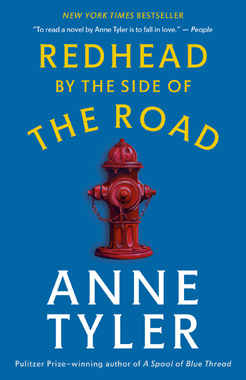
Now I’m judging books by their titles, but as a redhead, how could I go passed the latest novel by American author Anne Tyler: Redhead by the Side of the Road (published by Penguin Books Australia, 2021). The protagonist, forty-something Micah, is a creature of habit; you could set your watch by his routines.
By day he works as a freelance computer technician, and come evening looks after the apartment block he lives in. He has a woman friend, and turns in each night at ten o’clock. But when his better half tells him she’s about to be evicted from her place, and a teenage boy arrives at the door, saying he’s his son, Micah’s ordered life is plunged into turmoil.
From the little I’ve read about the book so far, it seems there’s no actual redhead character in the story, but best I say no more on the count. Coming in at about one hundred and seventy eight pages, Redhead by the Side of the Road is a shorter read though, which sometimes is exactly what you want.
RELATED CONTENT
Anne Tyler, books, fiction, literature, novels, TBR list
Some suggested reading for September
9 September 2021
A new-ish month, a new selection of suggested reading from the ABC Arts’ monthly book column. I’m liking the sounds of Things We See in the Light, by Sydney based Australian writer Amal Awad. Set in Sydney’s inner west, and loosely related to two of Awad’s earlier books, it tells the story of Sahar, who returns to Sydney after leaving her husband of eight years in Jordan. But it is an experience Sahar is reluctant to discuss with her friends, even as she becomes ever more settled in Sydney.
RELATED CONTENT
Amal Awad, books, literature, novels
Beautiful World, Where Are You, by Sally Rooney
9 September 2021
Beautiful World, Where Are You (published by Faber/Allen & Unwin) is the third novel by Irish author Sally Rooney. Alice and Eileen are old friends who are young, but not that young. They often exchange long emails as they attempt to put the world to rights, and make sense of their love lives. Alice, a famous novelist, asks Felix, a warehouse worker, to accompany her on a holiday to Rome.
Eileen, a literary assistant, who lives in Dublin, has recently ended a relationship and has begun flirting with Simon, an old childhood friend. The two women haven’t seen each other in many years, so when they eventually meet face to face, they find their perceptions of each other – impressions generated by way of their email correspondences – are in sharp contrast to reality.
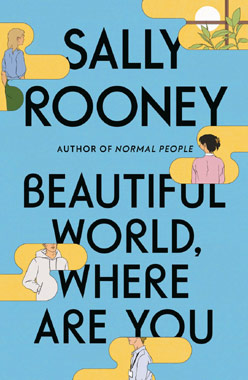
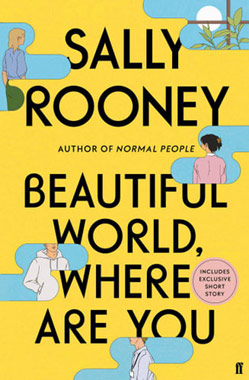
Oh to be a fly on the wall witnessing that meeting. Beautiful World, Where Are You has been published in two editions. The regular edition sports a blur cover, while the yellow cover book is a special edition hardback with a bonus short story. Another addition to the to-be-read list I think.
RELATED CONTENT
books, fiction, literature, novels, Sally Rooney, TBR list
After Story, by Larissa Behrendt
8 September 2021
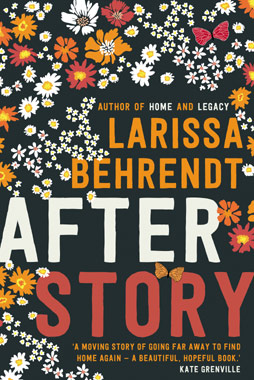
In After Story (published by University of Queensland Press, July 2021), the latest novel by Sydney based Australian author Larissa Behrendt, Jasmine, an Indigenous lawyer, is feeling rundown after an intense case. Della, her mother, meanwhile is struggling following the death of her aunt, and a former partner.
Jasmine believes it would do Della – who’s barely ventured beyond the small rural town where she lives – the world of good to go on an overseas holiday. An avid reader, Jasmine has always wanted to see the places where writers such as Jane Austen, and Virginia Woolf lived and worked, so they set off for England.
Jasmine has hopes the holiday will restore the somewhat neglected mother-daughter relationship. However the disappearance of a child in London’s Hampstead Heath, forces Jasmine and Della to relive the trauma the family suffered when Jasmine’s older sister vanished twenty-five years earlier.
RELATED CONTENT
Australian writing, books, fiction, Larissa Behrendt, literature, novels, TBR list
I Shot the Devil, by Ruth McIver
7 September 2021
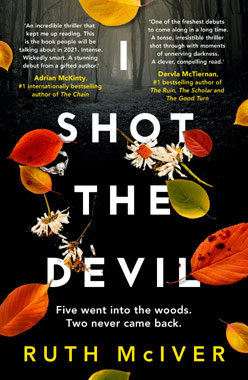
You know what they say about returning to your past, don’t you? Most people think it’s a bad idea. But for Erin Sloane, a crime reporter, the opportunity to write an investigative article about murders committed twenty-years ago, might be the career break she’s looking for. There’s a few problems though.
Erin knew of the two victims, while her father was one of the police officers who originally investigated the crime. Stories of devil worship and satanic killings were rife in the aftermath of the murders, and the case was eventually closed after police laid charges. But was that really the end of the matter?
It seems though Erin doesn’t quite realise how much she’s bitten off, in taking on the story. Dark secrets from the past, including many of hers, stand to be dragged into the light. Such is the premise of I Shot the Devil (published by Hachette Australia, September 2021), by Melbourne based author Ruth McIver.
RELATED CONTENT
Australian writing, books, literature, novels, Ruth McIver, TBR list
On Earth We’re Briefly Gorgeous, by Ocean Vuong
6 September 2021
On Earth We’re Briefly Gorgeous (published by Penguin Books Australia, 2019), is the debut novel of Vietnamese American writer and poet Ocean Vuong. The story is set around a long letter written by a twenty-something Vietnamese immigrant living in America, nicknamed Little Dog, to his mother, Rose, who is illiterate.
Little Dog’s letter traces his family’s history, prior to his birth, and their relocation to America. He recounts his experiences of being bullied at school, and goes on reveal things his mother did not previously know about him. It is not always a life lived happily though, and domestic violence, racism, and homophobia, are among recurring themes.
Based in part on Vuong’s own life, On Earth We’re Briefly Gorgeous was named as one of the top ten novels of 2019 by the Washington Post, and was also a finalist in the 2020 PEN/Faulkner Award. The novel is also set to be adapted for the screen, with American filmmaker Bing Liu directing.
RELATED CONTENT
books, film, literature, novels, Ocean Vuong, TBR list
Why don’t booksellers suggest more women authors to men?
3 September 2021
Jane Sullivan writing for the Sydney Morning Heralds, asks why book publishers and sellers seem to predominately promote titles written by men to men. Why not the work of more women?
You might argue that booksellers and publishers are only reflecting what the research consistently tells us: while women are prepared to read books by both men and women, far fewer men are prepared to read books by women. Margaret Atwood, for example, is one of the world’s bestselling writers, but only 19 per cent of her readers are men.
If you’re looking for a few suggestions though, I can recommend The Lying Life of Adults, by Elena Ferrante, The Weekend, by Charlotte Wood, How Much of These Hills is Gold, by C Pam Zhang, Picnic at Mount Disappointment, by Melissa Bruce, and The Paper House, by Anna Spargo-Ryan.
RELATED CONTENT
Robbie Arnott wins 2021 Age Book of the Year
3 September 2021
Tasmanian writer Robbie Arnott has won the re-booted Age Book of the Year with his 2020 novel The Rain Herron. Congratulations.
RELATED CONTENT
Australian fiction, books, literature, novels, Robbie Arnott
How do bookshops stay in business in the e-book age?
21 September 2015
By rights bookshops should have long since ceased to exist. Swept aside by e-books, electronic publishing, and online communication, and square into the dustbin of history. Indeed by now these quaint shelf lined emporiums should only be recalled via dwindling references, solely in nostalgic exchanges between older and younger generations, about the way things once were.
But that’s not quite what has happened. Booksellers are still with us. And rather than going into retreat, some are expanding, and opening new shops even. For all their convenience then, why have bookworms refused to wholly embrace the electronic successors of the bound paper volume? So what is it that bookshops are doing today to prosper, and remain in business?
Rather than attempting to extract trade secrets, or delve through annual reports, I asked myself what I could learn from booksellers, simply by looking at the way they appear to be operating, on the basis I was going to open a shop. So consider this more of a thought experiment, and a series of deductions, rather than in-depth or scientific research.
Paperback is the new black
In order to broaden their customer base, booksellers have become more exclusive by making a concerted effort to appeal to a more select band of consumers. These are people who favour the paper over the electronic, and see the endangered species that is the paper book, as having a certain desirability. But that’s not the only way booksellers define customers.
Harry Hartog, a name that somehow sounds like it should be familiar, is very much the new kid on the block when it comes to bookshops, having only opened in Canberra last October, and then Bondi Junction, Sydney, last month. But they have no doubt as to who their clientele are, being a “shop for the adventurer, the student of life and the next generation of reader”.
That’s no shop, that’s a boutique
If shopping for books was ever a perfunctory task, and a visit to a bookshop was uninspiring, and something to be dreaded, it certainly isn’t anymore. It’s not as if buyers have to navigate bland rows of overladen shelves bleaching in the cold glow of harsh fluorescent lights. Indeed, a keen eye to aesthetics on the part of booksellers, has transformed book shopping in recent years.
It’s not just about books
Once upon a time a bookshop used to be just that, a bookshop. You may have been able to source items of stationery, and maybe there was a shelf or two bearing accessories of some sort, but that was it. Today booksellers stock just about anything you care to imagine, from chocolate, lamps, posters, ornaments, toys, board games, to DVDs, and more, but why should I go on?
Ariel Booksellers, in Paddington, Sydney is a case in point. Scan through some of the photos of their merchandise (Facebook page) and it becomes clear that booksellers are turning to diversification as a means of attracting, and retaining customers. Bookshops don\’t have to become one stop shops, but it can\’t be too bad for business to offer customers a few extra options.
Engaging customers
Social media, and the likes of Facebook, Twitter, and Instagram, are boons for contemporary bookshops. Here are platforms that allow them to quickly and readily connect with their customers, helping them maintain a vital edge. Online channels aren’t the only ways of fostering interaction though, and book launches, and community events, also play a role.
Small is better?
In the bookshop survival stakes, it might be thought the bigger operators have the upper hand, on account of being part of a wider chain, and the benefits that must bestow. Sadly, that’s not always the situation, as shop closures, some years ago, by high profile sellers such as Borders, and Angus and Robertson, illustrates. So if the big shops can’t make it, what hope do others have?
More than you might imagine. Smaller, independent, booksellers, especially owner operated stores, are probably more motivated to focus on their customers, and build up relationships, something that may not always be a priority for the bigger players. Buyers are also more likely to find staff at smaller shops better attuned to their interests, than they might elsewhere.
Electronic purveyors of paper
So far it’s been a case of the electronic supplanting the paper when it comes to books, but Sydney based bookseller Big Ego Books (Instagram page) have adopted another tack, they operate as an electronic, or online only, seller of paper books. Hardly ground-breaking, but perhaps their speciality, sourcing “rare and hard-to-find titles”, is. There’s market niche for you.
And there we have it…
Well, a few suggestions at least. I for one am not keen to see the end of bookshops, but it certainly looks like plenty are doing something right, so hopefully they’ll be with us for a long time to come. As to the notion of opening a bookshop, it could hardly be considered a lost cause, even if it might not be easy, but here at least are a few pieces of the puzzle.
Originally published Monday 21 September 2015, with subsequent revisions, updates to lapsed URLs, etc.
RELATED CONTENT
books, bookshops, ebooks, legacy, novels, trends
Twitter novels: when will they be the next big thing?
9 February 2009
Would you read a novel that was served in 140-character instalments? Text message novels are already proving popular, especially in Japan, and with the ever increasing reach of Twitter, it’s only a matter of time before the 140-character novelists put aside their phones and try the idea online.
In fact, there are already several people tapping together Twitter novels, though at the moment their efforts are generally being greeted with the response: “what’s the point in that?”
Then again, there are still plenty of people questioning the point of Twitter itself, so while Twitter novelist superstars are yet to emerge, writing-off the potential of the idea is definitely premature.
After all, people have built celebrity around themselves in the past by way of all sorts of seemingly unfathomable means, including webcams, YouTube, and even blogging, so it’s only a matter of time before someone comes along with an idea for a Twitter novel that has mass appeal.
“The confessions of a lovelorn sex kitten” anyone?
Among some of the 140-character novelists currently exploring Twitter as a literary medium though, thoughts of fame — or notoriety — seem to be far from their minds.
For example Nick Belardes who writes “Small Places”, which he describes as “a very compartmentalized love story”, thinks Twitter is a great environment for developing a novel, but little else:
Don’t write a novel using Twitter, but mold a novel, transform a novel using Twitter. In my opinion, Twitter isn’t a scratch pad. Any good writer should have a plan, and so should either use a completed manuscript, or a portion, as is my case. The line-by-line rebuilding of the manuscript should be challenge enough. There should be lots of note-taking, forethought, and not just random phrases thrown at readers.
Mike Diccicco, author of The Secret Life of Hamel, sees composing a novel using Twitter as a way of improving his writing skills more than anything:
No — this is about the creative challenge of trying to be interesting and engaging and telling a story under a significant constraint. Plus, after years of preaching “compression” to copywriters in my ad agency, it’s time to see if I can practice what I preach.
For many Twitter novelists the challenge lies in building up a following, and maintaining an on-going interest in the story, something however that is all too familiar to many people already pedalling their wares online.
It’s just a matter of finding the right mix of the usual ingredients, a sticky idea, some deft execution, and a little bit of the WOW factor.
Originally published Monday 9 February 2009.
RELATED CONTENT