
Showing all posts about social media
Fake accounts temporarily delay Musk’s Twitter takeover
14 May 2022
Elon Musk has temporarily delayed his purchase of social networking service Twitter, citing concerns over the apparent number of fake and spam accounts on the platform. How far are we into the acquisition process, before Musk decides this is an issue? Some speculate he is looking for a way to back out of the deal completely, while others think something else may be at play:
“Generally speaking, people don’t sign merger agreements so they can walk away from them. They sign merger agreements so they can do deals,” said Donna Hitscherich, a professor at Columbia Business School. Zino said Musk could be using the question over fake accounts as an excuse to cut his offer price of $54.20 a share. “He is giving himself more options and giving himself more leverage,” he said. “It appears like he’s paying more than he needs to pay for this deal.”
Perhaps he could run one of his Twitter polls? Do you operate a fake Twitter account? Yes or no? If five percent of respondents answer in the affirmative, all will be sweet…
RELATED CONTENT
Elon Musk, social media, Twitter
Facebook doesn’t know what it does with your data
28 April 2022
Lorenzo Franceschi writing for Vice:
“We’ve built systems with open borders. The result of these open systems and open culture is well described with an analogy: Imagine you hold a bottle of ink in your hand. This bottle of ink is a mixture of all kinds of user data (3PD, 1PD, SCD, Europe, etc.) You pour that ink into a lake of water (our open data systems; our open culture) … and it flows … everywhere,” the document read. “How do you put that ink back in the bottle? How do you organize it again, such that it only flows to the allowed places in the lake?”
What are Facebook users meant to do here? Drain the lake?
RELATED CONTENT
Elon Musk offers to buy all Twitter shares
16 April 2022
Not content with a nine-percent stockholding in Twitter, Tesla CEO Elon Musk has made an offer to buy all shares in the social networking service. His intention is to take the company private so he can enact many of the changes he says are necessary for Twitter’s future.
His offer of US$54.20 per share values Twitter at some US$43 billion, meaning Musk would either need to borrow the money, or sell some of his Tesla shares, to complete the purchase. Musk is the largest shareholder in Tesla, owning about seventeen percent of the stock.
But CEOs selling down shares in their own company can make other investors nervous, as it sometimes signals difficult times ahead. Watch this space. I’m waiting to see what happens.
RELATED CONTENT
Elon Musk, social media, Twitter
Elon Musk pushes for Twitter free speech and edit button
6 April 2022
Space X, and Tesla CEO, Elon Musk recently bought a nine percent stock holding in social networking service Twitter, and has been given a seat on their board of directors. Concerns about free speech on the platform may have been behind the move:
On March 25, Musk posted a Twitter poll, writing, “Free speech is essential to a functioning democracy. Do you believe Twitter rigorously adheres to this principle?”
Musk is also keen to for users to have the ability to edit tweets, a feature many people have been repeatedly asking for. Twitter say they are currently testing an edit button, which will soon be available for all members.
RELATED CONTENT
Elon Musk, social media, Twitter
Twitter bots surge following Russian invasion of Ukraine
31 March 2022
Tim Graham, senior lecturer in digital media at the Queensland University of Technology (QUT) Digital Media Research Centre, has detected a significant surge in Twitter bots, being automated accounts on the social networking service, following the Russian invasion of Ukraine last month. It seems the purpose of many of these bots is to boost, or amplify, other Twitter accounts that are disseminating propaganda supporting the Russian invasion.
The massive spike around February 24, the day of the invasion, indicated some were probably bots, but was not conclusive. Next, Dr Graham deployed a specialised software called Botometer, which uses a machine-learning algorithm to distinguish bot accounts from human ones by looking at the features of a profile, including friends, social network structure, language, and sentiment. The model gives accounts a score from zero to one, with one showing it’s certain the account is a bot. “When we ran this model and checked the result, there was clearly this huge spike of accounts which had almost a perfect bot score,” Dr Graham said.
Twitter remains unconvinced by Graham’s work though, suggesting aspects of his research may be flawed, and asserting they have more information at their disposal in assessing whether or not accounts are automated or genuine.
RELATED CONTENT
The Oscar for the best Twitter nomination goes to…
7 March 2022
Last month I wrote that the Oscars were, for the first time, allowing the general public an opportunity to participate in the 2022 awards. The Academy of Motion Picture Arts and Sciences had decided to hold a popular vote, a people’s choice award, if you like, on social networking platform Twitter.
This “fan favourite” vote was one of two initiatives the Academy introduced this year, to bolster interest in the awards. In recent years television audiences have been abandoning the annual celebration of film in droves. A mere 9.85 million viewers tuned into the 2021 ceremony, compared to 23.6 million in 2020.
That’s an alarming decrease in anyone’s book. But it’s not only the Oscars who are struggling. The Emmy Awards, and the Grammy Awards, are also seeing significant declines in their television audiences. But, in the case of the Oscars, with past ceremonies clocking in at well over three-hours in duration, is anyone surprised?
While I’ve always been interested in the Academy Awards, I’ve not once sat through a televised broadcast of the event. Or I should say, an entire broadcast. I watched once, but alarmed at the glacial pace of proceedings, switched off the TV, and wandered around to the local cinema to see a movie.
When I came home, the Oscars hadn’t even reached the Best Picture award. To counter this indulgent run-time, the Academy has promised to slim down the event, and will omit certain awards all together from the live broadcast. How that will help, if at all, remains to be seen. The fan favourite vote, on the other hand, has been an overwhelming success.
Well, kind of. The proposal certainly drummed up interest, though not perhaps quite what the Academy envisaged. Twitter members residing in the United States were invited to tweet the title of their favourite film from the last year, and or a scene from a film of any age, appended with a particular hashtag.
People without Twitter accounts had the option to participate at OscarsFanFavorite. Voting for the fan favourite on Twitter seemed a little out of hand though, with the likes of Taxi Driver (from 1976), Apocalypse Now (1979), and No Country For Old Men (2007), being selected. All great films, albeit they were released well before 2021.
At least they were actual movies. Karl Quinn, an entertainment writer for The Sydney Morning Herald, spotted a film called Rochelle, Rochelle, sitting among frontrunners for the fan favourite award. Fans of nineties TV sitcom Seinfeld would be familiar with Rochelle, Rochelle, but year of release aside, there was another problem: the film does not exist.
While soon removed from the listings, its inclusion highlights the need to set firm parameters when opening the doors to everyone online. A few years ago, the Hottest 100, an annual music poll run by alternative and indie music Australian radio station Triple J, was swamped with votes for a track performed by Canadian singer Justin Bieber.
While Bieber’s nationality was not at issue — artists from across the globe feature prominently in the Hottest 100 countdowns — Triple J listeners took exception to the way some Bieber fans, spurred on by a large betting agency, were attempting to manipulate the vote. Ultimately the efforts of Bieber fans failed though.
But the question stands, was the Oscars fan favourite vote a folly on the part of the Academy of Motion Picture Arts and Sciences? Again, while the final answer remains to be seen, if nothing else, the idea started people talking, and taking action. Perhaps the interest stirred up may yet make a difference.
RELATED CONTENT
Twitter users to get Oscars vote
16 February 2022
Twitter users have been given the opportunity to participate in the Oscars/Academy Awards voting process this year, though it looks more like a people’s choice vote, rather than a say in the regular award categories.
From February 14 to March 3, Twitter users will be able to vote up to 20 times a day for their favorite film and favorite film moment of 2021. The winning film and scene will then be featured during this year’s Oscars broadcast.
Talking of the Oscars, Regina Hall, Wanda Sykes, and Amy Schumer, look set to be named hosts of the awards ceremony.
RELATED CONTENT
TikTok, sharing your videos and your personal data?
14 February 2022
I thought of setting up a TikTok page for Oblong Obsession on Book-Tok, but with the Instagram and Twitter pages, plus a little used Facebook presence, another social media channel seemed liked it’d be too much work for now. It might have been the right call though, given the concerns some privacy advocates have with the popular video-sharing app.
The study found that YouTube, which is owned by Google, mostly collects your personal data for its own purposes — like tracking your online search history, or even your location, to serve you relevant ads. But TikTok, which is owned by Chinese tech giant ByteDance, mostly allows third-party trackers to collect your data — and from there, it’s hard to say what happens with it.
RELATED CONTENT
To all the people who’ve blocked me on Twitter
11 December 2021
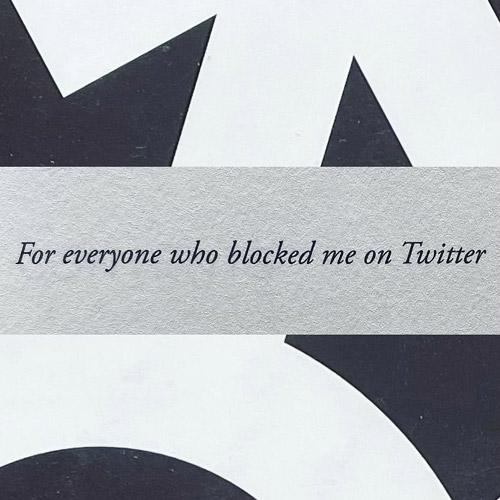
“For everyone who blocked me on Twitter”… I can’t tell you much about the book itself, but there’s a book dedication you don’t see every day, as seen in The End of Gender, by Canadian sex neuroscientist Dr Debra Soh.
Via Paul Dalgarno, on Bookstagram.
RELATED CONTENT
It’s time to think twice about Facebook, right?
6 October 2021
Tim Biggs, writing for the Sydney Morning Herald, on yesterday’s Facebook outage:
The fact that the impact was so wide may cause you to ponder what we all already know, that Facebook has inserted itself into as many facets of our online lives as possible, for the purposes of the collection and cross-referencing of our data, to drive its experimental advertising machine. And though outages like this are rare and the hyper-connectedness of Facebook services is unlikely to become an ongoing problem in the sense that they’re falling over all the time, it is timely that we’ve been forced to reckon with just how ubiquitous the company is, if only for a few hours.
I don’t use Facebook too much, but was alarmed I couldn’t access Instagram for several hours yesterday. But am I going to look for alternatives? Yeah, right…
RELATED CONTENT