
Showing all posts about trends
Monique Judge: bring back personal blogging in 2023
5 January 2023
Monique Judge, writing for The Verge:
Buy that domain name. Carve your space out on the web. Tell your stories, build your community, and talk to your people. It doesn’t have to be big. It doesn’t have to be fancy. You don’t have to reinvent the wheel. It doesn’t need to duplicate any space that already exists on the web — in fact, it shouldn’t. This is your creation. It’s your expression. It should reflect you.
I’m all for this, obviously. But as I wrote last month, social media apps have made it so easy to create a web presence (should I even use that term in 2023?), that buying a domain name, and installing a blogging application, seems like a lot of work.
Still to those willing to put in the hard yards, more power to you. And, for a more… succinct call to action, read Start a Fucking Blog, by Kev Quirk.
RELATED CONTENT
Barnes & Noble reverses death spiral, will open new bookshops
2 January 2023
In a move that must have surprised many people, American bookseller Barnes & Noble (B&N) recently announced plans to open thirty new bookshops. This in an age where bookshops are considered old hat, passé. It’s an incredible turnaround for a company once on the verge of collapse, but the B&N revival is something not only other booksellers can learn from, but also a host of other media, including music, newspapers, and film, writes American author Ted Gioia:
All the cool and up-to-date technologies are in financial trouble. Tesla share price has collapsed. Crypto is in decline. Netflix stock has dropped more than 50% in the last year. Facebook is in freefall. Even TikTok might be in trouble. But Barnes & Noble is flourishing. After a long decline, the company is profitable and growing again — and last week announced plans to open 30 new stores. In some instances, they are taking over locations where Amazon tried (and failed) to operate bookstores.
This is great news for people who still like to buy print books in a shop. I don’t think any B&N stores are slated to open in Australia any time soon, but nonetheless this is surely music to the ears of authors and book readers.
RELATED CONTENT
What’s wrong with people who don’t eat meat or drink? Nothing
2 January 2023
Despite Australia’s apparent reputation as a nation of big drinkers, forty-six percent of Australians either abstain completely from alcohol, or only consume one drink a month. If the thirteen percent of people who only partake of a tipple two to three times monthly are added, that’s almost sixty percent of the population who barely drink at all.
Yet people who have chosen to give up alcoholic beverages still find themselves under pressure to drink at social gatherings, particularly at this time of the year. This is something I’ve seen in the now ten years since I cut back on alcohol. Today I might have a drink maybe once every two months. While most people appear to be accepting of this choice, I’ve run into a few who aren’t. One or two even seem to feel threatened when the question comes up, but I’m not sure why this should be.
Australia, for instance, is also a nation of coffee drinkers, of which I am one, but I don’t hear of anyone who doesn’t drink coffee, or only has decaffeinated coffee, being put-down. The same goes for people who, say, don’t own a car, or even drive. I think you can even choose to refuse recreational drugs with total social impunity. Why then are some lifestyle choices greeted with virtual indifference, while other cause derision?
I also know people who embrace veganism are sometimes subjected to the same contempt as non-drinkers. Some people choose to eat a non-animal based diet instead of an animal one. So what? What’s in the Australian psyche that results in people who avoid meat or alcohol being derided? It is because those who we perceive to be outliers appear to pose some sort of threat? It is because meat and alcohol are — or were — so ingrained in our way of life, and no one should therefore upset the apparent status quo?
I might be optimistic, overly optimistic maybe, but I think attitudes are changing, albeit slowly. Is it really so hard to live and let live?
RELATED CONTENT
alcohol, Australia, psychology, trends
Australian CBDs will bounce forward, not back, in 2023
29 December 2022
Rob Stokes, NSW Minister for Cities, writing for the Sydney Morning Herald.
Rather than forcing workers back into CDBs, many of whom took to working from home during COVID lockdowns of the last few years, the NSW State government is looking at other ways of reinvigorating city centres across Australia’s most populous state:
Our CBDs are going to bounce forward, not back. They will rebound on a totally different trajectory in 2023. Over the course of the pandemic, the NSW government has invested $66 million in ways to reinvent how our central urban areas function. Programs to move dining into streets and public spaces, pop-up events, new walking and cycling paths, and reduced controls over music, retail and service of food and drinks have all changed the way we experience city streets.
The writing has been on the wall for CBDs for some time. With the advent of robust technologies allowing more people to work from home with greater ease, it was only a matter of time until workers migrated away from city centres. The COVID lockdowns, and work from home mandates, only brought forward the present state of affairs, it did not precipitate it.
None of that helps businesses who have long been based in CBD areas, and are struggling with the change though. Many are still reeling from the impact of COVID, not to mention construction of Sydney’s light rail transit system. Here’s hoping these initiatives are of benefit.
And here’s something intriguing. According to Stokes, the concept of CBDs was devised by white, middle class men, for white, middle class men:
The phrase “central business district” was coined by white, male, middle-class planners in Chicago in the 1930s and 40s, based on the notion that cities work most efficiently when different groups work, live and play in different precincts. CBDs were designed to be used by white, middle-class businessmen, 9-5, Monday to Friday. They were never really designed to include anyone else.
RELATED CONTENT
economics, politics, technology, trends
2023 the year of the RSS reader for email newsletters?
27 December 2022
While I trawl Twitter, Instagram, and other aggregator sites for news and information, I still also use Really Simple Syndication (RSS)… yes, I hear the laughter. If I had my way though, I’d rely solely on RSS, where every channel I peruse could be pulled into a single, convenient, interface. Trust me, reading the whole internet is so much easier when you only have to look at the one screen.
RSS, which, by the way, is really simple once you get the hang of it, allows you to read the content of any website, or social media platform for that matter, offering a RSS feed. But not everyone saw RSS as simple, and consequentially the technology has been out of mainstream favour for some time now. RSS developers were also at loggerheads as to the direction the syndication technology should take, while publishers were uncertain as to how they could monetise content served via RSS.
I’m also subscribed to about half a dozen newsletters, but I struggle to keep up with the many and myriad newsletters presently in circulation. And still some people say we’ve not yet reached “peak newsletter”. Really? I reached peak newsletter at least ten years ago. Having said that, I have vague plans to publish a newsletter here, but I’m not sure I want to inflict yet another newsletter on the world, as there’s surely enough of them already.
Imagine though you could read all your email newsletters by way of a RSS app. But you wouldn’t be seeing a web version of a particular email newsletter, something a provider like Mailchimp makes available. Instead, an email newsletter RSS app would pull the content of all the newsletters from your email in-box, and funnel them into the email RSS app. You’d then see your email subscriptions displayed in the same way as the RSS feeds of any websites you subscribe to are.
An email newsletter RSS reader just might make browsing all those newsletters a little more manageable. And the idea’s not so far-fetched either, says Nikki Usher, writing for NiemanLab, who thinks such an app is possible, various technical issues notwithstanding:
I predict that these people won’t stand for a universe where their email becomes ever more crowded just because of Elon Musk mucking up Twitter. The only way to survive in a world where multiple DC-insider publications are launching multiple newsletters and Twitter is no longer socially acceptable is to use an RSS reader that satisfies the intelligentsia and political elite.
Will we get it? It may well be that the feed from email to robust RSS reader needs an API that isn’t yet possible, given password-protected, your-and-Gmail’s-eyes-only email. RSS readers may need their own ecology of analytics in order to be commercially desirable and worthy of tech investment.
Might then 2023 be the year of RSS? Even if it is for email newsletters? It seems like a big call, but I’m watching this space. Might the current malaise towards the today’s centralised internet see RSS return to favour? Again, a big call, but who knows.
RELATED CONTENT
design, RSS, social media, technology, trends
How adorbs, 500 new Scrabble words for your playing inspo
21 December 2022
To see the pace at which the English language is evolving, though I’m not sure evolving would be everyone’s verb of choice — change, or even devolution, might better fit the bill — look no further than the latest batch of words that can now be used in popular word game Scrabble.
Some five hundred words have been added to latest edition of The Official Scrabble Players Dictionary, says David Astle, writing for The Brisbane Times. Among them are adorbs, convo, dox, inspo, jedi, stan, sitch, and thingie.
Despite the fanfare, however, you may stand in oppo (another intake) to such skeezy (repulsive) additions, yelling ixnay (slang term for veto) at this whole thingie (yep, that’s in too). Pushed to shove, you may even succumb to grawlix (the sweary symbols of cartoons), yet 500 new words represent less a bleak day for English than a chance to embiggen your Scrabble ammo, amirite? And your score.
RELATED CONTENT
entertainment, games, language, trends
A Bunch of Pretty Things I Did Not Buy by Sarah Lazarovic
28 October 2022
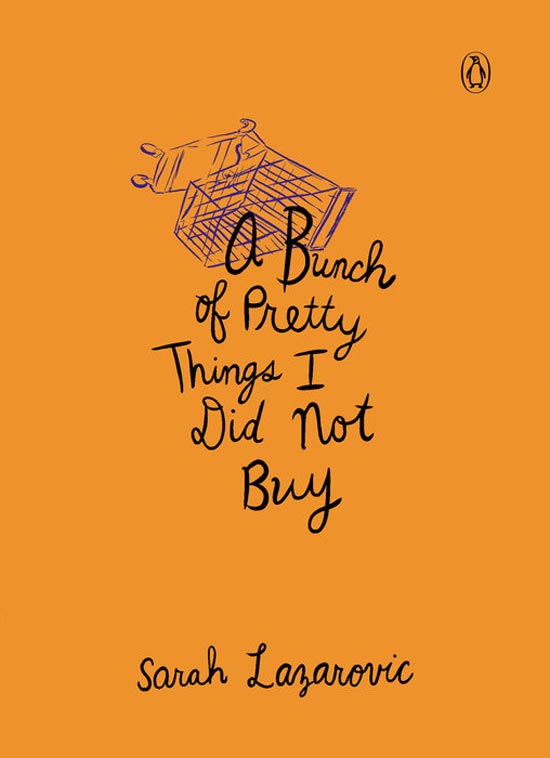
Instead of buying the things she wanted to, Toronto based Canadian writer, illustrator, and artist, Sarah Lazarovic decided to paint the objects of her retail desire instead. A year later she gathered the works together in her new book, A Bunch of Pretty Things I Did Not Buy, which is being published this month by Penguin Random House:
Based on a visual essay that was first published on The Hairpin, A Bunch of Pretty Things I Did Not Buy is a beautiful and witty take on the growing “slow shopping” movement. Sarah is a well-known blogger and illustrator, and she writes brilliantly without preaching or guilt-tripping. Whether she’s trying to justify the purchase of yet another particleboard IKEA home furnishing, debating the pros and cons of leg warmers or calculating the per-day usage cost of big-ticket items, Sarah’s poignant musings will resonate with any reader who’s ever been susceptible to an impulse buy.
If you’re looking for an introduction to the low shopping movement, A Bunch of Pretty Things I Did Not Buy sounds like the book for you.
RELATED CONTENT
art, books, Sarah Lazarovic, trends
Bad news sells but negative lyrics also sell songs
24 October 2022
In a study published in 2019 by Cambridge University Press, researchers found the lyrics of pop songs have become increasingly negative in the last thirty years. They reached this conclusion after analysing the emotional content of more than 160,000 songs released between 1965 and 2015.
One major trend in popular music, as well as other cultural products such as literary fiction, is an increase over time in negatively valenced emotional content, and a decrease in positively valenced emotional content.
RELATED CONTENT
Australian author Bri Lee on earning income from Substack
24 October 2022
On the subject of Substack, Sydney based Australian writer Bri Lee is another author who has turned to Substack. Asking subscribers for money can be a thorny matter, especially as readers have no compulsion to pay: Substack remains free for anyone to access.
But it comes down to the individual reader. They like a writer’s work, and wish to support them. As simple as that. No one is being forced to do anything.
People who do pay will often be paying to ‘support you and your work’ rather than necessarily paying because they perceive the value of what they get in their inbox is equal to the dollar figure you charge. When I launched the paid section in January 2021 I explicitly told people that I wanted to keep the vast majority of the content freely available, and that anyone who did pay was essentially subsidising the access of the non-paying subscribers.
RELATED CONTENT
Authors with profile can earn money publishing on Substack
24 October 2022
British author Tim Lott writes about starting a Substack page, and how the publishing platform can help writers generate income from their work. In Lott’s case it’s so far, so good:
What do my subscribers get in return for signing up? Anything I want to give them. I have total freedom. There are no editors or advertisers telling me what to do. Independence isn’t without its downsides. You have to learn to sell yourself, you have to understand how online media works and you have to be self-disciplined and dedicated. No editors, no agents, no marketing department. You’re on your own. But we novelists know how to be on our own. Now we have the chance to be multi-media publishers as well.
Profile is key here. Anyone with sufficient followers on the platform of their choosing can make money. While there are plenty of people doing well on Instagram or TikTok, they are what I call visual mediums. But they’re not the best for writing, especially long form writing, as they do not function so well as blogging platforms. Substack then may be the solution writers are looking for.
RELATED CONTENT