All the forensic psychological nuance that Rooney feeds us through Frances – her neurotic overthinking, her spiky self-loathing, her overworked efforts to affect nonchalant charm – those chaotic moments that lend Frances her skewed humanity, are dulled, if not lost, on screen. What you’re left with is lingering shots of Frances staring out a rain-streaked window, presumably deep in existential thought, but who knows?
Disappointing. I know I just about always look forward the screen adaptation of the novels I like, despite an innate weariness to the book to film thing…
The unbearable costs and instability of the rental crisis are pushing more people towards crowdfunding for accommodation, with housing-related appeals on one of Australia’s biggest fundraising platforms more than quadrupling over the past year. The campaigns range from requests for assistance with rental arrears and covering the costs of temporary accommodation, to appeals for help to buy caravans or other forms of mobile accommodation in the face of homelessness.
We are frequently told Australia is a rich — or at least well off — country, making situations like these unfathomable. There may be inequality, often the result of a lack of momentum, but how something basic like reasonably priced rental housing remains a problem beggars belief. I fear whatever the outcome of tomorrow’s federal election, there will be little change to the status quo. Because, you know, this a state issue, not a federal one.
Australians go to the polls tomorrow, Saturday 21 May 2022, to choose who will govern the country for the next three years. While issues such as climate change, the pandemic, and regional security have dominated the election campaign, matters arts and culture have been largely absent from the spot light.
In terms of policy in this area, the incumbent Liberal National Coalition government appears to offer little, while the present opposition party, Labor, has policy that Ben Eltham, a lecturer at the School of Media, Film, and Journalism at Monash University, describes as “surprisingly modest.” Eltham, together with four other policy experts, have compared the proposals of both major political parties, and graded each of them.
“I don’t make films anymore,” Haenel said. “Because of political reasons. Because the film industry is absolutely reactionary, racist, and patriarchal.”
Like many festival and award ceremonies, the National Indigenous Music Awards (NIMAs) have been forced to proceed with virtual/online events in the last couple of years. In 2022 however the NIMAs return in an in-person format, and will be held in Darwin on Saturday 6 August 2022.
The National Indigenous Music Awards (NIMAs) are recognised as one of Australia’s most prominent Indigenous music awards and have been celebrating Australian music for 16 years. The NIMAs showcase the rich musical landscape of Australia and highlight the music coming from all corners of the country. The Awards bring together acts who are yet to make their mark on the world alongside those who have achieved international acclaim, such as Gurrumul & Jessica Mauboy.
Kamila Andini tells a very personal story set against the backdrop of tumultuous political times in Indonesia in this beguiling period drama. Nana (a luminous Happy Salma) loses her family, including her husband, in the war in West Java. Years later, now in the 1960s, we meet her again. Her poverty now a thing of the past, she has remarried a significantly older man, Mr Darga, who is wealthy and a philanderer. Though her life is comfortable, Nana’s dreams are still occupied by the past.
A chance discovery of a carelessly forgotten item of clothing leads Nana to discover that Darga is having an affair with an even younger local woman, Ino. What follows is unexpected. Rather than a confrontation, Nana and Ino become friends, and take comfort in each other, jointly imagining a path to freedom. Meanwhile, through talk in the town of secret communists, and on radio broadcasts, the political tensions that will alter the future of Indonesia are made clear.
Before, Now & Then, also known as Nana, is competing against eleven other films for the Sydney Film Prize, the winner of which will be announced on Sunday 19 June 2022.
“Artists in this country are used to living one paycheque away from poverty.” With those words, Evelyn Araluen, winner of this year’s Stella Prize, had everyone’s attention. The proceeds from the literary prize mean Araluen will be able to pay down some debt, and work two jobs instead of three.
But that’s not the reality for many other writers — even those who are published — in Australia, if working two jobs, while still focussing on their art, is meant to constitute reality.
“Kids are already hung up on how much money you can make and whether you can do this for a living … I tell them the reason I write – the reason we all engage in books, art, theatre, anything – is that art changes people and people change the world. But I’m convinced there’s a whole generation of artists, and writers in particular, who will not choose this path.”
SparkToro and Followerwonk conducted a rigorous, joint analysis of 44,058 public Twitter accounts active in the last 90 days. These accounts were randomly selected, by machine, from a set of 130+ million public, active profiles. Our analysis found that 19.42%, nearly four times Twitter’s Q4 2021 estimate, fit a conservative definition of fake or spam accounts (i.e. our analysis likely undercounts).
That equates to one in five in accounts which seems staggeringly high, but then again, unfortunately, no, maybe not. Musk may rightly be concerned about the actual levels of fake and spam accounts on Twitter, but as a seasoned and reasonably prolific user it seems odd someone so keenly interested in the platform would be unaware of the extent of the problem.
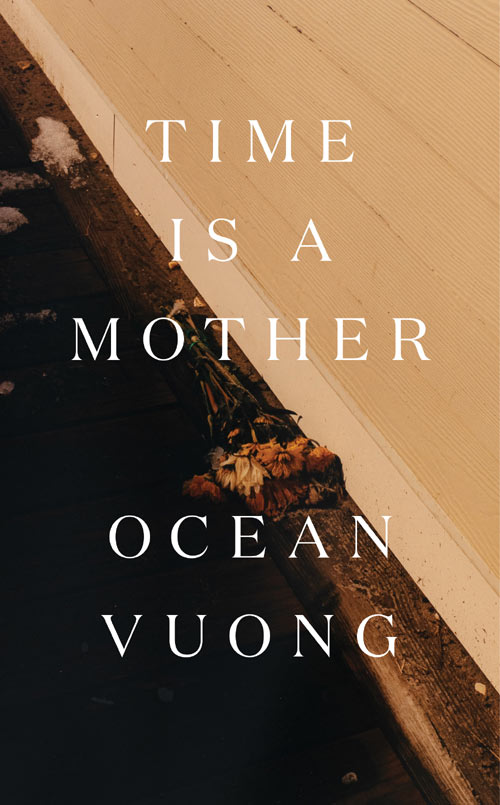
Time is a Mother (published by Penguin Random House, 5 April 2022), is a collection of poetry written by Northampton, Massachusetts based Vietnamese writer Ocean Vuong, following the death of his mother in 2019.
In this deeply intimate second poetry collection, Ocean Vuong searches for life among the aftershocks of his mother’s death, embodying the paradox of sitting within grief while being determined to survive beyond it. Shifting through memory, and in concert with the themes of his novel On Earth We’re Briefly Gorgeous, Vuong contends with personal loss, the meaning of family, and the cost of being the product of an American war in America. At once vivid, brave, and propulsive, Vuong’s poems circle fragmented lives to find both restoration as well as the epicenter of the break.
The finale of Vuong’s sprawling poetic vision is at once dangerous and peaceful, elegiac and triumphant. Vuong’s text pulses with an attentiveness to fear. It is through this emotion that he renders such luminous meditations on his life, and of the people who have come to change it. Vuong fears, which is to say, he refuses to not love.
As the centrepiece event of the Emerging Writers’ Festival, the National Writers’ Conference is all about informing and inspiring writers of all genres and styles. Hear the best industry advice from our distinguished Ambassadors and dive into conversations about how to start a publication, the role of literary criticism, the art of the interview and more.
It’s not all about listening to others though, aspiring writers will also have the opportunity to spruik their work during the conference:
Plus, book a Pitch It! Session for a unique opportunity to pitch your manuscript to a publisher or editor. You have just 5 minutes so keep it brief and don’t forget to leave room for questions! These publishers, editors and literary agents are here to support emerging writers, so give it a go.