7 December 2022
A recent survey of the Australian arts sector (PDF) reveals that slightly over half of mid-career artists are either considering leaving the arts, or are already retraining, so they can take up work in another sector all together.
Low rates of remuneration appear to be prompting a number of veteran independent artists and creatives to look elsewhere for opportunities:
In the words of one anonymous respondent: “I am retraining into the medical administration sector and will not be working in the arts anymore. That is a career of nearly 40 years gone due to the inability to survive financially.”
7 December 2022
Mark Dreyfus, the Australian attorney-general, says he will conduct a review of Australian copyright laws to ensure the income of artists is maintained, and copyright protections align with changes in technology that now allow the work of artists to be accessed across multiple platforms.
Technology means we can now all enjoy music, television, movies, books and art at the tap of a finger. Australia’s creative industry needs an effective copyright system that keeps pace with new technology and protects creators and other copyright owners from the unauthorised use of their works. This review will consider whether the copyright enforcement mechanisms in our laws remain appropriate, effective and proportionate.
7 December 2022
British journalist and writer Tim Jonze on participating in NaNoWriMo 2021, meeting the fifty-thousand word target in the requisite thirty days of November, and then… reading the work — for the first time — a year later:
Well, it’s been a year since NaNoWriMo. Could this book really be as bad as I imagined? Amazingly, the answer is no.
It is much, much worse.
Aside from the fact I could not meet the average 1,667 daily word requirement, to successfully complete NaNoWriMo, reading what I’d written, would be the other reason why I’d not take part.
6 December 2022
Antigone Kefala, an Australian poet of Greek-Romanian heritage, died on Sunday 4 December 2022, aged 92. Kefala was only two weeks ago named winner of 2022 Patrick White literary award.
6 December 2022
While I’m not one hundred percent sure we’re entering the end-days of social media, some recent talk of a resurgence in blogging, and a return to using RSS for content discovery, is encouraging. It’s kind of the web I know the best. But like anyone else, I can be found on the socials, Twitter and Mastodon, among them. I should add I’m an introvert, so my socials are relatively quiet. And no, the irony of that last sentence is not lost on me.
I first acquired the disassociated domain name, disassociated.com.au, in 1997. disassociated.com, meanwhile, came along in early 2003. But not before someone else, who’d bought the name, tried to sell it to me in the early 2000’s. But way back in the day, a person’s own website was always regarded the central pivot of their online presence. Pages on the early socials, Friendster, MySpace, and later Twitter, Facebook, and Instagram, were always seen as “outposts”.
As a web person you had presences there, because everyone else did, but they were not core to your overall online presence. And for good reason. The socials might have been public web-spaces, but they were privately owned. Fall foul of their terms of service, and you stood have your account suspended, or worse, permanently shut down. Sometimes without recourse, because you were in the realm of someone else who was setting the rules.
But no problem, you still had your largely untouchable core online presence, your website, at your own domain, which was self-hosted somewhere. Until we didn’t. The socials became too easy to use. They were free, and no hosting charges needed to be paid. Having a self-hosted website required some degree — no matter how little — of technical competence. Twitter and Instagram offered unlimited server capacity, ease of use, and, through their sprawling memberships, a multitude of potential followers. No more drawn out wrangling with SEO to find eyes to see your stuff, an audience was already present. You simply (sort of) had to make yourself known to them.
But before SEO and the socials came along, audience building was a little trickier. Website owners and bloggers were required to put in a lot more groundwork. In the late 1990’s I was writing blog posts before blogging was a thing. Back then we called these blogs online journals. To make ourselves known to other people then, we might write an online journal post about them, while linking to their website at the same time. Another option was through guestbook comments.
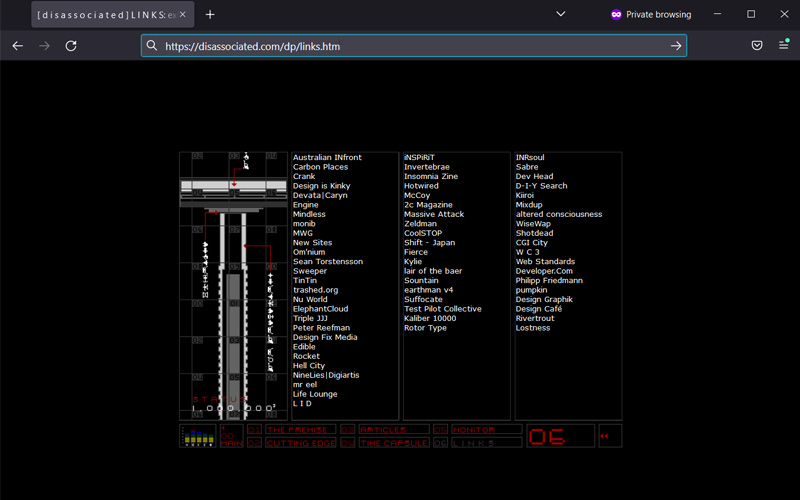
Guestbooks were one of the earliest methods of interacting with a website owner, and were hugely popular in the late 1990’s. There were akin to the comments section of a blog post, although the discussion was confined to a single page on a website, where the guestbook was situated. Another tried and true way of making yourself known to other website owners was by way of a links page. Above is the links page that featured on disassociated in late 1999. I know a lot of those links are gone now, but later on I might click links and see who is still around.
I guess you could say website link pages evolved into the blogrolls that once adorned the main pages, usually a side bar (which I stopped using about ten years ago) of a blog, when blogs per se arrived. The search engines however bought about the demise of the old school blogroll, from around 2007 or 2008. They were concerned many of the inclusions to what were the favourite websites of the blogger, were paid placements. In those earlier days, the search engines were also opposed to the practice of linking to so-called “bad neighbourhoods.”
Bad neighbourhoods were seen as websites having little, or no relevance, to the subject matter of the blog that linked out to them. For instance, it was seen as bad practice for a blog focussed on film production to link to a blog focussed on baking cupcakes. That could only be downright suspicious, couldn’t it? Too bad if the cupcake blogger was the significant other of the film production blogger, interlinking was simply unacceptable, and might earn you a slap down from a search engine.
Hopefully those days are behind us. The web is too vast and diverse a place for anyone to stay in their own lane. But blogrolls have been making a comeback. Not so much on individual blogs, but in the form of a number of aggregator websites, which are focused on content discovery, and the work of outstanding writers and bloggers. Chief among them are feedle, Blogroll, ooh.directory, and FeedLand, which is a feeds repository.
As I wrote on Twitter recently, “search engines are great for finding resources on topics of interest but scrolling through lists of blogs and randomly spotting something compelling is plain fun”. I for one am hopeful of a blogging renaissance, and other ways of discovering content, far from the shadows of the social media giants.
6 December 2022
The recently released results of a survey of Australian authors and writers make for sobering reading. If you’re considering a writing career, you ought to sit down before reading on. With rare exceptions, most Australian authors need at least one other job to make their writing ambitions feasible.
Income per annum varies according the nature of their writing, anywhere from about A$27,000 for educational writers, down to A$14,500 for literary authors. Bear in mind the minimum annual salary in Australia is a little over $42,000, based on a rate of A$21.38 per hour.
Education authors earned the highest average income from their practice as an author ($27,300), followed by children’s ($26,800) and genre fiction ($23,300) authors. Even though these figures are above the overall average for authors, they are not enough to live on, to support a family, or to pay rent or a mortgage. At the other end of the spectrum are poets, who earned an average of $5,700 from their creative practice. Literary authors earned $14,500, which is a decrease in real terms since 2015.
In case you’re wondering, literary authors are likely the sort of author anyone who wants to write wants to be. They also tend to be winners of literary awards including the Stella Prize, Miles Franklin, SPN Book of the Year, and Patrick White Award. And yet they only earn about a third of the Australian minimum wage for their craft.
6 December 2022
Somewhat related to my last post… Storywizard is a generative AI story creation app, that composes bedtime stories for children, complete with images, in real time.
We all have vivid imaginations and great ideas, but it’s not easy to express them and put them into writing. We built Storywizard to help parents and kids bring their ideas to life.
5 December 2022
For a long time it was believed the inevitable rise of automation technologies would bring about the end of repetitive and labour intensive jobs. Warehouse workers, drivers, and filing clerks would need to re-skill if they weren’t to be left unemployed.
But as digital and AI technologies evolved, the threat of being usurped by a computer moved up the ranks. An article published in The Economist in January 2014 (I couldn’t find an author credit, surely a machine didn’t write it?), warned that white collar professions such as accountants and doctors were also at risk:
Computers can already detect intruders in a closed-circuit camera picture more reliably than a human can. By comparing reams of financial or biometric data, they can often diagnose fraud or illness more accurately than any number of accountants or doctors.
Creatives meanwhile, writers and artists among them, always felt immune from these technologies. After all, how could a computer possibly produce an artwork, or write a book? Well, thanks to the likes of DALL·E and Jasper, we now know it’s possible. But creative output is not the limit of these technologies. They’re also capable of creative and problem solving… thought.
For instance, an application called Consensus, promises to seek answers, or consensus, to deceptively simple questions such as “is drinking coffee good or bad for my health?”, and potentially save hundreds, maybe more, of research hours. The app, once fully developed will be able to accurately scan multitudes of research papers on a particular topic, and deliver a pithy yet informative, summary in response to the query, says Derek Thompson, writing for The Atlantic:
Consensus is part of a constellation of generative AI start-ups that promise to automate an array of tasks we’ve historically considered for humans only: reading, writing, summarizing, drawing, painting, image editing, audio editing, music writing, video-game designing, blueprinting, and more. Following my conversation with the Consensus founders, I felt thrilled by the technology’s potential, fascinated by the possibility that we could train computers to be extensions of our own mind, and a bit overcome by the scale of the implications.
I expect in time AI technologies will be able to research and write the papers apps like Consensus will scan. But while AI apps can create artworks and perhaps write novels, will they really be any better at being creative? Let’s take blog writing as an example. A lot of people blog, but how popular are all these bloggers? We know some are more widely read than others. Their writing might be seen by hundreds of thousands of people, while other bloggers struggle to attract a handful of readers.
Just because, then, a machine writes something, does that mean the work will automatically have a larger audience? Will they cause every last writer on Earth to throw in the towel, and give up? I’m not so sure. Certainly the AI writers will improve, learn as they go, hone their craft, but will that result in more readers than an article written by a person? Maybe. Maybe not. Human and AI bloggers could be evenly matched. Of course, AI blogging apps will be able to research and write articles a lot faster, and that will be an advantage.
They’ll be able to publish an article on a given topic far more quickly than I can, and that work may rank on the search engines and elsewhere before mine. And that will suit some readers, but not all. And then we come to the human side of the process. Will readers be able to interact with the AI blogging app, as they can with human bloggers, through say email or social media? More crucially though, depending on the topic at hand, will an AI blogging or writing app, have the same authority to write as a person?
Could, for instance, an AI app write about raising a family? This is something most people learn about the hard way, by living through it. How could an AI blogging app possibly claim to be better qualified than a person, through “personal experience”, in this regard? How could the app ever gain the crucial trust to write on some subjects? This I suspect remains to be seen. At their core, AI apps are capable of thinking like people. For better or worse. I dare say, unfortunately, they will find a way.
4 December 2022
Image courtesy of A Owen.
Alcyoneus, a galaxy located some three and a half billion light years from Earth, at over sixteen million light years in length, is — without putting too fine a point on it — staggeringly huge. Our home galaxy, the Milky Way, at a mere one hundred thousand light years long, is positively minuscule in comparison.
But Alcyoneus isn’t a sixteen million light year long container of stars and whatever else fills a galaxy. Alcyoneus is what’s known as a radio galaxy, and the bulk of its length comes from radio lobes, which are a little like jets of radio energy, that fire out from opposite sides, into the surrounding space.
At its starry core Alcyoneus, which is likely an elliptical galaxy (unlike the image of the spiral type galaxy I’ve featured above), may not be all that much larger than the Milky Way. And that’s probably a relief for members of Alcyoneus’ galactic council, who only have to travel several hundred thousand light years to visit their constituents, rather than multiple millions.
If radio galaxies intrigue you though, Universe Guide has put together this explainer.
4 December 2022
If football/soccer isn’t your thing, but you love the thrill of elimination contests involving novels, you could always take a look at the Booker Prize World Cup:
We’ve selected, entirely arbitrarily, 16 winning books from the Booker Prize’s 53-year history, with each author representing a different footballing nation. In each case, the author is playing for their country of birth (which is more than you can say for the Qatar football team), and not necessarily the country with which they are best associated or where they live. We have drawn books against one another at random and in each ‘match’ — which will be posted on our Instagram and Twitter channels each day — we would like you to vote for the best book via a poll. The winning book will then progress to the next round. After the first round, there’ll be a quarter-final, semi-final and grand final.
The provision of each author playing for their country of birth is important, given South African born writer J.M. Coetzee, for example, has been an Australian citizen since 2006. Otherwise Peter Carey, with his 1988 novel Oscar and Lucinda, was Australia’s opening round representative.
While it could have been argued Australia was in with two chances, unfortunately as of the quarter final phase of the Booker Prize World Cup, both Carey and Coetzee had been eliminated. Such is life. Still, I’m waiting to see who wins. To take part, and support your favourite book, cast your vote via the Booker Prize Twitter or Instagram pages.