
The Luminous Solution, by Charlotte Wood
8 October 2021
The Luminous Solution (published by Allen & Unwin, September 2021) is new work – non-fiction this time – from Sydney based Australian Stella Prize winning author Charlotte Wood, she of The Weekend fame.
A rich inner life is not just the preserve of the arts. The joys, fears and profound self-discoveries of creativity – through making or building anything that wasn’t there before, any imaginative exploration or attempt to invent – I believe to be the birthright of every person on this earth. If you live your life with curiosity and intention – or would like to – this book is for you.
RELATED CONTENT
Australian literature, Charlotte Wood, writing
Abdulrazak Gurnah winner of the 2021 Nobel Prize in Literature
8 October 2021
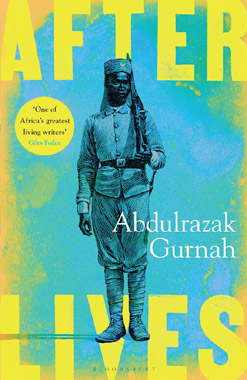
United Kingdom based Tanzanian novelist Abdulrazak Gurnah has been named the 2021 winner of the Nobel Prize in Literature.
RELATED CONTENT
Abdulrazak Gurnah, literature, writing
Now and Then: Ten Years of Stella
7 October 2021
Although the inaugural award was not made until 2013, it is ten years since the inception of the Stella Prize. To mark the occasion, Stella co-founder Chris Gordon will host an online discussion with past winners and shortlisted authors about the impact the award has had, and its outlook over the next decade, this evening at 6:30PM (AEDT). Details on how to be involved are here.
Join Stella co-founder Chris Gordon in conversation with Carrie Tiffany (winner of the inaugural Prize in 2013 for Mateship with Birds), Emily Bitto (winner of the 2015 Prize for The Strays), and Claire G Coleman (shortlisted in 2018 for Terra Nullius) as they discuss Stella’s impact thus far, and what might be achieved over the next decade.
RELATED CONTENT
Australian literature, literary awards, Stella Prize
On final approach: Forever, the new Flight Facilities album
7 October 2021
Seven years after the release of their debut Down to Earth, Sydney based Australian electronic act Flight Facilities lands on Friday, 12 November 2021, with their new album Forever. I’ve been queuing up their new singles – including the title track – on Spotify for weeks now… let the countdown to 12 November commence.
RELATED CONTENT
The Animals in That Country, by Laura Jean McKay
7 October 2021
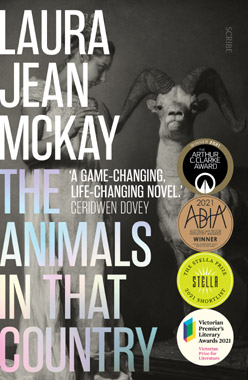
A flu of pandemic proportions is sweeping the country, and there seems to be little humanity can do to quell it, try as we might. That’s the somewhat familiar premise of The Animals in That Country (published by Scribe Publications, March 2020), the debut novel of New Zealand based Australian writer Laura Jean McKay.
But this disease had an odd symptom: those who become infected are possessed of the ability to understand the languages of animals. While having a conversation with their pets is probably something many people would cherish, that’s not quite the way this flu works. The infected become privy to the thoughts of every last creature. And for some people the result is an unbearable form of information overload. They die a slow death by madness, from an avalanche of once mute voices.
For straight-talking grandmother Jean, who works in a remote Australian wildlife park, the illness is a blessing in disguise. With the exception of Kimberly, her granddaughter, she much prefers the company of animals anyway. But when Lee, her son, leaves with Kimberly, in a bid to escape the outbreak, Jean, accompanied by a dingo named Sue, sees little choice but to go in search of them.
RELATED CONTENT
fiction, Laura Jean McKay, TBR list, writing
It’s time to think twice about Facebook, right?
6 October 2021
Tim Biggs, writing for the Sydney Morning Herald, on yesterday’s Facebook outage:
The fact that the impact was so wide may cause you to ponder what we all already know, that Facebook has inserted itself into as many facets of our online lives as possible, for the purposes of the collection and cross-referencing of our data, to drive its experimental advertising machine. And though outages like this are rare and the hyper-connectedness of Facebook services is unlikely to become an ongoing problem in the sense that they’re falling over all the time, it is timely that we’ve been forced to reckon with just how ubiquitous the company is, if only for a few hours.
I don’t use Facebook too much, but was alarmed I couldn’t access Instagram for several hours yesterday. But am I going to look for alternatives? Yeah, right…
RELATED CONTENT
Coffee prices are on the rise
6 October 2021
International Coffee Day was last Friday, 1 October 2021, but with it came word that coffee prices are on the rise, and may even double in the next year. While increases are hopefully welcome news to some bean growers who have been struggling with low margins, consumers can expect to pay more for a cuppa in the near future. The current catalyst for rising prices are lower than usual yields on coffee farms in Brazil, one of the world’s largest producers. As a result of severe droughts and then frosts, Arabica harvests may be their lowest in twelve years.
RELATED CONTENT
The Midnight Library, by Matt Haig
6 October 2021
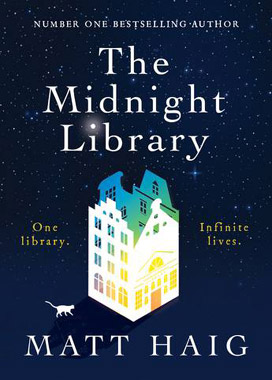
If we live in an infinite universe, or an infinite collection of universes, then all things are possible. There may be alternate versions of you and me, somewhere out there, living lives completely different to the ones we recognise as our present reality. Relative to this universe, that is.
The Midnight Library (published by Allen & Unwin, September 2020), the seventh novel of British author Matt Haig concerns itself with similar themes. In the absence, perhaps, of a multiverse, there is the Midnight Library. It is a place located on the edge of our universe, containing an infinite number of books.
One book is an account of the life you currently lead. Then there is another title, where you can read how your life might be, had you made different choices. It is to this far-flung story repository that Nora, a troubled young woman comes to, after she attempts to end her life. Nora has the chance to read the many stories her life could have been, had she decided to do something else.
Through these books, Nora goes on a tour of her mistakes and regrets, and sees where she went wrong. We all know the drill. Should I have taken the other job? Married someone else instead? It’s a charming, enviable, premise. To be able to undo all those bad decisions, and do the “right” thing. If only it were that simple. But if such a notion does appeal to you, maybe The Midnight Library will too.
RELATED CONTENT
fiction, Matt Haig, TBR list, writing
Miles Franklin Literary Award, 2022
6 October 2021
Good morning. Submissions for the 2022 Miles Franklin Literary Award opened yesterday. Writers, please submit your work ASAP as my to-be-read list, already made up of who knows many dozens of titles, isn’t long enough. Thank you.
RELATED CONTENT
Australian literature, writing
Barbara, by Mathieu Amalric… will the real Barbara stand up?
5 October 2021
How best to describe French actor and filmmaker Mathieu Amalric’s 2017 feature Barbara? A movie within a movie? So frequently do the lines between the real and the portrayed blur, it’s not always easy to tell.
Amalric, who also stars as a director making a bio-pic about a cabaret singer named Barbara, becomes enamoured with Brigitte, the actor portraying Barbara. But is it really Brigitte (Jeanne Balibar) he’s obsessed with, or her representation of Barbara? But he’s not the only person on set who’s confused. Brigitte, in learning what she can about Barbara, almost comes to believe she is the late cabaret singer.
RELATED CONTENT