
The ghostwriters and AI filling the world with garbage ebooks
18 April 2024
An eye-opening article by Constance Grady, writing for Vox. AI and unscrupulous ghostwriters are combining to flood the world with poor quality ebooks, sometimes called garbage ebooks, and giant online booksellers seem to be doing little about it:
Here is almost certainly what was going on: “Kara Swisher book” started trending on the Kindle storefront as buzz built up for Swisher’s book. Keyword scrapers that exist for the sole purpose of finding such search terms delivered the phrase “Kara Swisher book” to the so-called biographer, who used a combination of AI and crimes-against-humanity-level cheap ghostwriters to generate a series of books they could plausibly title and sell using her name.
RELATED CONTENT
artificial intelligence, books, publishing
A not so deep dive into a not so new neologism
17 April 2024
When it comes to what’s published online, I consider myself a moderately well-read person. Obviously, I’m not across every last thing posted on the web, but I probably spend a good couple of hours a day following news sites, what’s on the RSS feeds I subscribe to, social media, and so on.
Despite this, what I’d describe as big news stories still seem to slip me by. I’m sometimes surprised to read, for example, that a major international sports fixture is about commence. Or a music act that is otherwise a household name, is preparing to play their first show locally, and I had no idea they were even in the country.
Maybe that’s why — prior to a few days ago — I’d seemingly missed seeing the term deep dive, which is being used to refer to in-depth news stories, and blog posts, on a given topic. It’s quite possible however I missed seeing the neologism, in my daily futile attempts to sidestep that other overused noob of a term, reach out.
Of course neither deep dive, nor reach out are neologisms, new terms, as such. People I’m sure have been deep diving, or feel as if they have been, in the oceans and other bodies of water for eons. Similarly, people have been reaching out to grab an apple from the fruit bowl, or take a book off a shelf, for many long centuries.
But it is the connotation these terms are used in, that is new, or rather, somewhat new. So before writing a post heralding the advent of a freshly minted neologism, in this case deep dive, I decided to have a look around. This actually amounted to a pretty perfunctory look around, consisting of but a single search engine query.
That query led me to Merriam-Webster, a “leading provider of language information for more than 180 years”. Thanks to their listing of deep dive, I learned the term had been used to describe “an exhaustive investigation, study, or analysis of a question or topic”, since, wait for it, 1986.
1986. That’s like ten years before the internet as most of us know it, come along. Either I’ve been hanging out in all the wrong places online, all this time, or someone on TikTok has only recently made the term deep dive go viral. Obviously, my money is on the latter.
RELATED CONTENT
How crush proof is the average marriage? Maybe not much
16 April 2024
Gabe Trew, owner of Australian market retailer POP Canberra, decided to run a Valentine’s Day competition this year. He invited social media followers to send him, anonymously I believe, stories about the great love crushes of their lives.
Entrants would be in the running to win what was described as a “dream date.” But something strange happened. Two weeks after Valentine’s Day passed, submissions, or romantic confessions, were still rolling in.
Now, nearly two months on, and some five-thousand people, with stories to tell about their secret crushes, have been in contact with Trew. As a result of the promotion, eight couples — people previously staring down the barrel of possibly a lifetime of unrequited love — have come together.
Of those who were united with their crush through the POP Canberra promotion, I’m not sure how many, if any, were married, or in a relationship, immediately beforehand.
But when ABC National Radio show, Life Matters, recently canvassed the subject of crushes, some listeners admitted to holding a torch for someone else, despite being married. And some of these people eventually deal with the dilemma. They end the relationship, or marriage, they’re in, and find it in themselves to tell their crush how they feel. Sometimes, it turned out the light of their life felt the same way. But for others, the path can be fraught with peril:
For Julie, another Life Matters listener, things haven’t worked out so neatly. She’s been dealing with a difficult crush on a friend that has left her feeling confused and distressed. She’s also married, and has been trying to work out how to protect both her relationship with her husband and her friendship with the object of her crush. “I don’t want to hurt my husband. I’m sort of trying to hold on to that,” she says.
While things may have worked out well for some POP Canberra contest participants, it’s not all bad for those who remain where they started. Professor Michael Slepian, an American psychologist, says having the chance to air their secret, albeit anonymously, can be beneficial:
“[Individuals] do want to get secrets off their chest, they do recognise that a secret can burden them … but those opportunities rarely present themselves,” he said. “It [the POP Canberra competition] provides people this outlet that is not normally available to them, to talk about the things they don’t normally get to talk about.”
RELATED CONTENT
AI Pin by Humane pricked by poor user reviews
15 April 2024
Fans of Star Trek series The Next Generation will be familiar with the communication devices crew members used. Or should I say: wore. The small, yet high powered, long range devices, were typically attached to the shirt of a crew person’s uniform.
With a mere tap, those on the surface of a planet could contact their vessel, which was usually somewhere in orbit, and speak to whomever they desired. Instantly, and with perfect clarity. What Star Trek fan didn’t want to own such a gizmo? A wearable that actually, really, worked?
For a time, it looked like Star Trek fans might see science fiction become fact. In March 2023 word seeped out that Imran Chaudhri and Bethany Bongiorno, both former Apple employees, were developing, through new venture, Humane, a device reminiscent of the venerable communicator.
Chaudhri and Bongiorno intended their device, powered by AI, and aptly named AI Pin, to be far more than a simple means of two-way communication though. In addition to making phone calls, the AI Pin can send messages, make appointments, take notes, answer questions, take photos, and record video, among other things. In fact, I’m surprised Star Trek creators never beefed up their wearable communicators, considering the devices would have had several hundred years of technological development behind them, by the time of the twenty-fourth century.
But weeks ago, after a year of hype and anticipation, tech journalists were given AI Pins test units to try out. Their experiences, however, have not been much to write home about. Humane claimed the AI Pin will replace the smartphone, but as David Pierce, consumer tech writer for The Verge found, the device is presently in no danger of replacing any phone, let alone a smartphone:
I’d estimate that half the time I tried to call someone, it simply didn’t call. Half the time someone called me, the AI Pin would kick it straight to voicemail without even ringing. After many days of testing, the one and only thing I can truly rely on the AI Pin to do is tell me the time.
Making phone calls (perhaps) isn’t the AI Pin’s only capability. It is, as noted above, meant to do all sorts of other things. Answering questions, that might otherwise be asked of a search engine, is one of them. But Cherlynn Low, writing for Engadget, struggled even with this:
When the AI Pin did understand me and answer correctly, it usually took a few seconds to reply, in which time I could have already gotten the same results on my phone. For a few things, like adding items to my shopping list or converting Canadian dollars to USD, it performed adequately. But “adequate” seems to be the best case scenario.
The AI Pin does not have a screen. Instead it projects information onto your hand. Your hand also doubles as a keyboard, which is needed to enter a passcode to unlock the device. This sounds well and good in theory, but practice is another matter, as Julian Chokkattu, Wired’s review editor, notes:
I’m going to say it now: Humane’s laser projector display is never going to take off as a viable method of interacting with a gadget. It’s overly sensitive and slow to navigate. When the projection lands on your palm, you have to tilt your hand around in a circular motion to scroll through the icons until you land on the one you want to select. But tilt too much, and it moves past the icon you want, landing on the thing next to it. It’s just plain annoying. Using the projected interface to run through old text messages is also a chore — and yes, you can ask the Ai Pin to read your messages, but that’s just not going to work all the time.
It’s fair to say early reviews are not encouraging. Which is disappointing, as I had high hopes for the concept. I’d watched Chaudhri and Bongiorno’s various presentations, and was impressed by the potential of the device. But I noted many of the trials we saw were conducted indoors, in relatively quiet environments. Which made me wonder; how might the device perform outside, in stormy conditions? Could you hear what a caller was saying? Could they hear you? Of this I am not sure.
It seems to me AI Pin shipped too soon. The device just seems to have too many problems for one deemed market ready. But these are early days, for both AI Pin, and the AI technologies that underpin it, so perhaps a device that performs to expectations, will eventually come forth.
RELATED CONTENT
artificial intelligence, smartphones, technology
Six dead in knife attack at Westfield Bondi Junction
13 April 2024
The Australian Broadcasting Corporation (ABC):
A shopping centre in Sydney’s east has been evacuated amid reports of multiple stabbings and potentially a number of deaths. An eyewitnesses told the ABC shots were fired. NSW Police said emergency services were called to Westfield Bondi Junction just before 4pm after reports of multiple people being stabbed.
This is shocking. The centre would have been packed with weekend shoppers and young families.
I hotdesk there during the week when in Sydney. I’m trying to find out if the people I know who work there are OK, but ping me if you see this.
Update: sadly several people have died, and others were injured, as a result of the attack. The alleged perpetrator meanwhile was shot by a police officer, who was at the scene.
Update II: police are certain the attack was not terror related, nor motivated by any political or religious ideology.
RELATED CONTENT
Australia, Bondi Junction, current affairs, Sydney
The 2024 Stella Prize for Australian literature shortlist
12 April 2024
And talking of Australian fiction, the shortlist for the 2024 Stella Prize, the Australian literary award that recognises the work of Australian women and non-binary writers, was unveiled last week. The following six titles were selected:
- Abandon Every Hope: Essays for the Dead, by Hayley Singer
- Body Friend, by Katherine Brabon
- Feast, by Emily O’Grady
- Hospital, by Sanya Rushdi (Translated by Arunava Sinha)
- Praiseworthy, by Alexis Wright
- The Swift Dark Tide, by Katia Ariel
I’m a big fan of literary prize lists, be they long or short, given they’re always a great source of reading ideas, since I only sometimes have my finger on the pulse of literary happenings. In the same way Triple J’s Hottest 100 is great for new music discovery, for those unable to listen to music 24/7.
Good to see Melbourne based author Katherine Brabon listed with her latest novel. I really enjoyed her 2021 novel, The Shut-ins. I highly recommend adding it your TBR list, if you’ve not yet read it.
And for reference, here is the Stella’s longlist, which was published in early March. The 2024 winner of the Stella Prize will be named on Thursday 2 May 2024.
RELATED CONTENT
Australian literature, books, literary awards, Stella Prize
No one can interpret your dreams except you
12 April 2024
I sometimes write about books, novels, here. Usually Australian fiction, which I make a point to read as much of as possible. I’m currently (still) reading Before You Knew my Name, the 2021 debut of Melbourne based New Zealand author Jacqueline Bublitz. I guess therefore that’s close (in my book, if you’ll excuse the pitiful pun) to being an Australian title.
Perhaps though some people think this makes me worth approaching to write about other sorts of books, non-fiction even. Perhaps that’s why I was recently asked if I would read, and offer some thoughts here, about a recently completed book.
But I declined. It’s not because the title was self-published. As an online self-publisher, I have no problems with initiative based publishing. I’ve long been considering self-publishing a book, a novel myself, if I can ever finish writing it.
What bothered me was the subject matter: dream interpretation. Or, more succinctly, the regarding of objects, happenings, and other things that occur in dreams, as being symbols of some sort, that can be said to have a standard, or universal, meaning. For instance, two thousand people see a blackbird in a dream, and seemingly it means the same thing to each and every one of them.
Yeah, right.
Our dreams are our subconscious brain processing our individual thoughts, problems, concerns, hopes, you name it. How anyone else, another individual whom we’ve never met, is meant to know the significance of these visions we have — assuming we remember them — is beyond me.
As such, I have no interest in endorsing any books on the subject. The world does not need (and here’s hoping the author in question is not reading this) another pseudoscience title clogging the shelves at bookshops.
I have some wild crazy dreams sometimes. If my recollection of them is clear enough on waking, I try and jot down as much detail as possible, and self-analyse what I saw later on. Sometimes discerning a meaning is not hard, once going through the feelings, emotions, events, and of course, the people present, in the dream.
Often though, I’m just left with an intriguing notion to mull for a time, until something in the here and now distracts me.
I wrote back to the author, and told them their type of dream interpretation was not my thing, and wished them all the best with their work. By the way, I’m pretty sure I spotted a blackbird or two in a recent dream, but did not later end up buying a bunch of bananas, or whatever the sight of a blackbird in a dream is purported to mean.
RELATED CONTENT
Third best coffee on Earth? Sydney. Tenth best? Melbourne…
11 April 2024
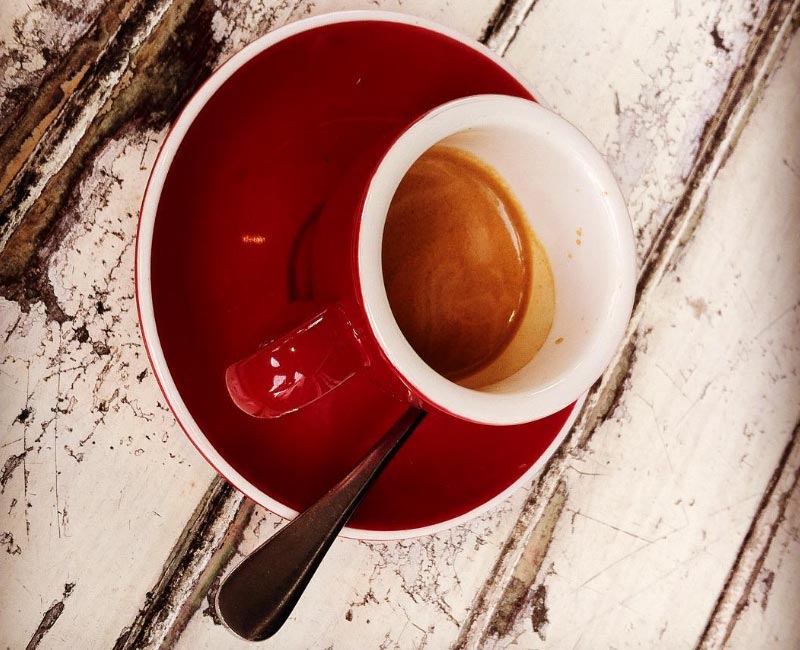
Espresso, brewed by Crepe & Coffee Co, photo by John Lampard.
Sydney has been adjudged the third best city in the world for coffee, this according to American magazine, Food & Wine. Copenhagen, perhaps unsurprisingly, comes in at number one, followed by Tokyo in second place. But here’s where things may get contentious: Melbourne — perhaps surprisingly — ranks at number ten on the list.
Number ten? How can that be? Did not Melbourne birth McCafe, the McDonald’s hamburger restaurant coffee-shop off-shoot? Isn’t Melbourne where the rest of Australia supposedly draws all ideas and inspiration coffee related from? Not that I’m trying to stoke up any Melbourne versus Sydney antagonism, or rivalry, here.
Not me. After all, I’m officially based almost two-hours drive north of Sydney. But when it comes to coffee consumption elsewhere, I’ve had more Sydney coffee than I have Melbourne. And besides, I like both cities. But they’re different places, they’re not cookie-cutter replicas of each other.
Objectively, how then could one possibly be better than the other? Let me illustrate, while keeping the theme victual. Years ago, a chef (whose name escapes me), described the differences between the two cities, thusly. When you go out for dinner in Sydney, it’s for a quick bite, because you’re on the way somewhere else.
That’s true. Sydney never stands still.
On the other hand, when you go out for dinner in Melbourne, it’s an occasion. People dress up, and stay seated at the table for hours. And sometimes we like doing both. But let’s avoid any further Melbourne versus Sydney discord, and take solace in the fact Australia is a country that embraces independent coffee brewers, and has little time for multinational coffeehouse chains.
RELATED CONTENT
Australia, coffee, Melbourne, Sydney, trends
A tribute to Kurt Cobain by his daughter Frances Bean Cobain
10 April 2024
Thirty-years ago, last Friday, 5 April, Kurt Cobain, American musician, and founder of grunge act Nirvana, died.
It was one of those remember-where-you-were-when-the-news-broke moments. I was sitting on the carpeted stairs of friend’s house, as we listened to a radio report about the tragedy. We could’ve sat in the lounge room, or around the kitchen table, but somehow not being in the same room as the radio, not being in its line of sight, made the news, I don’t know, easier to process.
Or maybe we felt the need to give the clearly upset DJ, who was discussing what happened, space.
To mark the thirtieth anniversary of Cobain’s death, his daughter, Frances Bean Cobain, who was twenty-months old at the time, published a tribute to her late father on her Instagram page. These are beautiful words, particularly, I thought, this excerpt:
In the last 30 years my ideas around loss have been in a continuous state of metamorphosing. The biggest lesson learned through grieving for almost as long as I’ve been conscious, is that it serves a purpose. The duality of life & death, pain & joy, yin & yang, need to exist along side each other or none of this would have any meaning.
RELATED CONTENT
The Internet is not written in pencil, nor is it written in stone
9 April 2024
An excerpt from Manuel Moreale’s recent interview — from his excellent People and Blogs series — with Oregon based American web designer and writer, Matt Stein.
I rewrite and edit heavily to try and find what I want to say. I wrote obscenely long answers to these questions and had to start over, and I’m one of those serial Discord+Slack edit-after-sending people. I would go broke as a stone engraver.
There could be no better way to describe my writing process. I’d likely go broke simply writing on paper, given the quantity I’d waste, attempting to publish a single post.
RELATED CONTENT