
Showing all posts about RSS
Blogs are Back: easily follow website and blog RSS feeds with one-click
26 January 2026
Subscribing to RSS feeds is my preferred option for following websites, but for people unfamiliar with the really simple syndication system, doing so can be daunting.
I’ve long thought subscribing to a website needs to be as easy as following someone on a social network. Tap the follow button to follow, and you’re following.
But following a RSS feed — doubtless something anyone reading this post could do in their sleep — isn’t necessarily straightforward. People first require a suitable RSS reader, again, something that’s easy when you know how. Then they need to go about the process of obtaining the URL of the RSS feed they wish to subscribe to.
But there’s more than one click involved in this process. While it’s easy as pie for some of us, I can see why many people decide not to bother, or simply stay on the socials instead.
Blogs are Back, created by Travis Van Nimwegen, an American software engineer, might be a solution to the one-click subscribe conundrum. Blogs are Back is two things: a directory of personal websites and blogs, and a simple way of following the RSS feeds of listed blogs.
Click the follow button of a website of your choosing, and that’s it.
Posts from any website a Blogs are Back user subscribes to will be visible in the integrated RSS reader. There’s also an option to submit a blog if it’s not already in the directory, and the more websites present, the better.
I’m not sure if an ubiquitous app/website, allowing people who know nothing at all about RSS, to follow RSS feeds with ease, will emerge — it seems to me RSS is mostly for those publishing their own RSS feeds — but this is certainly a step in the right direction.
RELATED CONTENT
blogs, RSS, technology, trends
Read a chapter of a book daily in your RSS reader
17 November 2025
Made by Las Vegas based software developer Pablo Enoc, who’s also behind indie RSS aggregator powRSS, lettrss will send a chapter of the book you’re reading to your RSS reader each day.
Here’s an idea with merit.
Reading novels is just about the last thing I get to each evening, and I don’t usually cover much ground before falling asleep. If a chapter of whatever I was reading appeared in my RSS feed though, I might make more progress since I read a lot of what takes my interest there. This idea might get a few more of us reading more regularly, since a chapter at a time usually isn’t too onerous.
At the moment only books in the public domain (or those out of copyright) can be read with lettrss. But this idea has possibilities. Imagine if book publishers were to make recent titles available this way, through possibly a subscription model of some sort.
RELATED CONTENT
books, novels, RSS, syndication, technology
Subscribe Openly, and (almost) one-click RSS feed subscriptions
23 September 2025
In an ideal world subscribing to a website/blog’s RSS feed should be as simple as following a page on the socials. Simply click the follow button, and that’s it. In the case of, say, Instagram all future posts of whoever you started following will be visible — algorithms permitting — in the main/home feed.
Of course, subscribing to a RSS feed isn’t difficult. If you know what you’re doing. But to those to don’t know much about RSS, clicking the subscribe button might result in confusion and frustration, and see them abandoning the process all together.
Sometimes clicking the subscribe button might only open the URL of the RSS feed, leaving a budding subscriber wondering what to do next. “Am I meant to bookmark this link?” they might wonder.
But before we ask people to subscribe to a RSS feed, we need them to understand they first need a RSS reader. A RSS reader is an app that allows people to subscribe to, and read, RSS feeds. But to the uninitiated, the process of installing a RSS reader might present another confusing hurdle, only further complicating matters.
Subscribe Openly, however, created by James, is a step in the right direction.
Instead of presenting a would-be RSS subscriber with a screen filled with the raw data of a RSS feed, when they click on the subscribe button, they are presented with a list of RSS readers they can install. Here’s what you’d see if you were subscribing to the RSS feed for my website this way.
Next it needs to be made understood to prospective RSS subscribers that setting up a reader app is not that difficult. They doubtless have numerous apps on their device already, a RSS reader would simply be just another app they need to install. Let’s get to it.
Perhaps though styling feeds so they’re coherent in a web browser is something publishers who syndicate content to RSS should consider. Having a RSS feed that renders like a webpage — that could be bookmarked like any other website — does of course seem like it defeats the purpose of having a RSS feed.
But, if people new to RSS see a coherent looking webpage when clicking the URL of a RSS feed, they might have more incentive to find out more about RSS.
RELATED CONTENT
blogs, content production, RSS, syndication, technology
Bloggers might have been syndicating content with ICE not RSS
11 September 2025
Ryan Farley, writing at Buttondown:
Not many people talk about how or why RSS won the content syndication war because few people are aware that a war ever took place. Everyone was so fixated on the drama over RSS’s competing standards (Atom vs RSS 2.0) that they barely registered the rise and fall of the Information and Content Exchange (ICE) specification, which had been created, funded, and eventually abandoned by Microsoft, Adobe, CNET, and other household names.
Here’s a slice of web history I was unaware of until now: an alternative blog content syndication specification that was — for a short time — in competition with RSS.
That Microsoft, as one of the backers of Information and Content Exchange (ICE) syndication, quietly began using RSS, says a lot. A lot about RSS, and Microsoft.
RELATED CONTENT
blogs, content production, RSS, technology, trends
RSS is so awesome it made the front page of Hacker News
1 September 2025
Some Hacker News (HN) members were astonished that a relatively concise blog post, written by Evan Verma, spruiking the merits of RSS, reached the front page of the news aggregator recently.
There’s probably not too many people on HN who don’t use RSS, but more generally, uptake is not particularly high. On that basis, any publicity is helpful. Let’s keep encouraging the adoption of RSS.
What is RSS? Read all about it here.
RELATED CONTENT
blogs, RSS, technology, trends
RSS as a W3C standard? Now there’s an idea
28 January 2025
If the World Wide Web Consortium (W3C) can adopt ActivityPub as a recommendation, something they did eight years ago, you have to wonder why they didn’t do the same for RSS.
The W3C should’ve gotten behind RSS long before they endorsed ActivityPub. They’re controlled by big companies who are truly scared of interop, explains why most of their proposed standards go nowhere.
One of the functions of web standards, published by the W3C, is interoperability:
W3C web standards are optimized for interoperability, security, privacy, web accessibility, and internationalization.
Interoperability, however, is also a tenet of the ActivityPub recommendation:
W3C’s role in making the Recommendation is to draw attention to the specification and to promote its widespread deployment. This enhances the functionality and interoperability of the Web.
We can have the ActivtyPub protocol, which has interoperability at it’s core, but not RSS, which is the same.
RELATED CONTENT
RSS, social media, social networks, technology, trends
RSS is really simple, why do so many find it complicated?
17 May 2024
Chris, writing at uncountable thoughts:
RSS is a pervasive, but little known, web technology that allows you aggregate all your content into one place for easy reading. There are very few websites without an RSS feed, although many don’t advertise the link (or, even realise they have it).
When you put an RSS feed link into your RSS, it is called “subscribing”. But don’t worry — it’s totally free, and you don’t give your email address.
Really Simple Syndication (RSS) is really simple. But a lot of people don’t see it that way, and anyone who has ever syndicated their web content, has always struggled to convince their readers of that. Like, probably since RSS arrived in March 1999. Yet RSS almost had its moment, during the so-called golden age of blogging, circa 2003 to 2010.
Writers took to writing blogs, and readers took to reading blogs. Content Management Systems like WordPress churned out RSS feeds automatically. All a blogger had do was prominently post a link to their RSS feed. Really simple. Writing posts explaining what RSS was, and why it was useful, was also common. Erstwhile (by the looks of it) Australian blogger Meg Tsiamis, of (defunct) Top 100 Australian Blogs Index fame, wrote a post in 2007, outlining RSS to her mother, and other of her readers.
Sadly, the more in-depth resource she linked to, is no longer online. In other words though, we’ve been trying for years, decades, to impress upon others the simplicity and function of RSS, but too little, or no, avail. Unfortunately RSS plain simply baffled just about anyone, and everyone, who didn’t write a blog. RSS was too technical, too geeky, many people complained.
But popular perceptions of RSS were only one problem. Accessing RSS easily was another. Some argued Google closing down their popular RSS reader, er, Google Reader (which I never used), in 2013, sounded the death knell of RSS. But the real problem had always been one of uptake, or rather, lack of uptake. Geekiness aside, some people questioned the purpose of RSS in the first place.
I recall, in 2014, trying to explain the utility of RSS to a co-member of a small business coffee meeting group I was then part of. I pulled out my laptop at the cafe we gathered at one morning, and showed him my RSS reader of the time (NewsGator, I think). “Look, see, you only have to visit one website to read one hundred websites,” I said, as I scrolled through my subscription list.
He marvelled as he looked on, recognising a number of websites he visited regularly. “All you need do is get a RSS reader app, like the one we’re looking at now, subscribe to the RSS feeds you like, and you’re set,” I said. Despite my small presentation though, he still looked confused. He didn’t seem to understand why you’d stop visiting a website, to read its content elsewhere.
Oh, the frustration.
Today RSS is even simpler. No apps are needed, one only has to create an account through a RSS aggregator website, Feedly for example (free for a basic account), and start subscribing. You don’t even need to know the URL of a website’s RSS feed. Type in the regular URL, and Feedly will search for available feeds.
Subscribing to an RSS feed is really the same as following someone on Instagram (IG). And it’s just as simple. Choose an IG page you want to follow, and tap the follow button. With RSS though, instead of following, you’re subscribing, although some RSS aggregators call the process following.
Better still, and as is often reported elsewhere, your subscription is anonymous (you could follow my RSS feed, and I’d have no idea unless you told me), and you only see the content you want to. There are no algorithms, or annoying “suggested for you” content. How good is that?
Well, not good enough, perhaps. Until subscribing to a RSS feed literally becomes as easy as following someone on social media, selling RSS as a really simple way of following a website, will, unfortunately, remain a hard sell.
RELATED CONTENT
blogs, RSS, technology, trends
2023 the year of the RSS reader for email newsletters?
27 December 2022
While I trawl Twitter, Instagram, and other aggregator sites for news and information, I still also use Really Simple Syndication (RSS)… yes, I hear the laughter. If I had my way though, I’d rely solely on RSS, where every channel I peruse could be pulled into a single, convenient, interface. Trust me, reading the whole internet is so much easier when you only have to look at the one screen.
RSS, which, by the way, is really simple once you get the hang of it, allows you to read the content of any website, or social media platform for that matter, offering a RSS feed. But not everyone saw RSS as simple, and consequentially the technology has been out of mainstream favour for some time now. RSS developers were also at loggerheads as to the direction the syndication technology should take, while publishers were uncertain as to how they could monetise content served via RSS.
I’m also subscribed to about half a dozen newsletters, but I struggle to keep up with the many and myriad newsletters presently in circulation. And still some people say we’ve not yet reached “peak newsletter”. Really? I reached peak newsletter at least ten years ago. Having said that, I have vague plans to publish a newsletter here, but I’m not sure I want to inflict yet another newsletter on the world, as there’s surely enough of them already.
Imagine though you could read all your email newsletters by way of a RSS app. But you wouldn’t be seeing a web version of a particular email newsletter, something a provider like Mailchimp makes available. Instead, an email newsletter RSS app would pull the content of all the newsletters from your email in-box, and funnel them into the email RSS app. You’d then see your email subscriptions displayed in the same way as the RSS feeds of any websites you subscribe to are.
An email newsletter RSS reader just might make browsing all those newsletters a little more manageable. And the idea’s not so far-fetched either, says Nikki Usher, writing for NiemanLab, who thinks such an app is possible, various technical issues notwithstanding:
I predict that these people won’t stand for a universe where their email becomes ever more crowded just because of Elon Musk mucking up Twitter. The only way to survive in a world where multiple DC-insider publications are launching multiple newsletters and Twitter is no longer socially acceptable is to use an RSS reader that satisfies the intelligentsia and political elite.
Will we get it? It may well be that the feed from email to robust RSS reader needs an API that isn’t yet possible, given password-protected, your-and-Gmail’s-eyes-only email. RSS readers may need their own ecology of analytics in order to be commercially desirable and worthy of tech investment.
Might then 2023 be the year of RSS? Even if it is for email newsletters? It seems like a big call, but I’m watching this space. Might the current malaise towards the today’s centralised internet see RSS return to favour? Again, a big call, but who knows.
RELATED CONTENT
design, RSS, social media, technology, trends
A return to blogging RSS and blogrolls for content discovery
6 December 2022
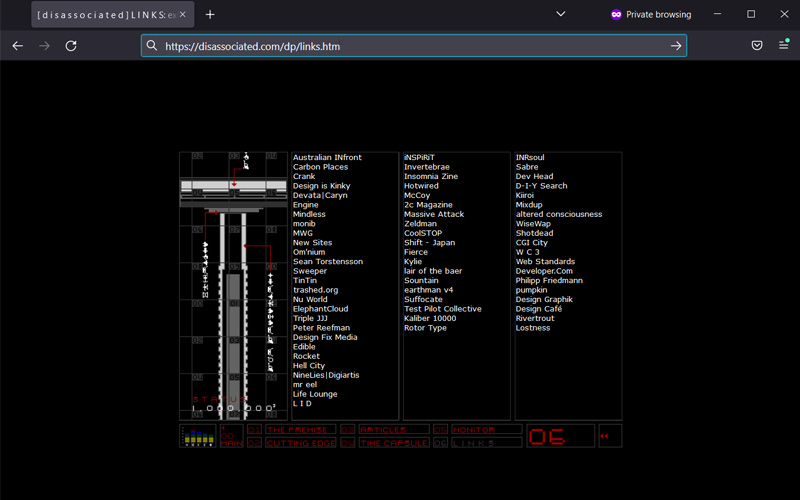
While I’m not one hundred percent sure we’re entering the end-days of social media, some recent talk of a resurgence in blogging, and a return to using RSS for content discovery, is encouraging. It’s kind of the web I know the best. But like anyone else, I can be found on the socials, Twitter and Mastodon, among them. I should add I’m an introvert, so my socials are relatively quiet. And no, the irony of that last sentence is not lost on me.
I first acquired the disassociated domain name, disassociated.com.au, in 1997. disassociated.com, meanwhile, came along in early 2003. But not before someone else, who’d bought the name, tried to sell it to me in the early 2000’s. But way back in the day, a person’s own website was always regarded the central pivot of their online presence. Pages on the early socials, Friendster, MySpace, and later Twitter, Facebook, and Instagram, were always seen as “outposts”.
As a web person you had presences there, because everyone else did, but they were not core to your overall online presence. And for good reason. The socials might have been public web-spaces, but they were privately owned. Fall foul of their terms of service, and you stood have your account suspended, or worse, permanently shut down. Sometimes without recourse, because you were in the realm of someone else who was setting the rules.
But no problem, you still had your largely untouchable core online presence, your website, at your own domain, which was self-hosted somewhere. Until we didn’t. The socials became too easy to use. They were free, and no hosting charges needed to be paid. Having a self-hosted website required some degree — no matter how little — of technical competence. Twitter and Instagram offered unlimited server capacity, ease of use, and, through their sprawling memberships, a multitude of potential followers. No more drawn out wrangling with SEO to find eyes to see your stuff, an audience was already present. You simply (sort of) had to make yourself known to them.
But before SEO and the socials came along, audience building was a little trickier. Website owners and bloggers were required to put in a lot more groundwork. In the late 1990’s I was writing blog posts before blogging was a thing. Back then we called these blogs online journals. To make ourselves known to other people then, we might write an online journal post about them, while linking to their website at the same time. Another option was through guestbook comments.
Guestbooks were one of the earliest methods of interacting with a website owner, and were hugely popular in the late 1990’s. There were akin to the comments section of a blog post, although the discussion was confined to a single page on a website, where the guestbook was situated. Another tried and true way of making yourself known to other website owners was by way of a links page. Above is the links page that featured on disassociated in late 1999. I know a lot of those links are gone now, but later on I might click links and see who is still around.
I guess you could say website link pages evolved into the blogrolls that once adorned the main pages, usually a side bar (which I stopped using about ten years ago) of a blog, when blogs per se arrived. The search engines however bought about the demise of the old school blogroll, from around 2007 or 2008. They were concerned many of the inclusions to what were the favourite websites of the blogger, were paid placements. In those earlier days, the search engines were also opposed to the practice of linking to so-called “bad neighbourhoods.”
Bad neighbourhoods were seen as websites having little, or no relevance, to the subject matter of the blog that linked out to them. For instance, it was seen as bad practice for a blog focussed on film production to link to a blog focussed on baking cupcakes. That could only be downright suspicious, couldn’t it? Too bad if the cupcake blogger was the significant other of the film production blogger, interlinking was simply unacceptable, and might earn you a slap down from a search engine.
Hopefully those days are behind us. The web is too vast and diverse a place for anyone to stay in their own lane. But blogrolls have been making a comeback. Not so much on individual blogs, but in the form of a number of aggregator websites, which are focused on content discovery, and the work of outstanding writers and bloggers. Chief among them are feedle, Blogroll, ooh.directory, and FeedLand, which is a feeds repository.
As I wrote on Twitter recently, “search engines are great for finding resources on topics of interest but scrolling through lists of blogs and randomly spotting something compelling is plain fun”. I for one am hopeful of a blogging renaissance, and other ways of discovering content, far from the shadows of the social media giants.
RELATED CONTENT
design, history, RSS, technology
Arthur C Clarke’s Newspad RSS news aggregator
30 May 2008
Author and futurist Arthur C Clarke is credited with predicting the emergence of a number of technologies, including a tablet-like device called a “Newspad”, which could serve the latest news stories from electronic versions of newspapers.
So far more has been said about comparing the Newspad to PDAs or Tablet PCs, but the Newpad also worked in a very similar way to today’s news aggregators, or RSS feed readers.
In the novelised version of 2001: A Space Odyssey, (chapter title “Moon Shuttle”, pg 66-67) Dr Heywood Floyd, chairman of the US National Council of Astronautics, spends time reading on his Newspad, while traveling to the Moon.
Floyd sometimes wondered if the Newspad, and the fantastic technology behind it, was the last word in man’s quest for perfect communications. Here he was, far out in space, speeding away from Earth at thousands of miles an hour, yet in a few milliseconds he could see the headlines of any newspaper he pleased. (That very word “newspaper,” of course, was an anachronistic hangover into the age of electronics.) The text was updated automatically on every hour; even if one read only the English versions, one could spend an entire lifetime doing nothing but absorbing the ever-changing flow of information from the news satellites.
Not only did Arthur C. Clarke predict PDAs and Tablet PCs, he also foresaw the emergence of news aggregators, and RSS technology.
Originally published Friday 30 May 2008.
RELATED CONTENT
2001: A Space Odyssey, Arthur C Clarke, film, legacy, RSS, science fiction, technology