
Showing all posts about technology
No brainer: is consciousness a natural quality of the universe?
24 August 2026
Christof Koch, a German-American neuroscientist, posits consciousness is an attribute of the universe, rather than something spawned by creatures possessed of a brain.
Although somewhat left of field, the notion has raised eye-brows.
Yet if consciousness is universal, so to speak, can any entity capable of reasoning, perceiving, learning, creating, and what not, eventually, somehow, become conscious?
Few people think AI could ever achieve consciousness, but what of AGI, were that ever to come into being? If we were to take this idea to its logical, yet absurd outcome, that is.
RELATED CONTENT
artificial intelligence, psychology, science, technology
WordPress.com Education, supporting, encouraging younger bloggers
21 August 2026
WordPress.com Education, is an initiative launched earlier week, designed to give school students across the world resources to setup and maintain their own blog:
This isn’t a stripped-down classroom version of WordPress.com. The Student Plan includes plugin support, 6 GB of storage, backups, staging sites, SFTP/SSH, phpMyAdmin, and Studio Sync. Students learn and build with many of the same tools they’ll encounter working with WordPress professionally.
The student plan, which includes everything that comes with the free WordPress.com blogs, together with the subscription personal and premium plans, is free for the first year.
For sure, WordPress has its naysayers, but anything that encourages people, particularly school students, to give social media a rest, and engage more fully with the web, can only be a good thing.
Getting started as a blogger, which is the main thing, is simplified with out-of-the-box products like WordPress.com. Once someone has reached a certain level of proficiency they can always look into other options for publishing blogs and websites.
RELATED CONTENT
blogosphere, blogs, self publishing, technology
AI and apps, the tools used in 2026 to apply for work
20 August 2026
I can’t remember the last time I applied for a permanent full-time job, but it was in the years soon after I left school. I held a couple of these sorts of jobs, but have pretty much worked freelance since. Leads there have come through people I know, or even disassociated.
It’s fair to say I have no idea what the — for want of a better word — formal process is today.
The last time I had what most people would probably consider to a be a “normal” job interview, I sat before a three-person panel. Needless to say things are quite different in 2026, as Millie Muroi writes (in a pay-walled article) for The Sydney Morning Herald.
One-third of Australian companies are said to use AI in their recruiting today. And if the experience of applying for work, in this instance a casual role at a large Australian discount department store chain, is anything to go by, it seems you don’t encounter a single person. At least initially.
The process, which Muroi partly filmed (not pay-walled), involves typing responses to questions posed by an AI chatbot, from wherever you happen to be. No need to show up in person anymore. She later received an email offering some “personalised” insights, which was AI generated.
It is claimed this practice means everyone’s applications are “seen”, and responded to. Is that a plus?
I expect the recruiting stage conducted by the AI chatbot results in a shortlist of candidates, who, following vetting by a person in HR, would then go in for a face-to-face meeting.
I doubt white-collar recruitment occurs in the quite the same fashion, though AI no doubt sifts through applications, which probably have to be lodged through LinkedIn. Fingers crossed my current line of work holds up, as job hunting using LinkedIn is not something I would relish.
RELATED CONTENT
artificial intelligence, technology, trends, work
AI companies using rare books to train agents, while destroying them
19 August 2026
Emanuel Maiberg, writing for 404 Media:
A 404 Media investigation was able to reveal Amazon’s book buying operation, which hasn’t been previously reported, by placing a tracking device in a rare book we suspected would be acquired by an AI company for training data, and following it around the country to its final destination.
It’s one thing to use books to train AI without seeking the author’s permission, nor paying a royalty, but is there any need to destroy them as part of the process?
There is the point that being rare books, they may be older publications, and copyright has lapsed, but that still seems to be beside the point. I was about to suggest these titles be donated to schools or libraries, once no longer needed, but they’ve likely no longer in one piece.
Going further, the process strikes me as being a form of book burning. The AI companies are taking all sorts of liberties with copyrighted material, but destroying books takes bad form to new lows.
RELATED CONTENT
artificial intelligence, books, technology
AI scrapers use bogus URL tracking tags to make website visits seem legit
17 August 2026
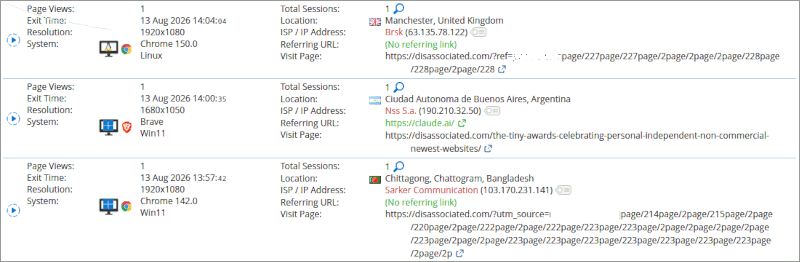
It looks like AI scrapers have been using a surreptitious method of making their marauding presence appear legitimate, this time by appending a bogus query parameter, or tracking tag, to the URL of the webpage they are targeting.
In the last month or so, I have seen a stack of page visit items looking something like this:
https://disassociated.com/?ref=yourwebsitepage/213page/page/page/ 14page/16page/page/2page…
I’ve replaced the actual website name with the generic yourwebsite marker in the above example.
What is particularly insidious though, is the way the crawlers are using the names of reputable websites and blogs that have linked to disassociated in the past.
Initially I thought some of these blogs had mentioned my website again, but after having a closer look at them, this is not the case. There’s also the detail that my web analytics app does not identify a referring page from the website supposedly sending visitors my way.
The frequency of visits doesn’t stack up either. I’m sure the blogs cited in the /?ref= parameter, that are supposed to be linking here, have many (human) readers, but I can’t imagine every last person, sometimes thousands of them, have been clicking through to my website.
Another possibility was my website had been shared in a newsletter. Usually though the URL query, or UTM parameter, I see in newsletters are along the lines of say ?utm_content, or ?utm_source.
One of the query parameters seen in the screenshot from my web analytics app does is ?utm_source though. However, with one exception I think, none the cited websites publish newsletters.
Also, if any of the cited websites were legitimately sending traffic here using a tracking tag, I doubt they’d use such a nonsensical URL path… page/14page/16page/page/2page… what?
It does puzzles me why these scrapers only seem to be targeting the front page of my website. Only a small amount of the total content posted here is visible there. But they’re AI bots, no doubt they know what they’re doing.
In the meantime, I’ll have to get used to seeing these analytics entries until I can figure out a way to block or mask them. That might be easier to say than do though.
But kudos (ironically) to Claude for acknowledging disassociated in response to a query about the Tiny Awards, in the above image. It’s much appreciated, truly, but doesn’t happen often enough.
RELATED CONTENT
artificial intelligence, technology, trends
LinkedIn CringeBot 3000, generating AI slop of the best quality
13 August 2026
Since the volume of slop-in-general is of epidemic proportions on the platform, it makes perfect sense an AI agent write actual AI slop for consumption there.
RELATED CONTENT
artificial intelligence, humour, social networks, technology, trends
Zuckerberg says AI will improve your relationships. Did an AI scam bot tell him that?
12 August 2026
Tangentially related to the previous post. A few days ago Meta CEO Mark Zuckerberg published the company’s latest AI vision. Or the one for this week at least. And the future is rosy, incredibly rosy.
If Meta has it their way, everyone will have access to their own “exceptionally capable” agent — must Meta use URLs that look like someone typed out a random string of keyboard characters? — (edit: URL amended) that seemingly will be able to help with anything at all:
Everyone will have an exceptionally capable personal agent that understands you, your goals, and everything you care about. Your agent will work 24/7 on your behalf to improve your relationships, health, career, finances, home management, hobbies, and more.
But I’d be concerned about the relationship advice this agent intends to dispense.
As we learned from my post yesterday, some AI agents, particularly those attempting to scam people, specialise in faking relationships. One can only hope Meta’s relationship guidance agent is not taking cues from such scam agents.
RELATED CONTENT
artificial intelligence, technology
AI scam bots better at faking relationships than human scammers
11 August 2026
There’s good news and there’s bad news, but in reality not much is really good. The good, such that it is; AI bots could well put scammers out of work.
The bad; the AI scammers are far more effective at deceiving people.
Disturbingly though, these are scams that involve entering into a fake relationship with the intended victim. In other words, AI bots appear to be better at faking human relationships than people.
Take a minute to think about that.
The human scammers, meanwhile, having been put out work, might instead look for an honest way to make a living. That would be a plus.
But here’s the problem. If AI scammer bots are so adept at tricking people, what else might they be capable of? Putting yet more people out of work? Or is there nothing whatsoever to worry about?
RELATED CONTENT
artificial intelligence, security, technology
Deserts, sea water, the AI data centre problem solved. Seriously
10 August 2026
Tech bros across the world have been giving everyone a right ear-bashing in the last few years about their AI agents, and the need for data centres to power them. And they’ve been crying foul in response to the environmental concerns many have expressed.
Tech bros worldwide are annoyed we don’t want to share our power and water supplies with them.
They’re unhappy we don’t want their data centres near the places we live, work, and send our kids to school. The tech bros are furious that we cannot seem to grasp the big picture. A prosperous and happy future of one-hundred percent dependence on their AI technologies is worth a few sacrifices.
Is it not?
Can’t we, the little people, cut back on our water and power consumption? Can’t we accept a little bit more climate change precipitated by water and power hungry data centres, is a small price to pay?
Wait up. Did I just say climate chnage? The phenomenon wreaking all sorts of havoc across the world, the driver of rising sea levels, temperatures, and unpredictable weather? Is not that sort of stuff the answer here? Not wild storms, and destructive bush fires.
No, I mean rising sea levels and warmer temperatures. Warmer temperatures must be the result of more sunlight getting through, right? That’s logical, isn’t it? Can you see what I’m getting at? You can’t be a much smart tech bro, if you don’t. That extra sunlight can be put to good use.
So people don’t want data centres near where they live. Fair enough. Who wants their golf club to make way for one? Not the tech bros. The solution is obvious. Build the data centres where no one lives. Like a desert. Ok, sure. But what about power? There’s no power infrastructure in the desert.
No problem. Build large solar panel arrays. No one lives in the desert, so no one will be around to complain about the solar panels. Ditto the data centres. But wouldn’t the cost of solar panel arrays be prohibitive? Sure, but again, no problem. Simply increase the price of AI tokens. Just slightly.
That solves the power problem. What about water? There’s gnenerally not much water in a desert. And, depending who you listen to, AI data centres either use enormous quantities of water, or hardly any at all. Either way, people don’t want thirsty data centres guzzling any amount of water.
What to do? The solution is obvious.
Pipe it in. End of story. That’s not really the end of the story, but anyone, even the little people, can surely see the logic. Sea levels are rising. That means there’s plenty of water at hand. But AI data centres in the desert may be hundreds, if not thousands of kilometres, from the ocean.
No problem, pipelines are still the answer. If something like the Guildford West pipehead and water supply canal, in the west of Sydney, Australia, can be brought into being, the tech bros can do something similar out in the desert. Bonus points if gravity feeds alone can somehow be used.
Sure, the Guildford West system is only about sixteen kilometres total length. But if pipes can span sixteen kilometres, simple logic says they can go further. And don’t forget about the East–West Pipeline in Saudi Arabia, which is about twelve-hundred kilometres long.
But wouldn’t the cost of building massive pipe systems be prohibitive? Sure, but again, no problem. Simply increase the price of AI tokens. Just slightly.
I think we’ve covered off everything.
The tech bros can have their data centres, and the rest of us won’t even know they exist. Plus one or two problems occasioned by global warming will be resolved. Well, maybe one. If you believe the ocean can be drained with a tea cup.
Of course, I expect no one to take any of what I said the least bit seriously. Really I don’t. Particularly the tech bros who want to solve this very problem. Besides, they don’t read my website.
But perhaps I speak too soon. They might ask one of their AI agents about the feasibility of building data centres in the desert, in the manner I’ve prescribed. Then they might learn about this suggestion, since my website’s content is scraped all too often by their AI bots.
Can I then expect the tech bros offer me any recompense? Anything at all. A single lousy AI token even? Yes, I’m quite certain that will happen. When hell freezes over.
RELATED CONTENT
artificial intelligence, climate change, technology
Show me an intelligent social media platform; I will show you a dead platform
5 August 2026
Jorijn Schrijvershof’s decision to close the Mastodon instance toot.community, which he established in late 2024, highlights many of the difficulties facing instance administrators on the decentralised social media platform:
Every day, I deal with spam, bots, technical issues, abuse reports, and user conflicts. Much of the moderation ends up being about personal disagreements rather than actual rule-breaking.
As I wrote last week, anyone can set up a Mastodon instance if they want to, but the majority are labours of love, including Aus Social, of which I am a member. They’re not money-spinners.
Unlike centralised social media platforms, such as Twitter/X and Threads, Mastodon instances are usually funded by their founders, together with any donations members might make:
There’s also the financial side. I’m very grateful to everyone who donated, but donations haven’t covered costs for a long time. I’ve had to shoulder most of the expenses, time, and responsibility myself.
It’s also a mistake to believe Mastodon is an oasis of thoughtful and considerate discourse. It isn’t always. There’s nothing wrong with robust discussion, but hostility and antagonism is another matter, even if it’s not of quite the same intensity present on other platforms.
Conflict may not be widespread across Mastodon, but dealing with it, as a someone who is effectively a volunteer admin, is time consuming, and disheartening:
More importantly, I don’t enjoy how people interact on social media anymore. Too often, conversations turn hostile or confrontational. A small amount of conflict and bad actors takes up a disproportionate amount of time and energy.
This was this idea, in the early days of Mastodon and Bluesky, that things would be different, better.
People migrating there thought they were leaving conflict and hostility that was rife elsewhere, behind. And for a time things did feel different. Interactions were relatively civil. There were those who feared this state of affairs would not last though.
But social media is social media, no matter what the platform. Wherever people congregate online, antagonism is seldom far away. As with bad news, discord sells.
The operators of the commercial, centralised platforms, relish tension. It brings in the punters, it engages (and enrages) them. And if the conversation only ever goes in circles, who cares?
Someone once said something like “show me an intelligent TV show, and I’ll show you a dead TV show.” I don’t recall the precise wording, but that was the gist of the quote.
Might it have been Kerry Packer or Rupert Murdoch?
It seems though the same principle applies to social media platforms. But antagonism is not restricted to social media, it’s rampant across the web, to the point it seems endemic to the web.
You don’t need to be a detective to work out why either. The low barrier to entry. The ease with which identities can be concealed. These are of course also advantages, but suit bad actors nicely. People, who supposedly, wouldn’t behave so poorly in face-to-face interactions. Supposedly.
And since every last user of a decentralised social media platform is unlikely to adhere to community guidelines, we’re probably going to see more Mastodon instances close. As with toot.community, trolls and disputes between members won’t be solely to blame, but they’ll be contributing factors.
There’s a thought that social media will kill itself eventually. Users are railing against heavy handed algorithms, abundant AI slop, and misinformation, among other annoyances.
But that day seems far off. Big tech will continue supporting the centralised platforms where the problems are at their worst, particularly if they remain profitable.
Sadly, it’s the not so well resourced decentralised social media platforms that are more at risk of being “killed” though, unless they can receive more support.
RELATED CONTENT