Say what you will about large shopping centres, those monuments to consumer greed with maze-like floorplans (quite deliberate by the way), but they have their adherents. And not just those hoping to be spotted in the queue as they await admittance to one of the centre’s luxury retailers either.
It’s not hard to see why either, especially for avid walkers. The size of larger centres — where walkable floor space, split across multiple levels, can potentially amount to several kilometres — make for ideal all-weather exercise circuits, for those calling themselves mall walkers. Back in the 80’s and 90’s when the popularity of mall walking was at its peak, organised groups of walkers would descend on the malls daily, usually soon after opening time.
The mall, in its quiet early hours, provides affordances most cities and suburbs cannot: even, open walkways, consistent weather, bathrooms and benches. The mall is also “safe,” as Genevieve Bogdan told The New York Times in 1985; the Connecticut school nurse was “apprehensive about walking alone outdoors early in the morning before work.”
This is something I partake of during lunchbreaks, when I’m in Sydney, and working from the food court of a shopping mall in the city’s east. It takes about twenty-five minutes to complete a circuit, and on a quiet day I might go around twice. By my estimations, I might cover close to five kilometres.
While I’m not there so much post pandemic, I used to notice others clearly doing the same thing. I’d regularly see the same people, pacing the walkways, during what I supposed was their lunchbreak. I’ve also seen one or two people posting on Twitter, saying something to the effect of “I’m doing a lap or two of the centre.” I’m not sure if organised walking groups are present though, as I’m usually there later in the day, and it sounds like they’re active earlier on.
But the future doesn’t look hopeful for latter-day mall walkers, at least in the United States. In 2020, CNBC reported up to twenty-five percent of malls in America face closure over the next few years. I’m not sure what the outlook is for shopping centres in Australia. I would say we’ll see some closures, as American trends tend to copy over here, even if there’s a lag of several years.
The winner of the 2022 Miles Franklin literary prize will be announced on Wednesday 20 July 2022, and to mark the momentous occasion I’ve remixed the disassociated logo with the Miles Franklin hues of blue for this week.
I’m a big fan of literary awards, as they’re great places to find quality reading suggestions. Of the six titles on the 2021 shortlist, I’ve so far read The Labyrinth by Amanda Lohrey, the 2021 winner, plus Lucky’s by Andrew Pippos, The Inland Sea by Madeleine Watts, and The Rain Heron by Robbie Arnott.
A teaser/trailer for the upcoming Amazon produced TV series The Lord of the Rings: The Rings of Power. Although a continuation of The Hobbit and The Lord of the Rings stories, written by late British author J. R. R. Tolkien, which are set during the Third Age of Middle-earth, events of The Rings of Power take place thousands of years earlier, in the Second Age.
[The Rings of Power] begins during a time of relative peace and covers all the major events of Middle-earth’s Second Age: the forging of the Rings of Power, the rise of the Dark Lord Sauron, the fall of the island kingdom of Númenor, and the last alliance between Elves and Men.
While Tolkien didn’t write specifically about the Second Age, the series is based on mentions of the era featured in the appendices of The Lord of the Rings. And unlike Tolkien’s vision of the Second Age which spanned thousands of years, The Rings of Power will play out over a far shorter timeframe.
The biggest deviation the writers made from Tolkien’s works, which was approved by the estate and lore experts, was to condense these events from taking place over thousands of years into a short time period. This was to avoid the human characters frequently dying throughout the series due to their relatively short lifespans, and to allow major characters from later in the timeline to be introduced earlier in the series.
The first series of The Rings of Power goes to air on Friday 2 September 2022.
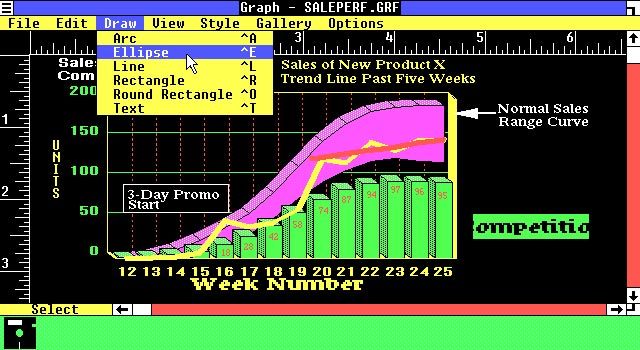
The image above is the Micrografx Windows Graph interface, which was released in 1987, used to create graphs and charts on computers running the Microsoft Windows 1 operating system, which launched in 1985.
While some people might say the bold fluorescent pink, green, and yellow colours against the black background clash, the more you look at them, the better they begin to look.
With the abundance of music in a variety of formats, vinyl, digital optical disc data storage (i.e. compact disc), and digital audio for instance, why is there a need take such a step in the first place? The thing is, none of these storage formats last all that long:
By Microsoft’s estimation, hard drives protect data for five years before they can go bad. Tape lasts about a decade, while CDs and DVDs can make it as long as 15 years before their contents are at risk of becoming illegible. While we seem to live in an age of progress — the iPhone can store thousands of songs in your pocket and stream countless more from the cloud — even in the best of cases, those songs will deteriorate millennia earlier than hieroglyphics carved into stone by the ancient Egyptians.
To conserve the music stored in the music vault — which incidentally will be located not far from the Global Seed Vault on the Norwegian island of Spitsbergen — compositions may be etched into quartz glass, using technology developed by Microsoft to store data as 3D patterns in a glass platter:
Microsoft begins with quartz glass, a high-quality glass that features a symmetrical molecular structure, which makes it far more resilient to high temperature and pressure than the glass in your home’s windows (and, like all glass, it’s immune to the electromagnetic scrambling of nuclear weapons). Then, using a femtosecond laser — a laser that can fire for one quadrillionth of a second — Microsoft etches information as 3D patterns into the glass. Once this data is stored, another laser reads the quartz, as machine learning algorithms translate the pattern back into music, movies, or any other digital information.
Mini-forests are more likely to nurture ecosystems, rather than single trees planted here and there, and, as a result, live longer. And better still, mini-forests can be established anywhere, even in densely populated urban areas, where there’s even a few spare square metres of land available.
A mini-forest is a small ecologically robust forest that can be planted by communities in parks and cities, in schoolyards and churchyards, and beside busy roads. It’s flipped traditional landscaping on its head. You get more biodiversity and a different appearance. It’s a dense band of multi-layer trees as opposed to the elegant but less ecologically useful line of single species down the side of the street.
Lewis’ call is based on the work of late Japanese botanist Akira Miyawaki, who advocated the planting of small forests with native species, as a way of fostering the emergence of ecosystems.
Ukrainian soldiers have been using e-bikes, specially modified to carry light anti-tank weapons, in the defence of their country from Russian invaders. The e-bikes allow defenders to move both quickly, and crucially, quietly, to positions where they are needed.
Soldiers on electric bikes have been spotted across Ukraine since the early days of the war, mostly on ELEEK brand bikes. e-bikes are fast and, critically, much quieter than a gas powered bike. They allow soldiers to perform quick guard patrols or move swiftly into position.
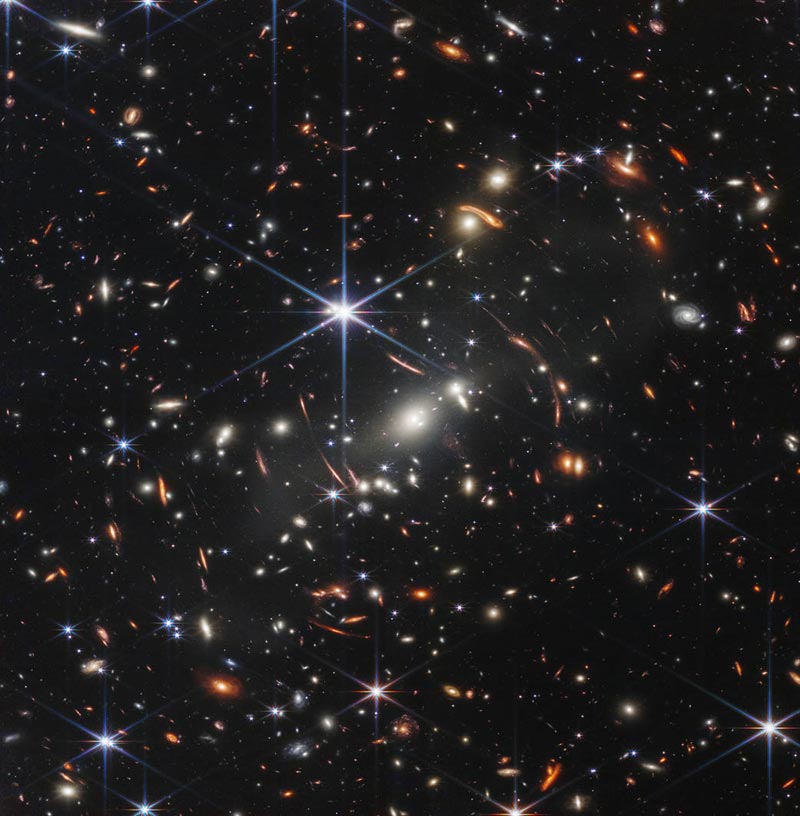
The first operational JWST photo is of the SMACS 0723 galaxy cluster, which is a little over five billion light years distant. Incredible isn’t it? The cluster seems far closer. What we’re really seeing here though is a snapshot of the cluster as it appeared five billion years ago.
Check out the red streak, that looks a little like a forward-slash towards the bottom centre. According to Rebecca Allen, an astronomer at Swinburne University of Technology, this was a galaxy with many of its stars still forming. Five billion years later, it might look like our galaxy, the Milky Way, today.
Image courtesy NASA, ESA, CSA, STScI, Webb ERO.
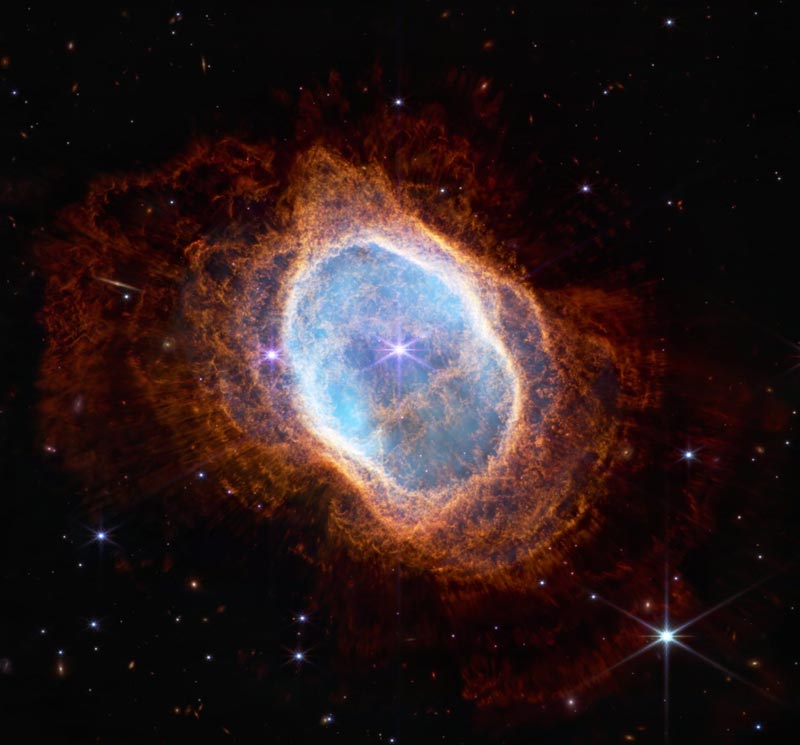
This picture of the Southern Ring Nebula, also known as Eight-Burst Nebula, and Caldwell 74, depicts the death throes of a binary star. The cloud of dust, hydrogen, and ionised gas, surrounding the binary is about half a light year across.
Image courtesy NASA, ESA, CSA, and STScI.
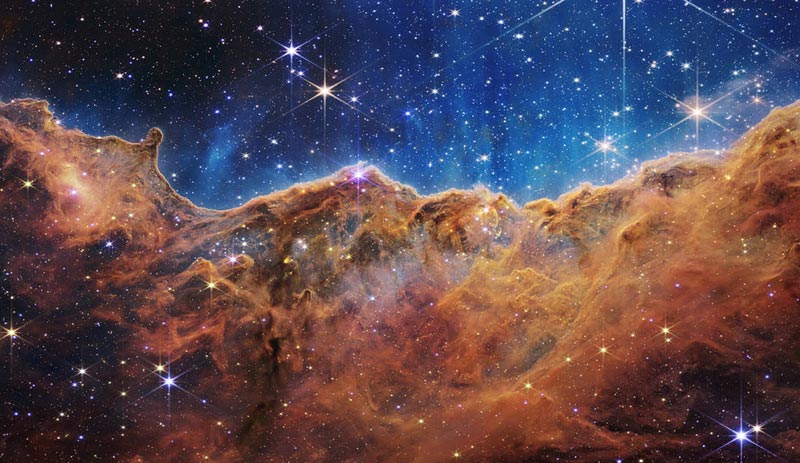
The Carina Nebula, situated some 8500 light years from Earth, is the sort of image we love seeing from deep space telescopes. Brimming with colour, pearly bright stars in the foreground, and intrigue, these nebulae are akin to intricate tapestries.
Image courtesy NASA, ESA, CSA, and STScI.
Hands up who’s hanging out for the next batch of JWST images…
For many people the LHC is most notable for finally confirming the existence of the elusive Higgs boson, nicknamed the goddamn particle by some scientists, on account of the difficulty they had finding it. The discovery though wasn’t quite the missing piece of the puzzle physicists expected it to be, says Dr Mitesh Patel, a lead researcher at CERN, giving rise to the possibility a fifth force of nature may exist, over and above the presently accepted four.
And then there’s the Higgs boson itself: it’s much lighter than expected. “It doesn’t really make sense on its own,” Patel says. “Everything about it tells us its mass should be much heavier. So, is something keeping it low? That’s what makes us think there’s something else.”
But the plot thickens. Shortly before the LHC was deactivated for upgrade, Patel and his team were struggling to make sense of data they had gleaned from older LHC experiments. What they were seeing didn’t stack up against the tenets of the Standard Model of physics, used to account for the four forces of nature, being electromagnetism, the weak force, the strong force, and gravity, even if the Standard Model does not actually explain gravity.
In the subatomic realm, particles interact and change all the time. And, according to the standard model, those known as beauty quarks should decay as often into muons as they do into electrons. But on the CERN team’s measurements, they became electrons 15 per cent more often than the muons, suggesting something could be tipping the scales.
Scientists are hoping further LHC experiments will also tell them more about dark matter, which coupled with dark energy, makes up ninety-five percent of the universe. But gravity remains the mystery. Standard Model does not account for it, and scientists are puzzled as to why it is far weaker than the other forces of nature. But they have some mind-boggling suggestions as to why:
[Some] speculate whether dark matter is really the effects of matter in another universe – gravity leaking through a multiverse into our own. It sounds like a Marvel film but Patel says “there are decent foundations” for the theory, namely that scientists still don’t understand why gravity is so much weaker than the other three forces of nature. “So people have speculated that maybe gravity behaves differently because it’s spread out in other dimensions in addition to our own”.
It is possible insights into these puzzles may be forthcoming sooner rather than later, once the LHC is up and running again. This I am looking forward to.