Break out the coffee and the cake: a celebration is on the cards. Tomorrow, Threads, Meta’s answer — and much needed foil — to X/Twitter, notches up its first birthday. I was there as the platform began rolling out, and managed to score (just) a relatively low (five-figure) badge number. 98,522 for the record. These membership number badges were, for a time, displayed on a member’s corresponding Instagram (IG) page. Mark Zuckerberg’s IG page boasted the surely desirable number one badge.
But the badges have long since vanished, and Threads, after a few fits and starts, has taken its place — albeit if engagement is on the lower side — with the other micro-blogging style social media platforms, including Mastodon and Bluesky. And with one-hundred-and-seventy-five million active monthly users, it’s probably been a good first year for Threads.
In contrast, X/Twitter didn’t reach the same number of active monthly users until well into 2012, some six years after launching. But making these sorts of comparisons between Threads versus what was then Twitter, isn’t all that helpful. Twitter had to start from scratch. It was, just about, the first of its kind. I still recall some the discussions around X/Twitter, following its debut. A lot of people weren’t sure exactly what the platform was about, or what it was meant to achieve.
X/Twitter’s relatively slow uptake could be partly attributed to this bafflement that enveloped the platform. By the time Threads arrived though, we were all seasoned social media platform users. On top of that, it was a simple matter of clicking a button on your IG page, to become a Threads member. The boost IG and — to a lesser extent — Facebook, gave Threads, cannot be understated.
Aside though from posting what I call an online journal entry daily, I don’t really do much on Threads, or any of the social media platforms, for that matter. But I do get drawn into some of the conversations that appear, courtesy of the Threads algorithm, in my main feed. These posts are an intriguing combination of day to day happenings and situations. There are retellings of encounters with people nice, and not so nice. Of dating disasters, and weird goings-on at work.
In a sense, these posts from people I don’t follow, or even know of, are akin to the “suggested for you” content that litters many an IG feed. Somehow though, these Threads posts don’t seem quite as annoying, or intrusive, as the — and I won’t mince my words here — shit that features on IG. My big hope for Threads is that it doesn’t go the way of IG, which now borders on the unbearable. But Threads may become a little more IG-like in another way: the presence of ads.
While the prospect is apparently being considered, it may still be a year before ads begin making an appearance on the platform. To my mind, this is not so much a question of what happens, but rather, the way it happens. Threads needs to turn a profit. We, the users, cannot have this online playground to frolic on, without there being someway for Meta to pick up the tab.
Ads of some sort seem reasonable to me. As I say, it comes down to the way, rather than the what. Perhaps then there will be a measured approach to advertising. Or, worst case, perhaps not. The devil is very much going to be in the details here.
That’s the good news. Tory Shepherd, writing for The Guardian, says the recently discovered exoplanet, dubbed Gliese 12b, might be able to host liquid water. We all know what that means. If there’s water, there may be life. Gliese 12b is so named because it orbits a star called Gliese. Now for the bad news. Gliese is a red dwarf.
I personally don’t have a problem with red dwarf, or M-type, stars. They’re actually kind of cool. And common. Up to seventy-five percent of stars in the cosmos are thought to be red dwarfs. The star nearest to Earth, Proxima Centauri, is a red dwarf. And while most stars in the universe have relatively short lifespans — for instance the Sun, which is about half way through its ten billion year life — red dwarfs live for trillions of years.
The last stars — as we currently understand them, at least — shining in the universe, will be red dwarfs. Go the red dwarfs. But, the problem is any planets orbiting in a red dwarf’s habitable-zone, will be tidally locked. That is, only one side of the planet will face its host star. That half of the planet therefore, in this case Gliese 12b, will be overly warm, while the other, dark side, will be rather cold.
This may not be particularly conducive to life. But some scientists have suggested life on planets orbiting red dwarfs in the habitable-zone, may take hold near the day-night terminator. This is where it will be neither too hot, nor too cold. But this would be an extremely narrow corridor, somewhat limiting the chances of life, especially intelligent life, developing.
Then there’s the red dwarfs themselves. They’re prone to regularly emitting intense radiation flares, which could have the effect of sterilising the surface of nearby planets. This points to the likelihood of Gliese 12b not being all that habitable at all. I think we need to reserve our excitement for the discovery of habitable Earth size planets, for maybe when they’re found orbiting other types of stars.
The Melbourne based bookseller had become well ensconced in the Australian literary realm, since being founded about twenty-years ago. The company, which is also listed on the ASX (though trading of shares has been suspended), had been struggling financially in recent years though.
I might say that of U2, whose music I once really liked, especially the stuff they did in the nineties. Achtung Baby. Zooropa. Pop. Even 2000’s All That You Can’t Leave Behind. These albums mostly represented their electronic music phase. I’d have them on loop for days at a time.
I drew the ire of friends though who told me I needed to listen to their real work, their earlier stuff. From the eighties. Of course: the eighties. The only decade real music was made, apparently.
But back to U2. I tried to get into their really early stuff, but it wasn’t quite the same, as their… (then) newer stuff. Though I still spin (is that the word I’m meant to use?) New Year’s Day (nothing changes on New Year’s Day…), from time to time, usually in late December. Today though, in 2024 — not 1985, or whatever it was — U2’s more recent music, is worse than their older, nineties, stuff.
Since 2000, nothing by U2 has excited me. How to Dismantle an Atomic Bomb, no. No Line on the Horizon, ditto. Songs of Innocence (remember the iTunes release?), forget it. Songs of Experience, nope. And if I hadn’t have looked it up, I wouldn’t have known U2 released a new album — albeit a re-working of earlier songs — called Songs of Surrender, in 2023.
In contrast, I pre-ordered All That You Can’t Leave Behind, and was outside the music shop before opening, on release day. The guy behind the counter, who (coincidentally) was Irish, and a U2 fan, told me this album was different from their previous three, and would take a few listens to enjoy.
And he was right. I did come to enjoy it. But that was over twenty-years ago. Today though, I barely listen to any U2 (except while writing this). None of it, however, fits into the category of being “gold”, as Nick Heer writes, compared to the new music being recorded by other artists in 2024. A lot of old music might be good, but that doesn’t necessarily mean it’s better than contemporary work.
But the bashing of recordings made in 2024 goes on. It’s noise. It’s garbage. It’s getting worse. It’s too easy to make. Whoever said that has obviously never tried to record a song. In any era.
This is the reason I continue listening to Triple J, which predominately plays new and alternative music. It’s an Australian radio station, but I think anyone, anywhere, can stream it. The main point being, it is none of this “hits and memories” stuff. These are the good old days, not some past decade. They’re also more Billie Eilish than Taylor Swift, if that makes a difference.
But look, if you can’t stand today’s music, I suggest you lock yourself away with the songs of, say, the Mama’s and the Papa’s, a sixties act, and whose music is surely “golden age” enough for you. Please do so immediately, so the rest of us can go about enjoying today’s new stuff.
The shortlist for the 2024 Miles Franklin literary award for works of Australian fiction, was announced earlier today. Of the ten novels named on the longlist in May, the following six titles have been included today:
Only Sound Remains, by Hossein Asgari
Wall, by Jen Craig
Anam, by André Dao
The Bell of the World, by Gregory Day
Hospital, by Sanya Rushdi
Praiseworthy, by Alexis Wright
Each author will receive five-thousand dollars for making the cut. Kate Evans, writing for ABC News, describes this year’s shortlist as one of the most culturally diverse, and notes that should a woman author win this year, that will be eight times in a row a woman has won.
My money would be on Alexis Wright’s Praiseworthy, which has been doing well on the award’s circuit. The 2024 winner will be unveiled on Thursday 1 August 2024.
Given the choice, a regular person, like you or me, who decides they’d like to become a superhero, will choose teleportation as their superhero superpower. In preference to three other choices they could have made: mind-control, flight, or supernatural physical strength. This is the long-story-short conclusion of some recent research into the subject, by Julian J. Hwang and Dongso Lee.
I’m not so sure about teleportation as a superpower though. It would certainly be useful for travel, but for a superhero? I’d go for mind-control, or supernatural physical strength, instead. Wouldn’t either of those be more useful in subduing your foes?
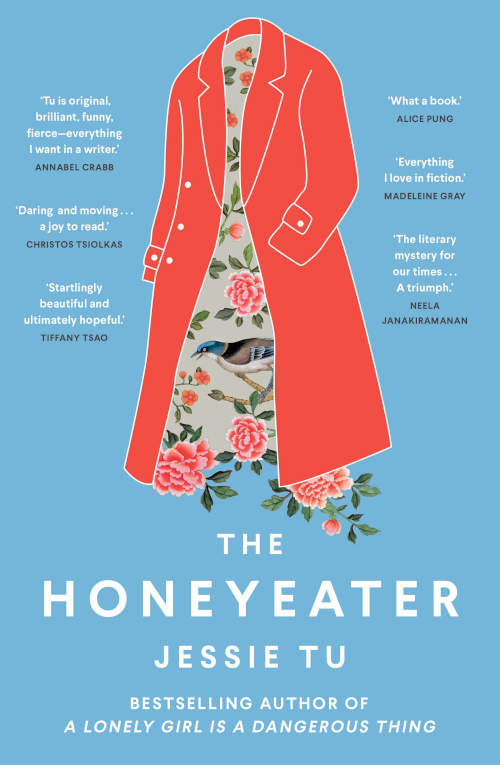
The Honeyeater is the second novel by Sydney based Australian writer Jessie Tu, and will be in bookshops on Tuesday 2 July 2024. That’s tomorrow.
I read Tu’s 2020 debut A Lonely Girl is a Dangerous Thing almost four years ago. It was the story of a once child prodigy musician, who wasn’t always successfully navigating life as a twenty-something adult. It often made for difficult reading. In contrast, The Honeyeater seems more like a thriller:
Young academic and emerging translator Fay takes her mother on a package tour holiday to France to celebrate her birthday. It’s a chance for the two of them to take a break from work and have a little fun, but they both find it hard to relax. Her mother seems reluctant to leave their room in the evening, and Fay is working on a difficult translation. On their last night in France, Fay receives the shattering news that her former lover has suddenly died.
Back in Sydney, Fay seeks solace from her mentor, Professor Samantha Egan-Smith, who offers her a spot at a prestigious translation conference in Taipei. But can she trust her? Does the Professor know more than she is admitting, or is Fay being paranoid? When a shocking allegation is made, Fay chooses to keep it secret. Is she protecting the Professor or exercising power over her?
Fay arrives at the conference in Taipei. Career opportunities abound, but it’s ghost month in Taiwan. Her mother had begged her not to go at that time, warning that she would be susceptible to dangers and threats. And there is almost nothing a mother won’t do to protect her child.
And coincidentally, Tuesday 2 July 2024 is also when the shortlist for Australian literary prize, the Miles Franklin, will be announced. Not that The Honeyeater will feature on that list, though who knows, it may in 2025.