
Could AI technologies be the end of writers and bloggers?
5 December 2022
For a long time it was believed the inevitable rise of automation technologies would bring about the end of repetitive and labour intensive jobs. Warehouse workers, drivers, and filing clerks would need to re-skill if they weren’t to be left unemployed.
But as digital and AI technologies evolved, the threat of being usurped by a computer moved up the ranks. An article published in The Economist in January 2014 (I couldn’t find an author credit, surely a machine didn’t write it?), warned that white collar professions such as accountants and doctors were also at risk:
Computers can already detect intruders in a closed-circuit camera picture more reliably than a human can. By comparing reams of financial or biometric data, they can often diagnose fraud or illness more accurately than any number of accountants or doctors.
Creatives meanwhile, writers and artists among them, always felt immune from these technologies. After all, how could a computer possibly produce an artwork, or write a book? Well, thanks to the likes of DALL·E and Jasper, we now know it’s possible. But creative output is not the limit of these technologies. They’re also capable of creative and problem solving… thought.
For instance, an application called Consensus, promises to seek answers, or consensus, to deceptively simple questions such as “is drinking coffee good or bad for my health?”, and potentially save hundreds, maybe more, of research hours. The app, once fully developed will be able to accurately scan multitudes of research papers on a particular topic, and deliver a pithy yet informative, summary in response to the query, says Derek Thompson, writing for The Atlantic:
Consensus is part of a constellation of generative AI start-ups that promise to automate an array of tasks we’ve historically considered for humans only: reading, writing, summarizing, drawing, painting, image editing, audio editing, music writing, video-game designing, blueprinting, and more. Following my conversation with the Consensus founders, I felt thrilled by the technology’s potential, fascinated by the possibility that we could train computers to be extensions of our own mind, and a bit overcome by the scale of the implications.
I expect in time AI technologies will be able to research and write the papers apps like Consensus will scan. But while AI apps can create artworks and perhaps write novels, will they really be any better at being creative? Let’s take blog writing as an example. A lot of people blog, but how popular are all these bloggers? We know some are more widely read than others. Their writing might be seen by hundreds of thousands of people, while other bloggers struggle to attract a handful of readers.
Just because, then, a machine writes something, does that mean the work will automatically have a larger audience? Will they cause every last writer on Earth to throw in the towel, and give up? I’m not so sure. Certainly the AI writers will improve, learn as they go, hone their craft, but will that result in more readers than an article written by a person? Maybe. Maybe not. Human and AI bloggers could be evenly matched. Of course, AI blogging apps will be able to research and write articles a lot faster, and that will be an advantage.
They’ll be able to publish an article on a given topic far more quickly than I can, and that work may rank on the search engines and elsewhere before mine. And that will suit some readers, but not all. And then we come to the human side of the process. Will readers be able to interact with the AI blogging app, as they can with human bloggers, through say email or social media? More crucially though, depending on the topic at hand, will an AI blogging or writing app, have the same authority to write as a person?
Could, for instance, an AI app write about raising a family? This is something most people learn about the hard way, by living through it. How could an AI blogging app possibly claim to be better qualified than a person, through “personal experience”, in this regard? How could the app ever gain the crucial trust to write on some subjects? This I suspect remains to be seen. At their core, AI apps are capable of thinking like people. For better or worse. I dare say, unfortunately, they will find a way.
RELATED CONTENT
artificial intelligence, creativity, psychology, technology, writing
Alcyoneus a sixteen million light year long radio galaxy
4 December 2022

Image courtesy of A Owen.
Alcyoneus, a galaxy located some three and a half billion light years from Earth, at over sixteen million light years in length, is — without putting too finer a point on it — staggeringly huge. Our home galaxy, the Milky Way, at a mere one hundred thousand light years long, is positively minuscule in comparison.
But Alcyoneus isn’t a sixteen million light year long container of stars and whatever else fills a galaxy. Alcyoneus is what’s known as a radio galaxy, and the bulk of its length comes from radio lobes, which are a little like jets of radio energy, that fire out from opposite sides, into the surrounding space.
At its starry core Alcyoneus, which is likely an elliptical galaxy (unlike the image of the spiral type galaxy I’ve featured above), may not be all that much larger than the Milky Way. And that’s probably a relief for members of Alcyoneus’ galactic council, who only have to travel several hundred thousand light years to visit their constituents, rather than multiple millions.
If radio galaxies intrigue you though, Universe Guide has put together this explainer.
RELATED CONTENT
The Booker Prize World Cup 2022
4 December 2022
If football/soccer isn’t your thing, but you love the thrill of elimination contests involving novels, you could always take a look at the Booker Prize World Cup:
We’ve selected, entirely arbitrarily, 16 winning books from the Booker Prize’s 53-year history, with each author representing a different footballing nation. In each case, the author is playing for their country of birth (which is more than you can say for the Qatar football team), and not necessarily the country with which they are best associated or where they live. We have drawn books against one another at random and in each ‘match’ — which will be posted on our Instagram and Twitter channels each day — we would like you to vote for the best book via a poll. The winning book will then progress to the next round. After the first round, there’ll be a quarter-final, semi-final and grand final.
The provision of each author playing for their country of birth is important, given South African born writer J.M. Coetzee, for example, has been an Australian citizen since 2006. Otherwise Peter Carey, with his 1988 novel Oscar and Lucinda, was Australia’s opening round representative.
While it could have been argued Australia was in with two chances, unfortunately as of the quarter final phase of the Booker Prize World Cup, both Carey and Coetzee had been eliminated. Such is life. Still, I’m waiting to see who wins. To take part, and support your favourite book, cast your vote via the Booker Prize Twitter or Instagram pages.
RELATED CONTENT
Booker Prize, books, literary awards, sport
Viva Magenta 18-1750 is the Pantone colour of the year 2023
3 December 2022

When I used to work in the web design shop, the announcement of the Pantone Colour of the Year was always highly anticipated. Mainly because everyone hoped their personal favourite colour would be chosen. It never happened to me, but I wasn’t fazed, there’s seldom a COTY I don’t like.
Anyway the colour (color?) of the year for 2023 is Viva Magenta 18-1750. I like it. The colour. And the name. To me, it sounds like the name of a planet that might feature in a sci-fi space opera movie franchise.
If you’re a designer though, here’s what you need to know to create Viva Magenta 18-1750. And to mark the momentous occasion on the design calendar, the disassociated website logo will be coloured Viva Magenta 18-1750 for the next little while.
RELATED CONTENT
For a hard boiled brew try deep fried coffee beans
3 December 2022
Instead of roasting some coffee beans, the more usual process for preparing beans for brewing, British coffee connoisseur James Hoffmann decided to deep fry a batch.
Like Hoffmann, I was unsure why anyone would actually, or ever want to, deep dry coffee beans, but his experiment is purely in the name of curiosity. After the beans have been fried, Hoffmann prepared two brews to sample. One by filter, the other by shot. All very interesting I’m sure, but I might stick to drinking roasted bean coffee…
RELATED CONTENT
Gaslighting named Merriam-Webster dictionary word of 2022
3 December 2022
Hopefully by making gaslighting their word of the year of 2022, online dictionary Merriam-Webster increases awareness of the the insidious practice:
Psychological manipulation of a person usually over an extended period of time that causes the victim to question the validity of their own thoughts, perception of reality, or memories and typically leads to confusion, loss of confidence and self-esteem, uncertainty of one’s emotional or mental stability, and a dependency on the perpetrator.
Merriam-Webster words of the year appear to be selected according to the number of lookups of the word in the previous twelve months. Oligarch, codify, and loamy, were also among those frequently enquired upon. But Loamy is an intriguing inclusion, because surely dirt and soil related matters wouldn’t be of much interest to a great many people. Well, you’d be surprised. Loamy found its spot in the limelight after being featured on word game Wordle earlier this year.
RELATED CONTENT
Sydney Modern builders become artworks by Richard Lewer
3 December 2022
The stunning new Sydney Modern Project, at the Art Gallery of New South Wales (AGNSW), opened to the public for the first time today. Replete with glass, metal, light tones, and large open, naturally lit spaces, on the upper levels at least, Sydney Modern was designed by Tokyo based Japanese architects Kazuyo Sejima and Ryue Nishizawa.
While much has been said about their contribution to the project, they are not alone in seeing their efforts recognised. Melbourne based New Zealand artist Richard Lewer spent time during construction of the gallery drawing some of the workers who brought the building into being.
I don’t know how often this happens, but now the industry and hard work of the building crew forms a collection titled Onsite, construction of Sydney Modern which resides on the lands of the Gadigal people of the Eora Nation, which can presently be viewed in the contemporary galleries at AGNSW.
RELATED CONTENT
art, Australian art, Richard Lewer
Spotify Wrapped 2022 into the genre-verse and Aussietronica
1 December 2022
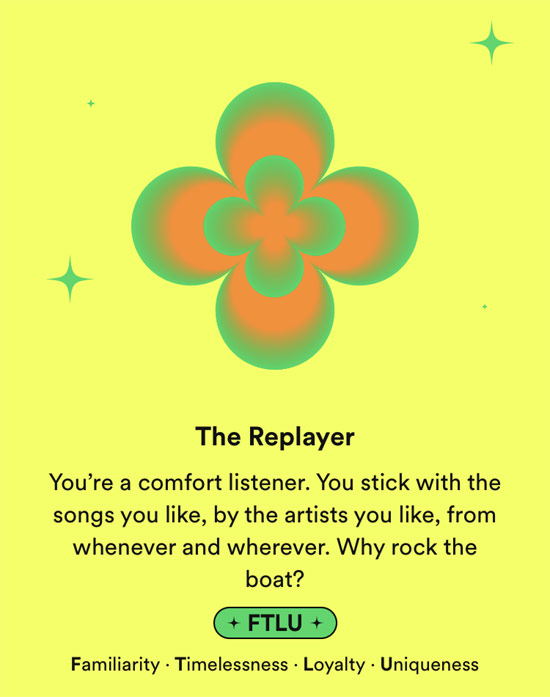
Spotify Wrapped for 2022 has dropped, and once again the music streaming service is bamboozling listeners with custom genre definitions and statistics that apparently place some listeners into what appear to be elite music listening categories. And it also looks like we have listening personalities.
One of my top genres — in what Spotify now call the genre-verse, a nod to Mastodon’s fediverse perhaps — is a genre dubbed Aussietronica. To spare scrolling pages and pages of search engine results, I’m going to take a punt here, because it seems quite self-explanatory, and state the obvious: this is Australian made electronica. I’d simply call it electronica, but have to admit Aussietronica is kind of cute, and maybe saves us from having to say “Australian made electronica” all the time.
And for a moment I thought I was kind of special when Wrapped informed me I was among the top five percent of listeners of Sydney based, yeah, Aussietronica act RÜFÜS DU SOL. I played their 2021 track Alive on loop earlier this year as I was re-booting disassociated. But a glance at Twitter trending revealed I was anything but special. Some people are finding themselves in even more exclusive bands, such as, but not limited to, point zero five percent.
I also learned I have a listening personality. To be precise I have a listening personality type, just like you (allegedly) have a Myers–Briggs type. My listening personality type, according to Spotify is F T L U, being Familiarity Timelessness Loyalty Uniqueness. The Replayer, they call me. The F and the L are doubtless a result of the aforementioned looping of Alive.
Listening personalities, all be they a gimmick, are kind of cool though. In fact I’ll go out on a limb and declare the Spotify listening personalities might just be a little more scientific than the other type indicator. But Wrapped is, according the Wikipedia page, a viral marketing campaign, so it is doing its job, getting the interwebs excited, once again, about our music listening preferences and habits.
RELATED CONTENT
Sydney act 1300 wins Triple J/RAGE music video of 2022
28 November 2022
And before another Ausmusic month, and November for that matter, falls behind us… Western Sydney based Korean rap act 1300 have won the music video of the year for 2022, with their clip Oldboy in the 2022 J Awards. The video was directed by long-time collaborator Raghav Rampal.
RELATED CONTENT
1300, Australian music, music, video
Trailer for Moja Vesna the debut feature of Sara Kern
27 November 2022
Moja Vesna is the slow-burning, deeply affecting, debut feature of Melbourne based Slovenian-Australian filmmaker Sara Kern, which premiered at the 2022 Melbourne International Film Festival. The trailer is certainly gripping.
In Melbourne’s outer suburbs, reticent Moja, her well-meaning Slovenian father Miloš and her volatile older sister Vesna all struggle to cope with the impacts of a significant death. But Vesna is in denial about the demands of late-stage pregnancy and Miloš barely speaks a word of English, so Moja is forced to assume the role of stabilising presence and cultural mediator — with little chance to mourn the loss of their mother.
Moja Vesna commences a theatrical season in Australian cinemas from today.
RELATED CONTENT