
Gabrielle Zevin wins Goodreads Choice best fiction award
9 December 2022
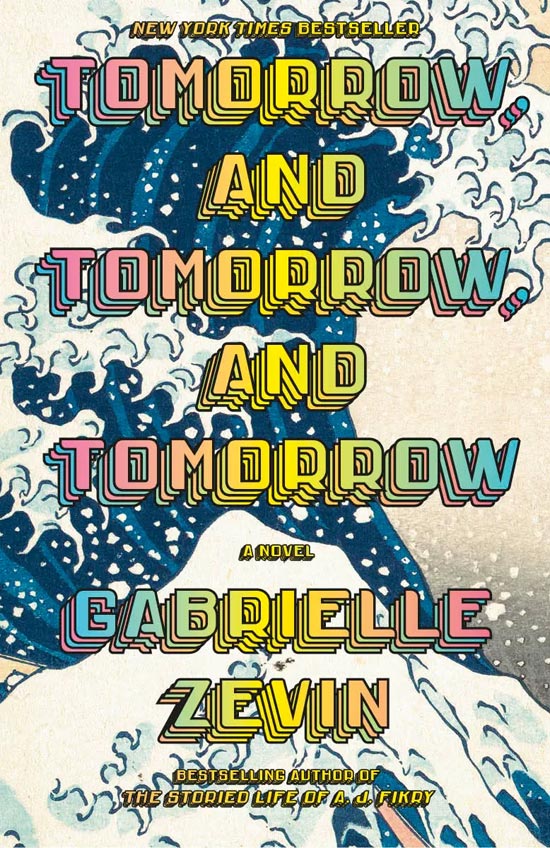
Los Angeles based American author Gabrielle Zevin has won the Best Fiction award in the 2022 Goodreads Choice Awards, with her latest novel Tomorrow, and Tomorrow, and Tomorrow, which was published by Penguin Random House earlier this year:
On a bitter-cold day, in the December of his junior year at Harvard, Sam Masur exits a subway car and sees, amid the hordes of people waiting on the platform, Sadie Green. He calls her name. For a moment, she pretends she hasn’t heard him, but then, she turns, and a game begins: a legendary collaboration that will launch them to stardom. These friends, intimates since childhood, borrow money, beg favors, and, before even graduating college, they have created their first blockbuster, Ichigo. Overnight, the world is theirs. Not even twenty-five years old, Sam and Sadie are brilliant, successful, and rich, but these qualities won’t protect them from their own creative ambitions or the betrayals of their hearts.
One of the games created by the characters in the novel, EmilyBlaster, has since become an actual game. Zevin’s book is on my TBR list, hopefully I get to it over the summer break.
Other titles to collect awards this year include The Maid by Nita Prose, which won in the Mystery and Thriller category, while Sea of Tranquility, by Emily St. John Mandel, won the Science Fiction award.
Goodreads members cast near on six million votes, in seventeen categories, for their favourite titles in the annual poll of books published in the last year.
RELATED CONTENT
books, Gabrielle Zevin, literary awards, literature, novels
Acting is not a glamorous career says Russell Crowe
7 December 2022
New Zealand born Australian actor Russell Crowe, also president of the Australian Academy of Cinema and Television Arts, speaking at the AACTA Awards this evening:
“The perception of glamour is merely a marketing tool that we take advantage of when it suits us. The reality of a creative life is workdays that never finish, crippling imposter syndrome, and the juggling act of trying to find a way to make your living in the gig economy,” said Crowe.
RELATED CONTENT
Australian film, film, Russell Crowe
Elvis directed by Baz Luhrmann wins eleven AACTA Awards
7 December 2022
Australian filmmaker Baz Luhrmann has cleaned up at the Australian Academy of Cinema and Television Arts (AACTA) Awards, held at Sydney’s Hordern Pavilion tonight, with his latest feature Elvis.
Among the eleven ACCTA Awards haul for the Elvis Presley biopic, were best director, best film, best lead actor, going to Austin Butler in the title role, and best supporting actress to Olivia DeJonge, for her portrayal of Priscilla Presley.
Other productions to be recognised included The Stranger, The Drover’s Wife The Legend of Molly Johnson, and River, which won the best documentary ACCTA. Full list of winners here.
RELATED CONTENT
Australian film, Baz Luhrmann, film
Half of Australian mid career artists considering career change
7 December 2022
A recent survey of the Australian arts sector (PDF) reveals that slightly over half of mid-career artists are either considering leaving the arts, or are already retraining, so they can take up work in another sector all together.
Low rates of remuneration appear to be prompting a number of veteran independent artists and creatives to look elsewhere for opportunities:
In the words of one anonymous respondent: “I am retraining into the medical administration sector and will not be working in the arts anymore. That is a career of nearly 40 years gone due to the inability to survive financially.”
RELATED CONTENT
Australian government to review copyright enforcement laws
7 December 2022
Mark Dreyfus, the Australian attorney-general, says he will conduct a review of Australian copyright laws to ensure the income of artists is maintained, and copyright protections align with changes in technology that now allow the work of artists to be accessed across multiple platforms.
Technology means we can now all enjoy music, television, movies, books and art at the tap of a finger. Australia’s creative industry needs an effective copyright system that keeps pace with new technology and protects creators and other copyright owners from the unauthorised use of their works. This review will consider whether the copyright enforcement mechanisms in our laws remain appropriate, effective and proportionate.
RELATED CONTENT
Australian art, copyright, technology
Never revisit your past that includes NaNoWriMo manuscripts
7 December 2022
British journalist and writer Tim Jonze on participating in NaNoWriMo 2021, meeting the fifty-thousand word target in the requisite thirty days of November, and then… reading the work — for the first time — a year later:
Well, it’s been a year since NaNoWriMo. Could this book really be as bad as I imagined? Amazingly, the answer is no.
It is much, much worse.
Aside from the fact I could not meet the average 1,667 daily word requirement, to successfully complete NaNoWriMo, reading what I’d written, would be the other reason why I’d not take part.
RELATED CONTENT
books, events, literature, writing
Vale Australian poet Antigone Kefala
6 December 2022
Antigone Kefala, an Australian poet of Greek-Romanian heritage, died on Sunday 4 December 2022, aged 92. Kefala was only two weeks ago named winner of 2022 Patrick White literary award.
RELATED CONTENT
Antigone Kefala, Australian literature, poetry
A return to blogging RSS and blogrolls for content discovery
6 December 2022
While I’m not one hundred percent sure we’re entering the end-days of social media, some recent talk of a resurgence in blogging, and a return to using RSS for content discovery, is encouraging. It’s kind of the web I know the best. But like anyone else, I can be found on the socials, Twitter and Mastodon, among them. I should add I’m an introvert, so my socials are relatively quiet. And no, the irony of that last sentence is not lost on me.
I first acquired the disassociated domain name, disassociated.com.au, in 1997. disassociated.com, meanwhile, came along in early 2003. But not before someone else, who’d bought the name, tried to sell it to me in the early 2000’s. But way back in the day, a person’s own website was always regarded the central pivot of their online presence. Pages on the early socials, Friendster, MySpace, and later Twitter, Facebook, and Instagram, were always seen as “outposts”.
As a web person you had presences there, because everyone else did, but they were not core to your overall online presence. And for good reason. The socials might have been public web-spaces, but they were privately owned. Fall foul of their terms of service, and you stood have your account suspended, or worse, permanently shut down. Sometimes without recourse, because you were in the realm of someone else who was setting the rules.
But no problem, you still had your largely untouchable core online presence, your website, at your own domain, which was self-hosted somewhere. Until we didn’t. The socials became too easy to use. They were free, and no hosting charges needed to be paid. Having a self-hosted website required some degree — no matter how little — of technical competence. Twitter and Instagram offered unlimited server capacity, ease of use, and, through their sprawling memberships, a multitude of potential followers. No more drawn out wrangling with SEO to find eyes to see your stuff, an audience was already present. You simply (sort of) had to make yourself known to them.
But before SEO and the socials came along, audience building was a little trickier. Website owners and bloggers were required to put in a lot more groundwork. In the late 1990’s I was writing blog posts before blogging was a thing. Back then we called these blogs online journals. To make ourselves known to other people then, we might write an online journal post about them, while linking to their website at the same time. Another option was through guestbook comments.
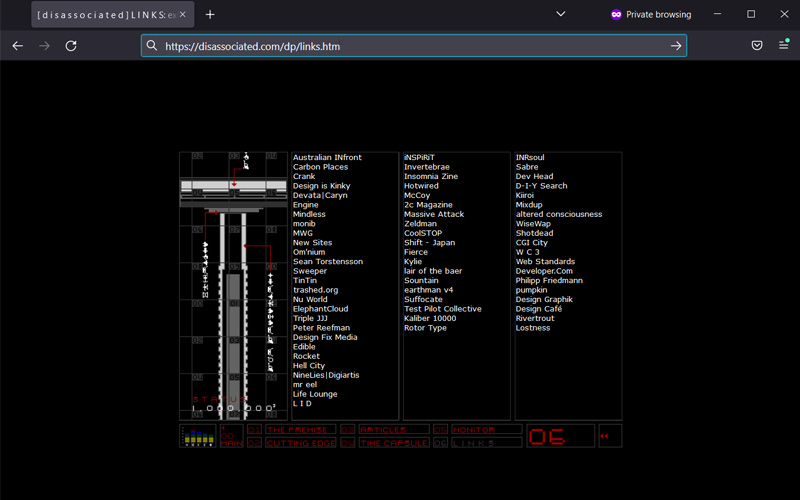
Guestbooks were one of the earliest methods of interacting with a website owner, and were hugely popular in the late 1990’s. There were akin to the comments section of a blog post, although the discussion was confined to a single page on a website, where the guestbook was situated. Another tried and true way of making yourself known to other website owners was by way of a links page. Above is the links page that featured on disassociated in late 1999. I know a lot of those links are gone now, but later on I might click links and see who is still around.
I guess you could say website link pages evolved into the blogrolls that once adorned the main pages, usually a side bar (which I stopped using about ten years ago) of a blog, when blogs per se arrived. The search engines however bought about the demise of the old school blogroll, from around 2007 or 2008. They were concerned many of the inclusions to what were the favourite websites of the blogger, were paid placements. In those earlier days, the search engines were also opposed to the practice of linking to so-called “bad neighbourhoods.”
Bad neighbourhoods were seen as websites having little, or no relevance, to the subject matter of the blog that linked out to them. For instance, it was seen as bad practice for a blog focussed on film production to link to a blog focussed on baking cupcakes. That could only be downright suspicious, couldn’t it? Too bad if the cupcake blogger was the significant other of the film production blogger, interlinking was simply unacceptable, and might earn you a slap down from a search engine.
Hopefully those days are behind us. The web is too vast and diverse a place for anyone to stay in their own lane. But blogrolls have been making a comeback. Not so much on individual blogs, but in the form of a number of aggregator websites, which are focused on content discovery, and the work of outstanding writers and bloggers. Chief among them are feedle, Blogroll, ooh.directory, and FeedLand, which is a feeds repository.
As I wrote on Twitter recently, “search engines are great for finding resources on topics of interest but scrolling through lists of blogs and randomly spotting something compelling is plain fun”. I for one am hopeful of a blogging renaissance, and other ways of discovering content, far from the shadows of the social media giants.
RELATED CONTENT
design, history, RSS, technology
Literary authors are among the lowest paid Australian writers
6 December 2022
The recently released results of a survey of Australian authors and writers make for sobering reading. If you’re considering a writing career, you ought to sit down before reading on. With rare exceptions, most Australian authors need at least one other job to make their writing ambitions feasible.
Income per annum varies according the nature of their writing, anywhere from about A$27,000 for educational writers, down to A$14,500 for literary authors. Bear in mind the minimum annual salary in Australia is a little over $42,000, based on a rate of A$21.38 per hour.
Education authors earned the highest average income from their practice as an author ($27,300), followed by children’s ($26,800) and genre fiction ($23,300) authors. Even though these figures are above the overall average for authors, they are not enough to live on, to support a family, or to pay rent or a mortgage. At the other end of the spectrum are poets, who earned an average of $5,700 from their creative practice. Literary authors earned $14,500, which is a decrease in real terms since 2015.
In case you’re wondering, literary authors are likely the sort of author anyone who wants to write wants to be. They also tend to be winners of literary awards including the Stella Prize, Miles Franklin, SPN Book of the Year, and Patrick White Award. And yet they only earn about a third of the Australian minimum wage for their craft.
RELATED CONTENT
Australian literature, books, literary awards, writing
Storywizard an AI for creating instant kids bedtime stories
6 December 2022
Somewhat related to my last post… Storywizard is a generative AI story creation app, that composes bedtime stories for children, complete with images, in real time.
We all have vivid imaginations and great ideas, but it’s not easy to express them and put them into writing. We built Storywizard to help parents and kids bring their ideas to life.
RELATED CONTENT