
All day I dream about the Roman Empire, like many others
18 September 2023
All roads, even Roman roads, lead to TikTok. Take any topic, no matter how obscure, how antiquated, and the subject will, it seems, surface, eventually, on the FYP tab of the ubiquitous video sharing app.
Last week it was the turn of the Roman Empire to trend. The Roman Empire. Antiquated: for sure. Obscure: certainly not. But the talk of TikTok it was. This after women were prompted to ask the men they knew how often they thought about the Roman Empire.
Some of the responses indicated this happened often. Several times a day, in some cases, apparently. Not bad for an institution that hasn’t existed in any real form for centuries. I myself still think about the old empire from time to time. I spent time in Europe once, and often encountered its remnants, even though I did not (somehow) visit Italy.
As a boy I was fascinated, obsessed more likely, by Rome. History teachers at school taught us about the Empire’s contribution to the world we lived in today, a contribution that was quite significant. In a sense we live, to a degree, in a scion of Rome. Of course we therefore think about Rome often: it’s very much a part of the fabric of our lives, a point Tyler Cowan underlines at Marginal Revolution:
I travel in the former Roman empire fairly often, usually at least once a year. I see pseudo-Roman architecture almost every time I go to Washington, D.C., which is maybe once every two weeks. There is a copy of the new Ovid translation sitting in the kitchen, and it has been there for a few months because I do not currently have time to read it. I see periodic Twitter updates about a Nat Friedman-Daniel Gross AI project to read ancient Roman scrolls. Christian references to ancient Rome cross my path all the time. Does it count to see Roman numerals? To write the words “per se”? To notice it is the month of August?
But I was thinking about the old Empire just the other week. In particular, the story of a short story, titled Rome, Sweet Rome, written by American writer James Erwin. In 2011, Erwin briefly serialised a story about a unit of some two thousand United States Marines who find themselves transported two thousand years back in time.
The Marines turn up in Italy with all of their munitions and equipment. Rome, Sweet Rome speculates on the outcome of a battle between the Marines, and the legions of the Roman Empire. The result seems like a foregone conclusion until it is realised the Marines have no way of replenishing their arms. Once they fire their last bullet, they’re fighting the Romans with swords and spears.
It’s no surprise — given how much Rome is still on our minds — that Rome, Sweet Rome garnered quite a bit of attention. At one point Rome, Sweet Rome was even optioned for film, with US production company Warner Bros acquiring the movie rights. Unfortunately for fans of the story, there has been little progress with a screen adaptation, following a re-write of the screenplay in 2013.
But who knows. Perhaps TikTok’s current interest in the Roman Empire might get the ball rolling again. TikTok has a certain power to open doors, if it can excite the interest of enough people.
RELATED CONTENT
history, Roman Empire, social media, trends
Everything I know about floppy disks, by Jonathan Pallant
18 September 2023
Everything you wanted or needed to know about floppy discs. An awesome computer science history resource put together by British IT consultant Jonathan Pallant.
Floppy disk drives are curious things. We know them as the slots that ingest those small almost-square plastic “floppy disks” and we only really see them now in Computer Museums. But there’s a lot going on in that humble square of plastic and I wanted to write down what I’ve learned so far.
RELATED CONTENT
Survivalism is the most difficult form of survival
18 September 2023
Making it as a prepper, or survivalist, is not merely a matter of storing some canned food in dug-out somewhere, and watching a few YouTube videos on the subject, warns Jessica Wildfire:
We don’t think about where we’d go to the bathroom. We don’t think about how we’d filter our water. We don’t think about what we’d do without all these survival tools made in a factory somewhere.
RELATED CONTENT
Lando Calrissian story now to be told as a film, not a TV series
16 September 2023
The Star Wars origin stories keep a coming. Lando Calrissian, one timer owner of the Millennium Falcon, apparent scoundrel, administrator of Cloud City, and later a general in the Rebel Alliance, is set to feature in his own big screen production.
A Calrissian backstory has been on the cards for some time, but was originally to be the subject of a TV series. Last Thursday however, news broke that series producers, Disney+, had decided to opt for a movie instead. Donald Glover, who portrayed a younger Calrissian in the 2016 Star Wars film Solo: A Star Wars Story, will reprise his role in the proposed feature length origin story, which at this stage appears to be simply titled Lando.
But if producers feel a Calrissian origin story is necessary, let’s hope they get it right. Solo, starring Alden Ehrenreich in the titular role, was underwhelming. To say the least. Han Solo is a character who works best as a happy-go-lucky, fly-by-the-seat-of-his-pants enigma, of a, well, scoundrel, one of whom we knew little about, a point reiterated by Ben Sherlock, writing for Game Rant, in 2021:
Han’s introduction in the shadiest corner booth of Mos Eisley Cantina in the original 1977 Star Wars movie already tells us everything we need to know about the character. He’s an intergalactic pirate and smuggler who’s only interested in money; his best friend (and, seemingly, only acquaintance in the galaxy) is a Wookiee named Chewbacca; and he’s the captain of the Millennium Falcon, the ship that made the Kessel Run in less than twelve parsecs.
There’s a sea of characters in the Star Wars universe, many of whom are more deserving of origin stories. Take Wuher, owner of the infamous Mos Eisley Cantina, where we of course first met Solo. Wuher’s no ordinary guy working a bar though. His is a story that needs exploring, as I’ve said before.
RELATED CONTENT
film, science fiction, Star Wars
Reality is an illusion, we are the dream of a dead universe
14 September 2023
The latest Kurzgesagt video may — like a number of their recent offerings — still have an end of days theme, but at least the subject matter is a little more fanciful. Even if we’re talking about the eventual heat death of the universe, or as Kurzgesagt posits, the already happened heat death of the universe.
Bizarre right? But our (apparent) existence may in fact be a random manifestation of a dark, cold, universe. The night sky, the awesome images of the James Webb Space Telescope, and everything else that we seem to perceive and experience, is but a figment of our imagination. Life, the universe, and everything. It might as well be the name of science fiction book.
I guess then it was a waste of time booking a table at the restaurant at the end of the universe, being the title of late British author Douglas Adams’ 1980 novel. It would seem that event’s been and gone.
RELATED CONTENT
Karaoke, not the whisper, the heart of Lost in Translation
14 September 2023
It’s been twenty years since American filmmaker Sofia Coppola’s second full length feature, Lost in Translation, was released. Pretty much all anyone could talk about at the time was the whisper scene at the end of the film, when Bill Murray’s character, Bob, uttered a comment into the ear of Scarlett Johansson’s character, Charlotte.
Murray’s words were inaudible to viewers of the film, precipitating a flurry of speculation as to what he said. You name it, people have probably argued in support of it.
I still have Lost in Translation in my aging DVD collection, and maybe every year or so, we bring it out for a spin. But the more I see the so-called whisper scene, the more pointless it becomes. Bob clearly says something uplifting to Charlotte. Great. So why keep it hushed up?
As a way of getting people to talk about Lost in Translation? But that seems like overkill, a stunt even. The movie already has numerous talking points. The pairing of Bill Murray and Scarlett Johansson. Their character’s respective marriage problems. Why Charlotte’s husband left her languishing in a Tokyo hotel room, while he went gallivanting around Japan, apparently for work.
But Tom Nicholson, writing for Empire Online, suggests that the karaoke scene is perhaps Lost in Translation‘s most poignant:
The karaoke sequence is a much better embodiment of what the movie’s about — a beautiful bit of intimation and suggestion and just enough irony to stop anyone taking what’s said entirely seriously. Every karaoke song choice is a chance to tell your fellow singers something about yourself using other people’s words.
The songs sung in the karaoke scene were Brass in Pocket, originally recorded by The Pretenders, and More Than This, by Roxy Music. Using other people’s words then could make figuring out what Bob whispered to Charlotte a little easier, if you still want to.
RELATED CONTENT
Bill Murray, film, music, Scarlett Johansson, Sofia Coppola
The Kagi Search Small Web, promoting independent websites, blogs
12 September 2023
Kagi Search is a pay-to-use subscription search engine founded in 2022, that promises to deliver relevant search results free of extraneous clutter and adverts. Another plus is Kagi’s undertaking not to track users, or collect their data.
But Kagi isn’t only about locating pertinent information and protecting the privacy of users. Last week they launched Kagi Small Web, an initiative highlighting the writing of independent publishers and bloggers whose work is often cast aside by the prevailing algorithms, and omnipresent influencers:
Initially inspired by a vibrant discussion on Hacker News, we began our experiment in late July, highlighting blog posts from HN users within our search results. The positive feedback propelled the initiative forward. Today, our evolving concept boasts a curated list of nearly 6,000 genuine websites featuring people with a wide variety of interests.
I’m chuffed to say disassociated is one of the websites to be included. I’ve spent the last few days clicking through a fraction of the six thousand or so publishers they’ve linked to, and am pleased to see one or two familiar faces. What a great idea this is. Thank you Kagi.
RELATED CONTENT
blogs, self publishing, technology
Privacy warning: your car may be monitoring your sex life
12 September 2023
The Mozilla Foundation, which is part of the same organisation that produces the Firefox web browser, and the Thunderbird email client, recently examined twenty-five car brands, and found consumer privacy left — to put it mildly — much to be desired. In fact, the foundation discovered cars to be in the “official worst category of products for privacy” that they had ever seen:
Car makers have been bragging about their cars being “computers on wheels” for years to promote their advanced features. However, the conversation about what driving a computer means for its occupants’ privacy hasn’t really caught up. While we worried that our doorbells and watches that connect to the internet might be spying on us, car brands quietly entered the data business by turning their vehicles into powerful data-gobbling machines. Machines that, because of their all those brag-worthy bells and whistles, have an unmatched power to watch, listen, and collect information about what you do and where you go in your car.
Not only did the majority of car brands that were studied collect large quantities of personal data, they were also highly inclined to on-sell that information. But there’s more. Some car brands were found to be gathering information about the “sexual activity” of customers. In other words, if you’re thinking about having sex in your vehicle, think again. Your car may be monitoring, and recording…
RELATED CONTENT
Trailer for Foe, a film by Garth Davis, with Saoirse Ronan, Paul Mescal
11 September 2023
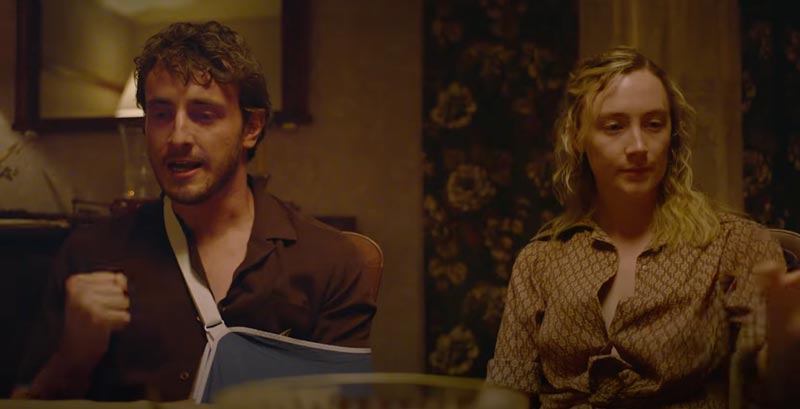
Still from Foe, a film by Garth Davis.
Foe, trailer, a science fiction psychological thriller, is the third feature of Australian filmmaker Garth Davis. Based on the 2018 novel of the same name, by Canadian author Iain Reid, and set in 2065, Foe tells the story of a married couple Hen (Saoirse Ronan), and Junior (Paul Mescal), who work on a secluded farm. Their lives, and happy marriage, are thrown into turmoil though when a stranger, Terrance (Aaron Pierre), arrives unannounced one day and informs them that Junior is to be sent to a space station for a year.
Hen however will not be left alone, a robot will be sent to keep her company during Junior’s absence. Terrance’s proposal, and the prospect of a human-like robot living with Hen for a year, quickly places a strain on the couple’s relationship. Foe, which opens in Australian cinemas on Thursday 2 November 2023, is certainly an intriguing conceit. What is behind Terrance turning up at the farm in the first place, and why is Junior required to spend a year living in space?
Ronan’s work speaks for itself, while Mescal’s recent performances include starring in Aftersun, and Normal People, a TV mini-series adaptation of Sally Rooney’s novel of the same name.
Update: Transmission Films advises that Foe opens in Australian cinemas on Thursday 2 November 2023.
RELATED CONTENT
film, Garth Davis, Iain Reid, Paul Mescal, Saoirse Ronan
Parts of Australia may see heatwaves before the spring equinox
11 September 2023
The ten-day weather forecast for some parts of NSW are currently predicting several days with maximum temperatures in the vicinity of thirty degrees centigrade. This, at the moment, for Saturday and Sunday, 16 and 17 September, and Tuesday 19 September. These temperature ranges come close to the official definition of a heatwave:
A heatwave occurs when the maximum and the minimum temperatures are unusually hot over a three-day period in a specific location. This is considered in relation to the local climate and past weather at that place.
Such a forecast may not be entirely surprising if not for the fact Australia is only into the first few weeks of spring. Technically though, were the spring equinox — which falls on Saturday 23 September this year — to be observed as the beginning of spring (as is the case in parts of the world), then it would still be winter in Australia. A heatwave in winter, fancy that.
Long range forecasts are not always accurate though, and conditions may change between now and the weekend. Still, such warm temperatures in the middle of September are alarming to say the least.
And for anyone wondering, each season in Australia commence on the first days of March, June, September, and December, because Australia adheres to the meteorological seasonal system. Many northern hemisphere nations however observe the astronomical season convention, meaning seasons change on about the beginning of the third week in March, June, September, and December.
RELATED CONTENT