
Showing all posts about books
The 2023 Miles Franklin Australian literary award shortlist
20 June 2023
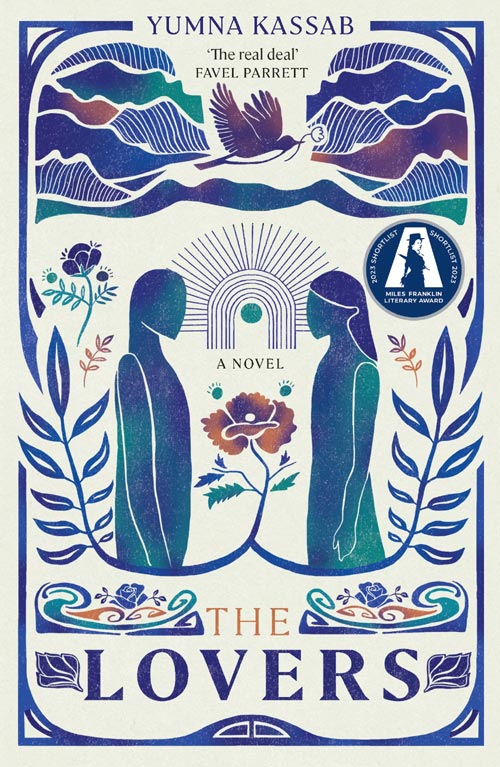
Book cover of The Lovers, by Yumna Kassab, named on the 2023 Miles Franklin shortlist.
The shortlist of the 2023 Miles Franklin literary award was announced this morning. The following six books have advanced to the next stage of the prestigious Australian literary award:
- Chai Time at Cinnamon Gardens by Shankari Chandran
- Cold Enough for Snow by Jessica Au
- Hopeless Kingdom by Kgshak Akec
- Iris by Fiona Kelly McGregor
- Limberlost by Robbie Arnott
- The Lovers by Yumna Kassab
More good news for Jessica Au and Robbie Arnott who continue to not only win literary awards, but be nominated for them. And good to see some not so often seen writers make the shortlist. In a statement, the judges said the shortlisted titles all represent fresh and bold fiction writing:
The 2023 Miles shortlist celebrates six works that delve deeply into archives and memory, play confidently with style and structure and strike new grounds in language and form. From deeply immersive tales to polished jewels of craft, from lyrical mappings of land to convention-breaking chronicles, this is novel-writing at its freshest and boldest.
The winner will be named on Tuesday 25 July 2023.
RELATED CONTENT
Australian literature, books, literary awards, Miles Franklin
Self-publishing a book is no walk in the park: Helen Moody
16 June 2023
On the subject of self-publishing, retired Australian horticulturist journalist and foreign aid researcher Helen Moody recently published her own book, South Coast Islands NSW. While Moody’s title is selling well, six-hundred copies from a print run of seven-hundred have sold, Moody was surprised at the difficultly entailed by self-publishing:
However, Moody says if she’d known how difficult it was to self-publish, she would have never started. “I’ve had to be author, administrator, finance officer, event organiser, delivery driver, marketing and promotion officer,” she said.
RELATED CONTENT
books, publishing, self publishing, writing
An overview of the book publishing industry in Australia
16 June 2023
A fascinating overview of the book publishing industry in Australia, and probably globally, by Dave Gow, who recently went through the process of self-publishing a book:
Traditional book publishers are essentially operating like startup investors or venture capitalists. They make a string of bets on authors and hope that one or two out of ten pays off big. This way, they make enough to cover the losses on others and come out with a reasonable profit.
From what I can gather, Gow enjoyed some success by taking the self-publishing route.
RELATED CONTENT
books, publishing, self publishing, writing
American author Cormac McCarthy has died, aged 89
14 June 2023
American author Cormac McCarthy, writer of novels including No Country for Old Men in 2005, The Road in 2006, and more recently in 2022, The Passenger and Stella Maris, died on Tuesday 13 June 2023. According to a statement on his website, he died of natural causes.
So long Cormac McCarthy, and thanks for all the stories.
RELATED CONTENT
books, Cormac McCarthy, novels
The Literature Map, find an author’s literary neighbours
14 June 2023
The Literature Map charts the literary connection between writers. The closer writers are in literary style, the more likely a reader will have read the work of other authors in a writer’s “neighbourhood”. For instance, literary neighbours of Irish author Sally Rooney include Margaret Atwood, Taylor Jenkins Reid, Elena Ferrante, and Dolly Alderton. These are all writers whose books I have read.
RELATED CONTENT
books, literature, Sally Rooney, writers
Will Vision Pro change or enhance the book reading experience?
8 June 2023
A few days ago Apple unveiled its much anticipated spatial computer headset device, Vision Pro. According to Apple, the product is “a revolutionary spatial computer that seamlessly blends digital content with the physical world, while allowing users to stay present and connected to others.”
This assertion is borne out by American Apple/tech blogger John Gruber, who briefly tried out a test version of the Vision Pro, on the sidelines of this year’s Worldwide Developers Conference (WWDC):
First: the overall technology is extraordinary, and far better than I expected. And like my friend and Dithering co-host Ben Thompson, my expectations were high. Apple exceeded them. Vision Pro and VisionOS feel like they’ve been pulled forward in time from the future. I haven’t had that feeling about a new product since the original iPhone in 2007. There are several aspects of the experience that felt impossible.
If you have even the slightest interest in the Apple headset, I suggest you read Gruber’s article in full. While the device is capable — or eventually will be — of doing all sorts of things, including offering an almost immersive movie watching experience, the rendering of (could we call them) fantasy scenarios caught my eye:
Then, a dinosaur — a velociraptor-looking thing, seemingly about 9 or 10 feet tall — approached the “portal” in the wall and came halfway through into the room. I was invited to stand up from the couch and approach it. […] The dinosaur was not pre-recorded. It reacted, live, to me, keeping eye contact with me at all times. It was spooky, and a significant part of my own lizard brain was instinctively very alarmed. I got extremely close to the dinosaur’s head, and the illusion that it was real never broke down.
Aside from the dinosaur simulation, Gruber also saw an excerpt of James Cameron’s 2022 movie Avatar: The Way of Water. I’m not really a fan of 3D films, I sometimes think they’re an eye-straining gimmick, but Vision Pro sounds like the platform 3D movies have been waiting for:
Cameron shot Avatar 2 with state-of-the-art 3D cameras, and the 3D effect was, as promised, better than anything I’ve ever seen in a theater or theme park. I don’t generally like 3D feature-length movies at all — I find myself not remembering them afterwards — but I might watch movies like Avatar this way with Vision Pro. But even though Avatar is 3D, it’s still a rectangular movie. It’s just presented as a very large rectangle with very compelling 3D depth inside that rectangle.
While a completely different medium from dinosaur simulations and 3D films, the possibilities Vision Pro presents made the book reader in me wonder how, or if, books, or novels, could be consumed on the platform. Books don’t exactly constitute digital content in this context, but still, could the way they’re “read” be somehow augmented, or enhanced, on a headset like this?
Might a book optimised for Vision Pro consumption combine an audiobook experience with visuals other than (but not excluding) pictures or illustrations. “Video” vignettes perhaps? And then audio. What about some background sound? Or might that be something book readers would resist?
While not every novel published would be adapted for Vision Pro — for obvious reasons, cost being one — I can’t imagine ebooks, which one or two people will read on their Vision Pros, not ever being altered or embellished, in some way for the platform.
RELATED CONTENT
Deadly Game, the debut novel of British actor Michael Caine
8 June 2023
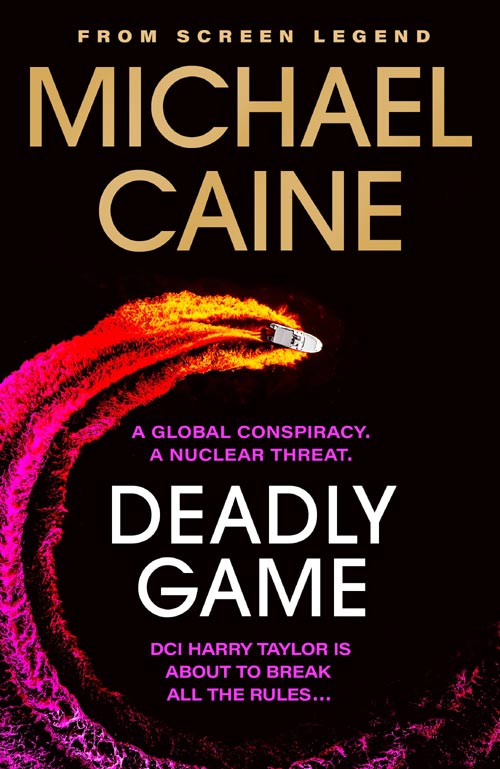
Book cover of Deadly Game, written by Michael Caine.
At the age of ninety, British actor Michael Caine has turned his hand to novel writing. His debut title, Deadly Game — set to be published in Australia by Hachette on Tuesday 28 November 2023 — quite possibly draws a certain amount of inspiration from some of Caine’s acting roles:
DCI Harry Taylor has no respect for red tape or political reputations — but he’s great at catching criminals. And all his unorthodox skills will be needed as an extraordinary situation unfolds on his doorstep: a metal box of radioactive material is found at a dump in Stepney, East London, but before the police can arrive it is stolen in a violent raid.
With security agencies across the world on red alert, it’s Harry and his unconventional team from the Met who must hit the streets in search of a lead. They soon have two wildly different suspects, aristocratic art dealer Julian Smythe in London and oligarch Vladimir Voldrev in Barbados. But the pressure is on. How much time does Harry have, and how many more players will join the action, before the missing uranium is lighting up the sky?
Copy on the Hachette page describes Deadly Game as hero Harry Taylor’s “first adventure”… does this mean more thrillers written by Caine are in the works?
RELATED CONTENT
books, fiction, Michael Caine, writing
Gaia, symbol of climate change failure, in Every Version of You, by Grace Chan
5 June 2023
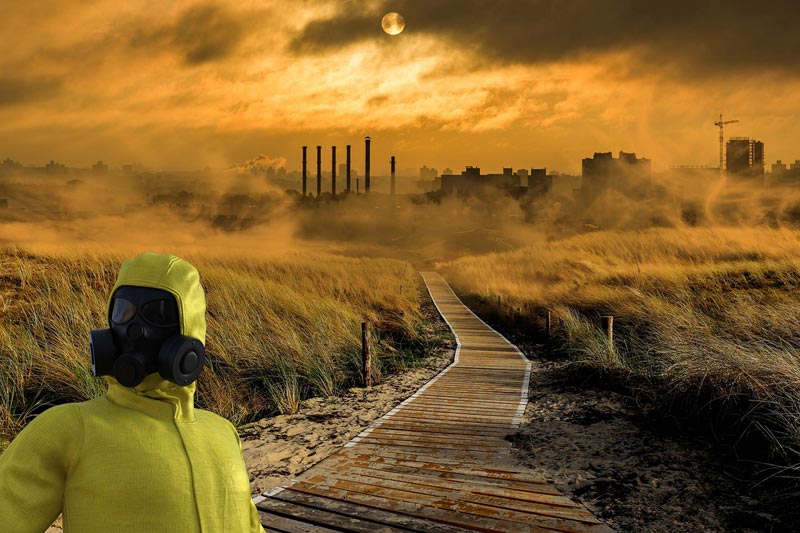
Image courtesy of Pete Linforth.
Warning: spoilers ahead. Return to this article once you’ve finished reading the novel.
Every Version of You, published by Affirm Press in 2022, is the debut novel of Melbourne based Australian author Grace Chan. Set in the late twenty-first century, primarily in Melbourne, Chan’s novel is about a young couple, Tao-Yi and her boyfriend Navin, and a momentous decision they need to make, which has life changing consequences.
Climate change has rendered Earth almost uninhabitable. Outdoor activities have become uncomfortable and dangerous. People need to don protective clothing and equipment before leaving the cocoon-like sanctuary of their dwellings. Body suits to block the Sun’s burning rays. Goggles and facemasks to combat dust, and other airborne irritants.
But the creation of a would-be new world, a “hyper-immersive, hyper-consumerist virtual reality” named Gaia, offers humanity an alternative to the world outside. And while this digital, artificial, macrocosm, mimics the old world in virtually every way, it also offers inhabitants a whole lot more.
Accessing Gaia, called logging in, is facilitated by climbing into a small, diving bell like chamber, filled with a gel-like liquid, called a neupod. While people’s bodies lie immersed in the pod’s gel, their minds roam free in Gaia, and they go about their lives, as normal. Except here, their presence takes the form of a digital avatar, one they are able to continually customise.
They go to work and school. They see friends and family. They engage in sporting and recreational activities. People “live” in Gaia just as they do in the real, outside, world. But within its realm, people can do more than live their old lives. They can venture to places they once only dreamed of, and become someone they could never have been otherwise.
Gaia, a promise of eternal life, but at a cost
Like everyone else, Tao-Yi and Navin switch back and forth between Gaia and the outside world, although Navin spends more time in Gaia than Tao-Yi. But one day a technology emerges allowing people to permanently meld with Gaia, through a process called “Uploading”.
In essence, Uploading, also known as mind uploading, allows a person to live forever within Gaia’s seemingly boundless domain. But there is a crucial caveat. Once uploaded, a person cannot return to the old world. Not, at least, as a corporeal entity. Uploading transforms a person into a conscious digital entity, through a procedure that extracts their every thought, memory, and personality.
A person’s no longer needed body is disposed of in manner they choose beforehand, once Uploading is completed. Despite Tao-Yi’s misgivings, Navin was a keen proponent. And not just because he saw himself as an early adaptor. Navin was also afflicted with a chronic illness, one that medicine could not alleviate. Uploading would allow Navin to live disease free.
And there were doubtless others in Navin’s position. Medical science could offer these people no hope, but Uploading, and becoming a digital version of themselves, would completely eliminate their ailments. For some, the decision to Upload was easy to make. They could enjoy full “health”, and also be free of the ravages of climate change. To say nothing of “living” forever.
Although in a minority, there were people — called holdouts — who refused to Upload. They wished to remain in the “meatspace”, a derogatory term given to the old world. Xin-Yi, Tao-Yi’s mother, was among them. And even Tao-Yi — for the benefits Uploading bestowed upon Navin — was far from convinced that permanently merging with Gaia was the right thing to do. And for good reason.
Gaia, a symbol of climate change denial
Tao-Yi knew Gaia was not a solution to climate change, only a means by which to escape it. To her, and other holdouts, Gaia was humanity’s way of signalling defeat in the battle to restore Earth’s environment to the way it once was. But not only that. Gaia, while being heralded as a new beginning for humanity, also potentially spelt the end of the line for humans.
Aside from a small number of holdouts braving life in the near inhospitable real world, all of humanity’s eggs were in the single basket that was Gaia. Its digital inhabitants had condemned themselves to eternal imprisonment on Earth. Gaia also left humanity all the more vulnerable to some sort of planet-wide calamity, such as the asteroid impact that brought about the end of the dinosaurs.
It was be hoped the tech savvy denizens of Gaia would eventually figure out a way to leave Earth, and at least put down roots elsewhere in the solar system. If not beyond. But a global catastrophe was not the only danger facing Gaia. The digital realm also depended on an army of (presumably self-replicating) robots to maintain its infrastructure.
There would be the hope the robots continued to serve, and replace themselves. But what if these maintenance droids infused themselves with an intelligence of their own? And what if they one day turned against their digital masters, and pulled the plug on them?
Some of these concerns — and could they be the basis for a sequel, or even an Every Version of You expanded universe? — are alluded to in the novel, even if they are beside the point. Gaia is a potent symbol of climate change denial, and the unwillingness, by some people, to do anything about it. Gaia might promise eternal life, but that could be an eternity spent regretting sacrificing Earth to climate change.
Gaia, why does the name sound familiar?
In Greek mythology Gaia is the goddess of Earth, and the mother of all life. She is one of the “primordial deities”, the first generation of Greek gods, and the grandmother of Zeus, god of sky and thunder, and later king of the cosmos, and the other Greek gods.
As a name for the digital realm humanity withdraws to, Gaia may also derive from the Gaia hypothesis, which was formulated by late British scientist and futurist James Lovelock in the 1970s. His theory proposes “living organisms interact with their inorganic surroundings on Earth to form a synergistic and self-regulating, complex system that helps to maintain and perpetuate the conditions for life on the planet.”
In Every Version of You, humanity has well and truly failed to “maintain and perpetuate the conditions for life on the planet.” But by creating a new, artificial, domain named Gaia, perhaps the people of the late twenty-first century — up to their eyes in denial — could claim to have succeeded in achieving this goal.
RELATED CONTENT
books, climate change, climate fiction, Grace Chan, science fiction
The 2023 Australian Book Design Awards (ABDA) winners
31 May 2023
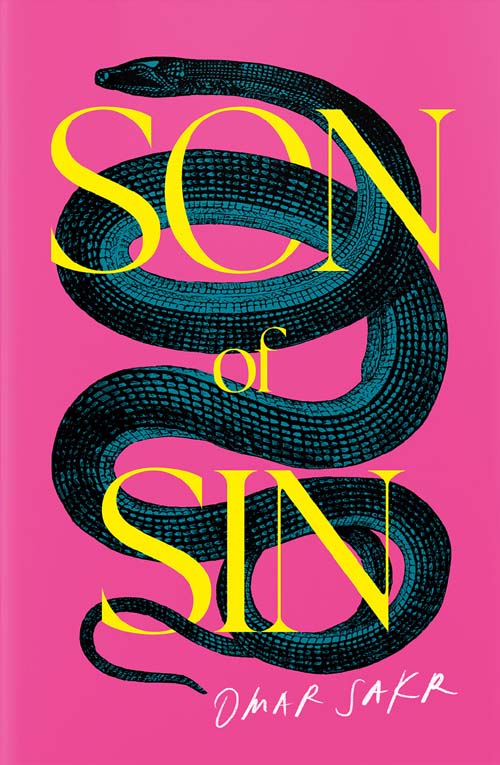
Book cover of Son of Sin, written by Omar Sakr, designed by Amy Daoud.
The Australian Book Design Awards (ABDA) not only judge books by their covers, they celebrate them, and last week the winners of the 2023 awards were announced. Son of Sin written by Omar Sakr, pictured above, won the Best Designed Literary Fiction/Poetry Cover award, with a cover created by Sydney based book designer Amy Daoud.
In other categories, Zeno Sworder, who both wrote, and designed the cover for My Strange Shrinking Parents, won the ABDA Cover of the Year prize, while ABDA’s Book of the Year award went to QUEER: Stories from the NGV Collection, with a cover by Dirk Hiscock and Karina Soraya, who both work at the National Gallery of Victoria.
All of the winning covers can be seen on ABDA’s Instagram page.
RELATED CONTENT
Australian literature, books, design, Omar Sakr, Zeno Sworder
The rise of experimental, strange Australian literature and fiction
29 May 2023
There’s a lot to like about smaller, independent, book publishers. The first has to be the quality of the stories they’ve been bringing to bookshelves in recent years. This is borne out by the increasing presence of indie published titles in the long and short lists of Australian literary awards such as the Stella, and the Miles Franklin.
The second is the “risk” smaller publishers — many of whom are members of the Small Network Press — will take on a book with a storyline that might be regarded as fringe, something perhaps their mainstream counterparts are reluctant to do.
Nina Culley, writing for Kill Your Darlings, says the publication of titles including Grimmish by Michael Winkler, Every Version of You by Grace Chan, and Dropbear, a collection of poetry by Evelyn Araluen, is signalling a move away from “realist” stories, towards writing more on the experimental and strange side.
Small presses, literary magazines, anthologies and poetry collections have long since encouraged outlandish stories, experimentation and play, and we are now seeing more smaller publishing houses doing the same. Publishers like Spineless Wonders, SubbedIn, UQP, Transit Lounge and Giramondo are revolutionising Australia’s literary output by responding to an expanding readership that craves literary disobedience.
I’m intrigued by what is regarded as “literary disobedience” though (much as I like the term). For instance I finished reading Every Version of You last week, and despite the novel being described as a work of speculative literary fiction, the entire premise really seemed all too plausible. But maybe I need to stop consuming as much science fiction and fantasy as I do.
RELATED CONTENT
Australian literature, books, Evelyn Araluen, Grace Chan, Michael Winkler