Sydney based Australian writer and artist Leslie K. Lau recently self-published a book, Pulling Weeds, Folding Laundry. These are tasks many people probably don’t care to think much about, let alone carry out, but Lau saw them in a new light — as moments between moments — while undergoing treatment for cancer:
Ultimately, it is a story of how a cancer diagnosis revealed the reality of life, how volatility and uncertainty was in fact the norm and not the exception.
It is the retelling of a journey of finding peace, contentment, and joy in the moments between moments.
It is a tale of navigating hard times, perceived or otherwise, and coming out the other end.
What a wonderful way to say slow down and appreciate those seemingly insignificant moments in life, since they are still very much a part of it.
At this moment, Threads is #2 on the App Store’s top free downloads list, and X is #51. On the Play Store, Threads is #6 and X is (scroll, scroll, scroll…) #66. This rebranding would be a firing offense if the mastermind behind it didn’t own the company. (So much for Threads being the one that’s supposedly gasping for air.)
Despite the good app install numbers, engagement reportedly remain low on Meta’s rival to Twitter/X. Abené Clayton, writing for The Guardian, says Threads saw 576,000 active users in August, compared to over two million in July.
Threads is up against a few competitors, Mastodon and Bluesky to name a few, so the market is perhaps a little crowded. I would add Twitter/X to that list, but owner Elon Musk seems intent on destroying the platform, and in the process, his plans for… world domination.
Entries for the 2024 Victorian Premier’s Literary Awards (VPLA) are open until Sunday 10 September 2023. The VPLA is one of Australia’s most valuable literary awards, and the shortlists — which will likely be announced sometime in December — are always filled packed with quality titles.
The Matildas two nil loss to Sweden in the third-place playoff match in the 2023 FIFA Women’s World Cup, played at Brisbane Stadium, on Saturday 19 August, came not only as a disappointment, but also a surprise, to supporters of the Australian women’s football team.
Although the Matildas enjoyed their best ever World Cup tournament in 2023, in being placed fourth, many believed the team had a better an average chance of winning the playoff game for the 2023 bronze medal.
If perhaps Matildas head coach Tony Gustavsson had not been so intent on maintaining “continuity”, by refusing to change the team’s line-up throughout most of the World Cup, winning third place was indeed a distinct possibility. Yet of the twenty-three players in the full Matildas squad, only thirteen spent significant time on the field. And that might have been twelve, had Sam Kerr, the Matildas’ captain, not been sidelined for much of the competition with an injury. Of the remaining ten players in the Matildas squad, only a handful saw game minutes.
Samantha Lewis, football writer for ABC Sport, underlined the point, at half time during Saturday’s match, when the Blågult, Sweden’s women’s football team, were leading the game one nil:
The Matildas look tired. Not just physically but mentally: their passes have been off, their decisions half-a-second too slow, their challenges late and clumsy.
It’s a cliche, but Sweden look like they want this more, and the extra day of rest they’ve had over Australia is noticeable in terms of their reaction times and pressing speed.
Tony Gustavsson has been criticised towards the pointy-end of this tournament for not using his bench enough and relying on fatigued players to get the job done, but this feels like a game where he really needs to trust the fresh legs available to him if they want to get back into this and go home with a rose-gold medal.
While Sweden played their semi-final match a day earlier than Australia, I doubt the extra twenty-four hours rest alone made them the better team in Brisbane. Even though, like Australia, they did not change their semi-final line-up, either.
Gustavsson seems to have forgotten winning tournaments on the scale of a World Cup are a team effort. He should have drawn more from the wider Matildas’ squad, rather than constantly relying on the same core players. Playing six international games — from the first group stage match, to the third-place playoff — over the course of four weeks, with virtually no substitutions, is a big ask for any team, no matter how good. Gustavsson was therefore extremely fortunate there were no serious injuries (with the exception of Kerr) forcing him to ditch the team continuity he craved.
I’m surprised though someone as seasoned as Gustavsson didn’t recognise the need to rest players, and bring some “new legs”, to quote Samantha Lewis, onto the field. And not just prior to the third-place playoff either, but throughout the competition. Being sidelined, and deprived of the opportunity to shine, must have come as a blow to those in the Matildas’ squad who sat out the entire World Cup on the reserves bench.
Not only was the thinking unfortunate, but the “continuity policy” also represented, I think, a missed opportunity. Because great things could have come to pass.
And let’s not forget the home-field advantage, something the Matildas enjoyed as tournament co-hosts, and something that can work in favour of Australian athletes. The 2000 Sydney Olympics are an example, where Australia won a record fifty-eight medals, the nation’s best showing at a Summer Olympics to date.
A rejuvenated Matildas’ team, by way of a few substitutions, and with their supporters right there beside them, might have made all the difference on Saturday night.
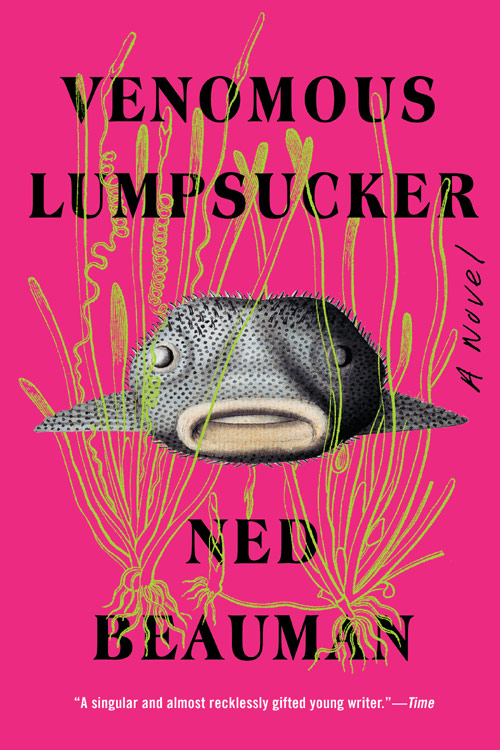
Going by the publisher’s outline, Venomous Lumpsucker has the lot. A cli-fi, sci-fi dystopian chiller-thriller set in the near future, in a world possibly irreparably damaged by climate change:
The near future. Tens of thousands of species are going extinct every year. And a whole industry has sprung up around their extinctions, to help us preserve the remnants, or perhaps just assuage our guilt. For instance, the biobanks: secure archives of DNA samples, from which lost organisms might someday be resurrected . . . But then, one day, it’s all gone. A mysterious cyber-attack hits every biobank simultaneously, wiping out the last traces of the perished species. Now we’re never getting them back.
Karin Resaint and Mark Halyard are concerned with one species in particular: the venomous lumpsucker, a small, ugly bottom-feeder that happens to be the most intelligent fish on the planet. Resaint is an animal cognition scientist consumed with existential grief over what humans have done to nature. Halyard is an exec from the extinction industry, complicit in the mining operation that destroyed the lumpsucker’s last-known habitat.
Across the dystopian landscapes of the 2030s — a nature reserve full of toxic waste; a floating city on the ocean; the hinterlands of a totalitarian state — Resaint and Halyard hunt for a surviving lumpsucker. And the further they go, the deeper they’re drawn into the mystery of the attack on the biobanks. Who was really behind it? And why would anyone do such a thing?
The prize, awarded since 1987, is presented annually to the best science fiction novel first published in the United Kingdom in the previous calendar year, and is named after British author and futurist, Arthur C. Clarke, who died in 2008.
The Matildas, the Australian women’s soccer (football) team, had a stellar run during the 2023 FIFA Women’s World Cup, hosted by Australia and New Zealand. While they didn’t make it to the final, their passion to succeed won them legions of new fans in Australia, and I dare say, further afield.
The Tillies, as they’re known to some followers, play one last match against Sweden on Saturday 19 August 2023, to determine who wins the 2023 tournament’s bronze medal. Whatever the outcome — whether they are placed third or fourth — 2023 will be Matildas’ best ever result in a World Cup.
If you’d like to learn more about the Matildas, its members, and their 2023 campaign, then the Disney produced documentary, Matildas: The World at Our Feet, trailer, comes highly recommended. I have it on good authority that a New Zealand sports lover became a Matildas fan after seeing this show.
Melbourne based Australian author Rowan Heath was named winner of the 2023 ABR Elizabeth Jolley Short Story Prize at an online ceremony held last night, with a fiction work titled The Mannequin. The prize was created in 2010 to honour the memory of late British born Australian writer Elizabeth Jolley, and is presented annually by the Australian Book Review (ABR).
All the ingredients of a thriller-like race against time are there. Trust me. So here I am, calling action.
First, opportunity presents itself:
The mercurial Musk had just taken over Twitter. Amid the ensuing chaos, [head of Instagram Adam] Mosseri’s boss at rival Meta smelled opportunity.
Next there are senior Meta executives on family holidays in Europe, taking breathless phone calls from their boss in the middle of the night:
It was nighttime in Italy, and Mosseri spoke softly to avoid waking his sleeping wife. The group discussed Twitter-like features they could add to existing apps, including Instagram.
Zuckerberg, however, had a different idea: “What if we went bigger?”
Now that exact requirements are understood, and the enormity of the task at hand can be seen in the cold light of day, the inevitable panic begins to set in:
“Oh God, we’ve got to figure this out, because [Zuckerberg is] very excited about this,” Mosseri recalled thinking. “Sometimes you can tell when he kind of gets his teeth into something.”
The last thing, of course, you want to do is disappoint the boss. But you know what they say: when the going gets tough, the tough get going:
With a mandate from Zuckerberg to take a big risk, Mosseri assembled a lean, engineer-heavy team of fewer than 60 people to hack together a bare-bones app on a breakneck timetable more reminiscent of a start-up than an entrenched tech giant.
That paragraph sounds like it packs a punch, but a sixty person team is hardly “reminiscent of a start-up”. Instagram, which Threads is built upon, was, at the beginning, the work of two people, Michel Krieger and Kevin Systrom. But who cares? This is the movies, and all audiences want is a great story.
And size of the development team notwithstanding, there were challengers aplenty. Mainly what product features not to include, rather than what to ship:
To keep things moving, the Threads team punted thorny decisions and eschewed difficult features, including private messages and the ability to search for content or view the feeds of people you don’t follow.
But the clock is ticking. No one knows when the competitor — he who must not be named — might snatch back possession of the ball, and wrest the game away from the team we’re barracking for. But (naturally) such fears prove to be unfounded:
That night, a “core group” worked together at Meta headquarters while Mosseri and other team members chatted on an internal messaging forum, watching the sign-ups pour in. Mosseri recalled astonished team members asking, “Are we sure about these numbers? Can someone double-check that the logging isn’t messed up?”
And there we have it, the happy ending. One hundred million app signups. But wait, how can you call ever declining engagement, and plummeting time spent on the platform, a happy ending? Of course you can’t, but don’t you see where this is going? Wait for it. Wait for it. To a sequel, of course.
Last week, the Australian Broadcasting Corporation (ABC) reduced the number of active pages it has on Twitter/X to just four. The Triple J page, which I follow, was among accounts to be archived. David Anderson, managing director of the ABC, says the move follows a trial in February this year, when three accounts were shuttered:
“In February we closed three program accounts, for Insiders, News Breakfast and ABC Politics, and the results of that have been positive,” he said. Mr Anderson said the reduced activity will allow staff to focus “on the accounts that overwhelmingly provide the most value.”
The ABC has been the subject of a number of rounds of staff cuts in recent years, and doubtless archiving some of the Twitter/X pages will reduce staff workloads. Twitter/X owner Elon Musk, however hit back at the decision, labelling it censorship:
Well of course they prefer censorship-friendly social media. The Australian public does not.
What does he mean censorship, and since when has Musk had it down with the Australian public? The ABC is operating on plenty of other channels, including their website, television and radio, along with other social media services such as Facebook.
The ABC also have a number of active Threads accounts, and are looking into boosting their presence there further. Here’s hoping the page of the aforementioned Triple J is among them.