
Corporate jargon alternatives by Matt Watson
13 August 2024
American web developer Matt Watson has re-written many latter-day, jarring, corporate-speak terms, with words and phrases from long past times. For instance, instead of “circle back”, say “bring word again”. Or, replace “open communication” with the surely eye-brow raising “regular intercourse”.
In other examples, ASAP becomes “betimes”, change agent (what?) becomes “efficient cause”, while lean in is now “assiduously apply”. There are many more. Now all we need is a substitute to reach out. Hmm. Let me think. Hang on, I think I have it. How about “contact”?
RELATED CONTENT
Mark and Evette Moran Nib Literary Nib Award 2024 longlist
12 August 2024
Seventeen books have been included on the recently announced Mark and Evette Moran Nib Literary Nib Award 2024 longlist. Also known as the “Nib”, the literary award celebrates excellence in Australian literary research, and as such works of any genre, including fiction, non-fiction, and autobiography, are eligible for inclusion.
- A Very Secret Trade, by Cassandra Pybus
- Alice™ The biggest untold story in the history of money, by Stuart Kells
- Because I’m Not Myself, You See, by Ariane Beeston
- Bennelong and Phillip: A History Unravelled, by Kate Fullagar
- Book of Life, by Deborah Conway
- Crimes of the Cross, by Anne Manne
- Datsun Angel, by Anna Broinowski
- Donald Horne, by Ryan Cropp
- Edenglassie, by Melissa Lucashenko
- Frank Moorhouse: Strange Paths, by Matthew Lamb
- Killing for Country, by David Marr
- My Brilliant Sister, by Amy Brown
- Reaching Through Time, by Shauna Bostock
- Transgender Australia – A History since 1910, by Noah Riseman
- Wear Next, by Clare Press
- What the Trees See: A Wander Through Millennia of Natural History in Australia, by Dave Witty
- Wifedom, by Anna Funder
A shortlist of six titles will be published on Tuesday 17 September 2024, with the winner being named on Wednesday 27 November 2024.
RELATED CONTENT
Australian literature, books, literary awards
Nothing about Kissing by Kathryn Lomer wins 2024 Furphy literary award
12 August 2024
Hobart based Australian poet, and young adult writer, Kathryn Lomer, has been named winner of the 2024 Furphy literary award for short stories, with her work Nothing about Kissing (PDF).
Set in Tasmania’s Museum of Old and New Art (Mona), also in Hobart, Nothing about Kissing, is the story of an unnamed museum cleaner, who’s early morning shift gets off to a rather bad start.
I’m not really into short stories, they’re a hard act to master, but Lomer’s work is, literally, a winner. It’s short enough to read during a refreshment break, so do give it a look.
RELATED CONTENT
Australian literature, books, Kathryn Lomer, literary awards
More price rises are on the way for coffee drinkers
9 August 2024
Bad weather continues to hit coffee growers in Brazil and Vietnam, forcing Australian coffee suppliers to warn of shortages, and more price increases.
It’s been a tough few years for coffee producers. When I wrote about production problems almost three years ago, droughts in Brazil were impacting harvest yields, causing a reduction in supply. Labour shortages, occasioned by the pandemic, saw growers in NSW also struggling to harvest.
By early 2022, there were fears coffee might be on the way to seven dollars a cup. Mercifully, that dire prediction has yet to come to pass.
A large cup of takeaway coffee costs five dollars at the places I usually go to. It’s a sensible price, especially if paying with cash, as I sometimes do. I’ve become quite used to having no small change rattling around in my pocket, even if current coffee prices are leaving me more, er, out of pocket.
If the cost of a cup were to press on towards the six dollar mark, I’d start becoming seriously worried about the viability of many coffee shops. Surely some customers would start cutting back, though there is the argument that consumers continue to make smaller comfort purchases, while forgoing other, more costly, outgoings.
And check out the image in this ABC News article, which breaks down the cost of a cup of coffee in Australia. For a small cup, coffee beans only constitute about twelve percent of the total cost. The rest of the money goes elsewhere. But perhaps we should be thankful in Australia after all. A cup of coffee costs about eight dollars in San Francisco, while people in parts of Switzerland pay ten dollars. Five dollars must seem a like a joke to coffee drinkers in those locations.
RELATED CONTENT
The Ledge, a new thriller/whodunit by Christian White
8 August 2024
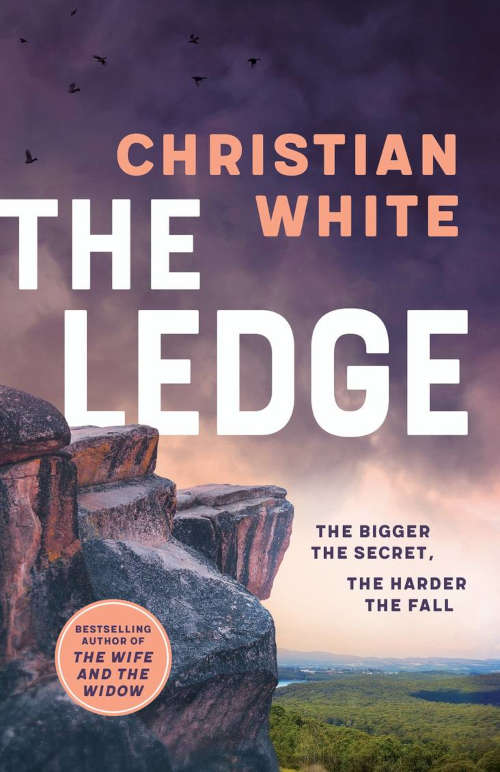
The Ledge is the fourth novel by Victoria based Australian writer, and master of twists that will leave you breathless and dumbfounded: Christian White.
When human remains are discovered in a forest, police are baffled, the locals are shocked and one group of old friends starts to panic. Their long-held secret is about to be uncovered.
It all began in 1999 when sixteen-year-old Aaron ran away from home, drawing his friends into an unforeseeable chain of events that no one escaped from unscathed.
White’s novels are chock full of the things readers of thrillers and suspense love: red herrings, blind alleys, smoke and mirrors, lies, deception, characters with multiple aliases, the list goes on. So far I’ve read The Nowhere Child, White’s 2019 debut, and The Wife and the Widow, which possibly has of one the most mind-blowing twists in the genre.
Wild Place, meanwhile, published in 2021, remains on my TBR list, where it will be joined by The Ledge, when it is published on Tuesday, 24 September 2024.
RELATED CONTENT
Australian literature, authors, books, Christian White, literature, novels
I Was a Simple Man, a film by Christopher Makoto Yogi, with Steve Iwamoto
8 August 2024
Made in 2021, I Was a Simple Man, trailer, is the third feature of American writer and filmmaker Christopher Makoto Yogi, who also wrote the screenplay. Masao Matsuyoshi (Steve Iwamoto), an elderly man who has spent most of his life in Hawaii, is terminally ill, and has months to live. As he nears death, he looks back on his life, often with regret.
Recollections of his late wife Grace (Constance Wu), his estranged daughter Kati (Chanel Akiko Hirai), whom he left in the care of other family members, and grandson Gavin (Kanoa Goo), who both live elsewhere, dominate his troubled thoughts. As David Ehrlich, writing for Indie Wire, notes: just because people don’t stay behind doesn’t mean they ever leave.
This is a story that will require the patience of some viewers, as it meanders back and forth through time, and ethereal, earthy locations, on the Hawaiian island of Oahu. The finale, though muted, is poignant. We really die alone, perhaps as we (really) lived. But you die with yourself.
RELATED CONTENT
Chanel Akiko Hirai, Christopher Makoto Yogi, Constance Wu, film, Kanoa Goo, Steve Iwamoto
Who needs LinkedIn when you can network at music festivals?
7 August 2024
Networking tips for music festivals, by Harry Carr:
Don’t make the mistake that most people make and switch off as soon as you reach Paddington. Maximise your train journey by reaching out to your extended network, to see if they are going to Glastonbury Music Festival. If there’s a speaker or business guru you admire on the conference circuit, there’s a good chance he’s being dragged along by his girlfriend, who is half his age. Drop him an email and ask him if he wants to meet up for coffee. You should aim to send between 100-150 emails on the train.
Via Things Magazine.
AND… also seen at Things, London Flipped, said to be the first full-size map of London drawn upside-down. It might seem weird, but there’s nothing strange about it at all: this is what London looks like from Australia, don’t you know…
RELATED CONTENT
humour, music, social networks, technology
Dense Discovery notches three hundred editions, opens reader community
7 August 2024
Melbourne based Australian designer and publisher Kai Brach’s weekly publication, Dense Discovery (DD), is one of the few newsletters I subscribe to. If you have an interest in, well, everything, then DD is for you. First published in September 2018, the three-hundredth edition was posted yesterday.
And to mark this most impressive of milestones, Brach launched a community space, the DD Lounge, especially for supporters, friends of DD. That a regular newsletter can go on to spawn a community says a lot. Yes, I know there are other similar such communities, but still it’s something.
Congratulations on publishing three-hundred editions DD.
RELATED CONTENT
content production, design, publishing
Stone Yard Devotional by Charlotte Wood included on Booker Prize longlist
6 August 2024
Sydney based Australian author Charlotte Wood has been included on the 2024 longlist for the Booker Prize, with her latest novel, Stone Yard Devotional. It is the first time a work by an Australian writer has featured on the Booker longlist since 2016.
I’m reading Stone Yard Devotional right now, and loving it. Some reviewers however have complained it plods, and is too introspective. The story is about a woman, non-religious, who retreats to a convent in outback Australia for a while to sort out her life. Her musing however, are interrupted by a number of unexpected happenings.
Wood’s 2019 novel The Weekend is another great read, in case you’re on the lookout for book recommendations. It was adapted for the stage, and has been optioned for a screen production.
RELATED CONTENT
Australian literature, Booker Prize, Charlotte Wood, literary awards
disassociated turns twenty-one again, sort of
6 August 2024
This is — again: sort of — /timeline page content, which seems to be a bit popular on InterWebs and IndieWeb at the moment.
Today — or rather last Sunday 4 August 2024 — does not really mark the twenty-first birthday of disassociated. That would’ve been back in 2018, given the first non-blog inception of this website went online in 1997. But, the oldest, presently published blog post, dates back to Monday 4 August 2003. A post about the Windows Operating System (OS), NT4, that I’d been forced to stop using, after upgrading my then computer.
I had a few nice things to say about Windows OS’s back then, quite the contrast to the present time. Ever since properly rebooting disassociated in May 2022*, I’ve gradually been restoring selected old posts from the early days. The post I wrote twenty-one years ago, predates content management systems (CMS) such as WordPress, and was instead written onto a static HTML page.
In 2007, as I was preparing to migrate to WordPress, I spent several months copy and pasting several years of “blog” posts onto a template, I would later upload into my first WordPress database. WordPressing, was the term I used to describe that process. But anyway, there we have it. Twenty-one years (unless I restore even older posts, and there’s one or two), of blog posts at disassociated.
But then again, who doesn’t like turning twenty-one a few times?
* though I’d sort of been back since September 2021.
RELATED CONTENT