
Blogging about blogging versus adding value through your blog
21 June 2024
The majority of my posts are either platform explanations/justifications or organizational posts. Stuff like, “I’m moving the Archives here” or “I’ve added a ton of Links there.” Other times it’s simple announcements about me moving my blog someplace new. So, why do I feel the need to talk about this?
This is something I grapple with, though maybe not to the same degree. Are people really interested in my blog posts about my blog? They’re pretty far and few between here, the last meta, blogging about blogging post, was when I added (re-added) a blogroll. I don’t know, maybe they’re a bit more common. What’s meta, and what’s not meta, can be highly subjective.
Yet a concept that — supposedly — has shaped the way I write here, derives from Twitter. I’m talking about Twitter when it was Twitter back in the day, not what it is presently. Anyway, we’d all been on Twitter for a couple of years, when 2009 arrived. By then, Twitter was deemed to be a mature platform for networking and micro-blogging, and now it was time, we, the users, conducted ourselves with a little more… sophistication.
“Add value” was a term frequently bandied about at the top of 2009. Add value meant we ought to ease back on tweeting about what we had for lunch (but not completely), and start contributing to a more useful overall conversation. Maybe there were a few years when value was indeed added through our tweets, or at least those of whom I moved in the same circles with.
But I decided I needed to bring the add value mantra to disassociated. To me, that meant less posts of an introspective nature, and more, er, useful stuff. No more: “I updated to the latest version of WordPress”, or “I backed up my website database last night”. I wanted to publish articles people might find helpful. I wasn’t sure what interest people, who wanted to find out more about how the Oscar nomination process worked, or etiquette at a classical music recital, would have in stuff meta.
Some people might argue these two examples are informational, or magazine style, posts. Not the sort of thing that belongs on a personal website. But the distinction possibly lies in the definition of a personal website. One of my first websites was a personal website, but not the very first. Instead, it was a web fiction series (emphasis on fiction), a collaboration with a friend. At that point, I saw the web as, among other things, a story telling platform.
In other words, anything other than a platform for publishing diary-like posts. Who could possibly be interested in that, I thought. But after seeing others doing it, I eventually followed suit, and started publishing an online journal. By the time the web fiction series came to an end, I had two websites, one personal — which included my online journal — and the other more magazine-like, that I called Channel Static. But I’m not sure how much “value” Channel Static really added to anything.
This was all in 1997, 1998 though. I don’t think it was until 2007, when I re-invented disassociated as a WordPress website, that value really came into the equation. But not at first. There was much meta-stuff going on. WordPress version this, WordPress version that. There was a whole lot of blogging about blogging also. A lot of that may have been me channelling the zeitgeist though.
Blogging was taking off in 2007. There were people making a full time living through their blogs. It was an exciting time to be blogging alive. Despite running a magazine website that was still meant to be a personal website, in so much as it was mine, it was near nigh impossible to ignore what was happening in what we called the blogosphere.
The 2009 catch cry to “add value” was more of a wake-up call to me to get more serious about what I published here. Even if the message had been intended for the twitterati. But the next person’s interpretation of “adding value” is their call to make. If you feel you achieve that through informational, magazine style, publishing on your personal website, well that’s fine. Exactly the same goes for meta, and blogging about blogging, posts.
They’re not called personal websites for nothing: they’re there for you to do whatever you choose.
RELATED CONTENT
blogs, history, technology, trends, Twitter
Easy OS, an experimental Linux distro, by Barry Kauler
21 June 2024
I’m in the process of migrating my OS away from Windows. I’ve been running Linux Mint, considered to be a user-friendly, Windows-like distribution of the Linux family of OS’s, on a backup device for almost two weeks now. It’s been a learning curve naturally, but so far, so good.
In the meantime though, the word Linux seems to jump out at me, whenever I’m going through my RSS subscriptions, or other news channels. A distribution (distro), called EasyOS, the creation of software developer Barry Kauler, caught my eye the other day, and might be one to consider, if you’re looking to change your OS, for whatever reason.
RELATED CONTENT
Burritos power Guzman Y Gomez to hot sharemarket debut
21 June 2024
Shares in Australian founded Mexican food restaurant Guzman Y Gomez (GYG: it’s not only an initialism, it’s a ticker code) had a stellar debut on their first day of trading on the ASX, with one market pundit describing the launch as “the hottest float on the stock market in years“:
Its shares opened at $30, a premium of more than 36 per cent to what investors paid ahead of the blockbuster initial public offering under the ticker “GYG”.
The float price for GYG shares was $22, and as of the close on trading, yesterday afternoon, were priced at $30 a piece. GYG’s burritos sure are hot, as I’ve said before.
RELATED CONTENT
The Peaky Blinders military unit helping to defend Ukraine
21 June 2024
Kathryn Diss and Mathew Marsic, writing for ABC News:
For Commander Anton, it’s difficult to imagine returning to his quiet life before the war. The 33-year-old former builder is now a battle-hardened soldier who risks his life every day, just kilometres from the Russian border. He is part of an elite squad of soldiers who call themselves the “Peaky Blinders”, after the violent British television drama.
What a remarkable story. I couldn’t conceive of being involved in a drawn out armed conflict to defend my homeland. But then neither of course did the brave Peaky Blinders unit members, until Russia invaded their country. More power to them, I say.
RELATED CONTENT
Before Sunrise turns thirty, my theory about what happens
20 June 2024
It’s a favourite around here. Because don’t we love meeting someone we connect with at first sight? But Sunday 16 June 2024, marked the thirtieth anniversary (Facebook link) of the premiere of Before Sunrise, directed by Richard Linklater, and starring Julie Delpy and Ethan Hawke. Another two films followed, with about nine years separating each of the three stories.
Obviously the thirty-year anniversary has intensified speculation about a fourth movie. But that remains up in the air, apparently. In 2018, speaking at the SXSW Film Festival, Hawke, who played Jesse, said he thought the film series “felt complete”. By earlier this year though, he seemed to have changed tack, and said there were “ideas” for another instalment.
Delpy — who portrayed Celine — however, has declined to reprise her role. But I think the scene where Celine and Jesse meet on the train, in Before Sunrise, maps out their life together, and points to what eventually happens. In their carriage, we see a young couple, a middle-aged couple who argue incessantly (ah, Before Midnight), and an elderly couple, sitting contentedly, together.
I think, if ever an instalment of Celine and Jesse in old age were made (would Before Twilight be an apt name?), that’s where the story might ultimately end. And there we have it, the conclusion of the Before film series, without the need to make any more (yes: parting is such sweet sorrow) titles that risk compromising the integrity of the earlier instalments.
RELATED CONTENT
Ethan Hawke, film, Julie Delpy, Richard Linklater
Now that we have IndieWeb how are others to find it?
19 June 2024
How do people who don’t know about IndieWeb, but would like to escape the web-scape funk they’re beholden to, find out about IndieWeb, asks Delyo Dobrev. This is the million dollar question.
Everyone and their grandma and their dog is talking about social media’s bad influence. But do they do anything about it, or do they boomerpost comic strips about more and more kids staring at their phone and waiting for likes?
Blogrolls/links-pages, web directories, and web rings, are among ways to promote the work of other IndieWeb adherents. But you need to be within the IndieWeb realm in the first place, to go on the journey these aggregators will take you. They’re great for their members, but, unfortunately, overwhelming for newcomers, as a Hacker News member pointed out:
How do people make use of such an aggregator? Do people checkout blogs individually and subscribe to feeds to individual blogs or interest? The sheer number of the collection dissuades me. I’m wondering, instead, if it’d be useful for the aggregator to offer an aggregated feed itself, but that might be too random a feed and subjects!
Time is also a factor, doing rounds of IndieWeb discovery is a commitment. Getting started needs to be, somehow, easier. Back to Dobrey:
I remember surfing, actually surfing from link to link, from site to blog to web altar. And it took just a search or two to get started.
That’s what I did back in the day. But sans search engines. I was lucky enough to make, early on, the acquaintance of dozens of personal website owners (sometimes referred to as webmasters, as in masters of their web domain), and would read about their latest finds, as often as possible.
But I’d also stay up literally half the night, every night (even after coming in from a night out), and surf to the websites others had written about on their online journals.
That’s not so straightforward today. Back then, twenty-four hour days felt like they were forty-eight hours long. Now they feel more like twelve hour days. But to introduce more people, specifically audiences, to the joys of IndieWeb, there needs to be an easy path for newcomers to trek.
That is the challenge. That is the million dollar question.
RELATED CONTENT
Are more first time authors struggling to get published?
18 June 2024
Kate Dwyer, writing for Esquire:
Almost everyone mentioned that debut fiction has become harder to launch. For writers, the stakes are do or die: A debut sets the bar for each of their subsequent books, so their debut advance and sales performance can follow them for the rest of their career.
It might be harder today to launch a debut novel than in past decades, but people still succeed in doing so. What sort of sales might be generated by a “successful” debut novel, is another matter though. Spoiler: probably not a whole lot, unless the title is the next Harry Potter, or has enjoyed some sort of celebrity endorsement.
Promotional channels are more fractured, and maybe the number of people who want to write a book is greater. Everyone has a book has in them, after all. It could be tools such as word processors, and access to helpful resources online, empower more to try getting published.
So what to do, to help debut authors? Encourage more people to read newer fiction? Place less emphasis on the classics? Why not? If people are reading books that are centuries old, when is there time to read contemporary work? For my part, I rarely look at anything over ten years old nowadays.
I tried though. Don Quixote, by Miguel de Cervantes. Mansfield Park, by Jane Austen. Both cornerstones of Western literature, no doubt. How many novels feature a key character, having been out of the country on a prolonged absence, returning home, unexpectedly, late at night? We can thank Mansfield Park for that.
But despite my interest in these novels, I finished neither. I’m sure they’re both great books, but they’re just not for me. Ditto Vanity Fair. So contemporary fiction it is. Call me shallow and uncultured, but hopefully I’m helping a new or emerging author at the same time.
RELATED CONTENT
books, fiction, literature, novels
Intermezzo by Sally Rooney, on bookshelves in September 2024
17 June 2024
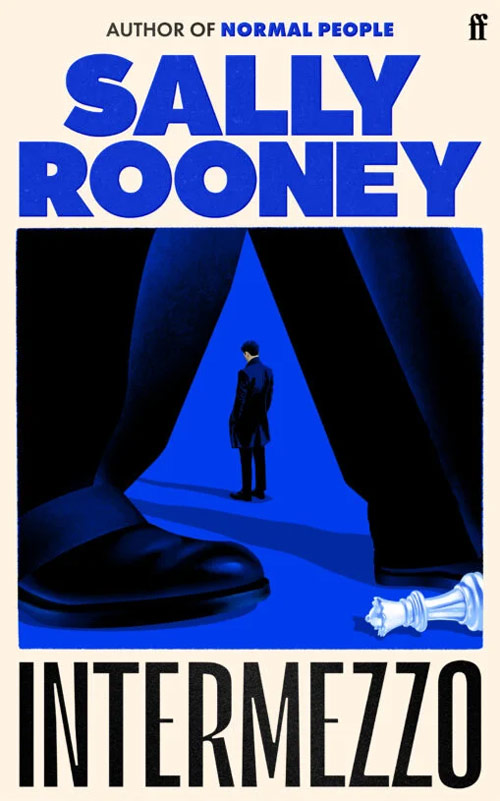
Intermezzo, the fourth novel by Irish literary fiction author Sally Rooney, will be published on 24 September 2024*. The synopsis is classic Rooney:
Aside from the fact that they are brothers, Peter and Ivan Koubek seem to have little in common.
Peter is a Dublin lawyer in his thirties — successful, competent and apparently unassailable. But in the wake of their father’s death, he’s medicating himself to sleep and struggling to manage his relationships with two very different women — his enduring first love Sylvia, and Naomi, a college student for whom life is one long joke.
Ivan is a twenty-two-year-old competitive chess player. He has always seen himself as socially awkward, a loner, the antithesis of his glib elder brother. Now, in the early weeks of his bereavement, Ivan meets Margaret, an older woman emerging from her own turbulent past, and their lives become rapidly and intensely intertwined.
For two grieving brothers and the people they love, this is a new interlude — a period of desire, despair and possibility — a chance to find out how much one life might hold inside itself without breaking.
I’ve liked all of Rooney’s novels, with Conversations with Friends, her 2017 debut, being my favourite so far. I’m yet to see the TV adaptation, but am told the book/screen crossover didn’t quite work.
I don’t know about anyone else, but I find many of Rooney’s male characters not to be all that driven, certainly when it comes to the women in their lives. The men are flawed (as are all of Rooney’s characters), and that’s ok, but they just don’t seem to have much motivation.
But said women are usually the lead protagonists, so maybe Peter and Ivan, especially since they are Intermezzo’s main characters, will be less plodding, less non-committal?
* that’s 24/9/24. Obviously not a palindrome… but does the date have some sort of significance, or was it chosen solely for its, um, numerical symmetry?
RELATED CONTENT
books, literature, novels, Sally Rooney
The WWDC edition of the Talk Show, ChatGPT, tall poppy syndrome
17 June 2024
John Gruber, of Daring Fireball, presented another edition of the Talk Show, at Apple’s annual Worldwide Developers Conference (WWDC). The live show featured usual Apple executives Craig Federighi and Greg Joswiak, who were joined this year by John Giannandrea, perhaps best known for his work with Siri, Apple’s digital assistant.
I’m hardly an Apple aficionado, I only have an iPhone, but I still catch the WWDC edition of the Talk Show, just because I usually find the topics of conversation fascinating. I also read Daring Fireball daily. The website, not the RSS feed. Both experiences are essentially pretty much the same, so I opt for the website. But again, not because I’m any Apple fanboi, but mainly because a lot of what is published there is simply interesting to read.
I don’t usually watch the show in its entirety though, I listen, in podcast style, while doing other things. Two hours is a long time to sit and watch. But I took time this year to read some of the comments left on the Talk Show YouTube page. There’s a few unhappy campers out there.
A number of people were critical of what they considered to be Gruber’s rambling style of interviewing. I can’t say I’ve ever found that a problem, at least with the WWDC shows. He spends a bit of time introducing a topic, which sometimes need explanation, and then his guests respond. I suspect envy may be at the root of most of this criticism.
And a little bit of what, in Australia is referred to as, tall poppy syndrome. Some people also felt Gruber doesn’t ask hard enough questions, but I’m not sure that’s the intent of the WWDC edition.
The topic of Apple’s partnership with ChatGPT was raised, specifically the question of who is paying who for the technology that will power Apple Intelligence, their in-development AI platform. It’s been the subject of much speculation. A firm, but friendly, “no answer” was offered by Greg Joswiak, Apple’s head of worldwide marketing, however. Well, at least the question was asked.
RELATED CONTENT
artificial intelligence, technology, trends
What about anti-virus apps? On going #IndieOS with Linux
14 June 2024
As I wrote a few days ago, I’m in the process of trying out Linux operating systems, specifically Linux Mint. With the release of Windows 11, I think Microsoft has (finally) jumped the shark. Others will probably argue that happened long before Win 11 came along. They’re likely right.
I’ve been doing a lot of reading about Mint, and what apps I might need to run the OS as smoothly as possible. Inevitably, the question of anti-virus (AV) software came up, something I posed to my search engine. I was quite surprised to read that anti-virus software isn’t (necessarily) needed on Linux OS’s.
Needless to say, I did a double take when I saw that. Isn’t going without an AV app foolhardy in this day and age? Well, yes in general, but in regards to Linux, possibly. That’s because there are a few factors at play. For one, devices with Linux OS’s are only present in relatively small numbers. As such, they’re not worth the effort for most writers of malicious code.
Targeting Linux wouldn’t cause enough disruption for them apparently. I’d say there though, disruption to even one person’s computer would be devastation in spades. But let’s hold to the hope that writing Linux viruses is, for the most part, a waste of time.
Then there’s the difficulty of running malicious code, on account of the permissions setting structure of Linux. Someone would almost knowingly need to install a virus file for one to take hold. I’ve only been using Mint a few days so far, but each time I install an app, I’ve needed to enter a password.
That might present a huddle when it comes to executing a virus. Another point is just about every Linux app is only available by way of an app store. And only vetted, safe apps, are included in the store. If apps are sourced solely through Linux stores, supposedly a system will remain safe.
I have no doubt that viruses present far less of a threat to Linux computers, but still feel nervous about being without some sort of AV protection, as useless as some Linux users claim it to be. So I’ll see how I go. But it made me wonder. Is the whole AV industry a by-product of the vulnerabilities in one family of operating systems?
Malicious code presents a problem for all platforms, so that’s unlikely to be the case, even if it might be fun to think as much. On the other hand, it seems to me the family of operating systems in question, is the virus itself, in so much as it now seeks to dominate, and control, its users.
While the jury may be out — in my mind at least — as to the question of AV apps for Linux, I’m sure that taking this step into the realm of what I’m calling #IndieOS, is the right one. And why not?
If #IndieWeb represents a move away from an internet under the control of large corporate entities, to one where individuals have more sway, then migrating to Linux is adopting an OS that likewise gives individuals similar control. #IndieOS? Yep, that’ll do me.
RELATED CONTENT