19 July 2025
The shock jocks in question are Kyle Sandilands and Jackie O, who host a show — The Kyle and Jackie O Show — on a Sydney based commercial Australian radio station. The pair, especially Sandilands, often find themselves in hot water, on account of inappropriate and offensive comments made on air.
Last Wednesday, the Sydney Morning Herald published an article making the claim Australian musician Ben Lee had suggested Kyle and Jackie O host Triple J’s annual Hottest 100 countdown.
Triple J is a non-commerical Australian radio station with a focus on broadcasting new and independent local music, but mixed with non-Australian indie music. The Hottest 100 charts listeners’ favourite songs of the previous calendar year, regardless of country of origin.
But next Saturday, 26 July, Triple J will broadcast a one-off Hottest 100 of listener’s all-time favourite Australian only songs, as part of their fiftieth birthday celebrations.
In response to the Herald article, Lee posted a clarification on his Instagram page, saying Triple J’s Hottest 100 countdown, in its present format, should be broadcast by a commercial station. The jays, Lee explains, as a government funded station, should only support Australian music.
What I’m saying is let commercial radio handle servicing multi-national major labels — that’s their job. Triple J is taxpayer funded and I think those funds would be better used almost exclusively supporting Australian artists and culture.
I get where Lee is coming from here.
But the Hottest 100 is a draw card event for the jays, and likely introduces new listeners to the station, who in turn go on to hear the station’s predominately Australian music programming. On the other hand, as Lilya Murray, writing for Arc, a UNSW student publication, points out, representation of Australian artists in the Hottest 100, has been declining in recent years:
In 2024, only 29 Australian artists featured in the Hottest 100. This was a significant drop from 2023, which featured 52 local artists, and 57 from 2022.
Triple J has a mandate to broadcast a minimum of forty-percent Australian music, though the station claimed in 2019 they played closer to sixty-percent. Why then would fewer Australian musicians be featuring in the annual countdowns?
One suggestion here is that many Hottest 100 voters are not regular Triple J listeners, and are voting up music they’ve heard elsewhere. But I’m not sure you can stop people voting for non-Australian music, unless maybe it wasn’t aired on Triple J in the first place. After all, the Hottest 100 is meant to be a poll of Triple J listeners, not other stations.
But I doubt a one-hundred percent focus on local music, both played by Triple J, and included in the countdown, is the answer either. I’ve always enjoyed the jay’s mix of new and independent, and predominantly Australian music, and the annual Hottest 100 that results.
But more discussion about local music can only be a good thing, something the misleading notion that Kyle and Jackie O host the Hottest 100, might have precipitated.
19 July 2025
Emma Roth, writing for The Verge:
The News/Media Alliance, a trade association behind major news publishers, announced that it has “successfully secured” the removal of 12ft.io, a website that helped users bypass paywalls online.
Thomas Millar, the 12 Foot Ladder founder, saw his app as a way of “cleaning” web pages, by disabling scripts that blocked access to non-paying subscribers. The News/Media Alliance, on the other hand, viewed 12 Foot as an illegal tool, that deprived publishers and writers of subscription income.
18 July 2025
According to data collected by Statcounter. At face value this suggests one in twenty people in the United States are using a Linus OS on their computer. That’s not a bad number. Of course, Windows OS’s still dominate, but it looks like some people are looking for alternatives.
I migrated my laptops to Linux Mint about a year ago. While it hasn’t been one-hundred percent plain sailing, I’d much rather be where I am than where I used to be.
17 July 2025
Tony Stubblebine, CEO of online publishing platform Medium, writing at Medium:
I’m gonna write the wonky post of Medium’s turnaround. I’m not sure if a company is allowed to be this blunt about how bad things were. But it’s very much of the Medium ethos that if something interesting happened to you, then you should write it up and share it. So hopefully this will give some inside info about what happens to a startup in distress, and one way to approach a financial, brand, product, and community turnaround.
Like many online writers I signed up for Medium — which is similar to Substack — a couple of years after its 2012 founding. A few people I knew were publishing there, and I was curious to see what it was about. I’m yet to post anything though.
But Stubblebine’s account of Medium’s ups and downs is, at times, astonishing. Particularly the amounts of money, both as investments, and in debt, that are involved. Of course, there will be plenty of people who’ll call those sums a pittance, but speaking as a boot-strapping independent online publisher, they are incredible.
The lure of publishing your work on a platform such as Medium, lies in the opportunity to be paid for it. And no doubt, some writers posting on Medium do well.
For my part, the prospect of publishing there (or on similar platforms) is tempting, but doing so just isn’t in my DNA. I’ve never liked the idea of assimilating my brand into someone else’s, something I’ve said before. Anything you do on a third-party publishing platform is doable on your own website/blog, if you are prepared to persevere.
That’s not to say I wouldn’t ever post there, and for someone like me, a platform such as Medium might be comparable to a social media channel.
16 July 2025
Specifically, the time frame encompassing the dot-com boom (late 1990’s), Web 2.0 (early twenty-first century), and the 2010’s. The 2010’s don’t seem that long ago, but then again it’s been nearly six years since. Six years is close to thirty internet years (LinkedIn page), if you subscribe to the idea.
Classic Web features screenshots of websites from this period, and is curated by Richard MacManus, creator of Cybercultural, which documents the history and cultural impact of the internet, and founder of defunct tech blog, ReadWriteWeb.
I feels a certain ambivalence looking back at some of these old websites, particularly those of the dot-com and Web 2.0 eras. The web had a bit more character back then — certainly from a visual perspective — but there were downsides. Lack of accessibility, and even a sense of aesthetics, among them. But while we might have more accessibility today, visually the web appears more generic.
16 July 2025
Alisha Buaya, writing for Media Week:
Uber has reunited Australian film icons, stars of The Castle, Michael Caton, Stephen Curry and Anthony Simcoe, to highlight Uber Green’s transition to a fully electric rideshare product.
The Castle was made by Australian actor, comedian, and filmmaker, Rob Sitch. The 1997 film is a feel good, David versus Goliath comedy, about a working class family attempting to stop property developers taking their home, their castle, away from them.
But wait until you see where the home is located.
The Uber promotion informs riders they now have the option to hire an EV for their journey. As yet, I’m not sure just how much of The Castle — aside from the stars — comes into this.
14 July 2025
Victoria based Australian author, Christian White, that raconteur of the redirect, that teller of tantalising thrillers, has a new novel, The Long Night, being published on Tuesday 28 October 2025. His publisher, Affirm Press, describes White’s fifth book, as his “darkest” yet:
Em has lived a quiet life with her complicated mother and is now looking for love and a potential escape from her small hometown. When a masked man kidnaps her in the dark of night, though, she is drawn into a terrifying world.
Jodie has been trying to forget a troubling time in her life, pouring her trauma into her work and out of her mind. Until one night her daughter is kidnapped and Jodie is dragged back into the violence.
As Em and Jodie race into the darkness, the agony of the past rushes up to meet them. It will take all their devotion and courage to escape this night alive.
Here’s hoping White’s good run of form continues. I’ve read all of his novels except (so far) Wild Place, and will be looking out for The Long Night later this year.
13 July 2025
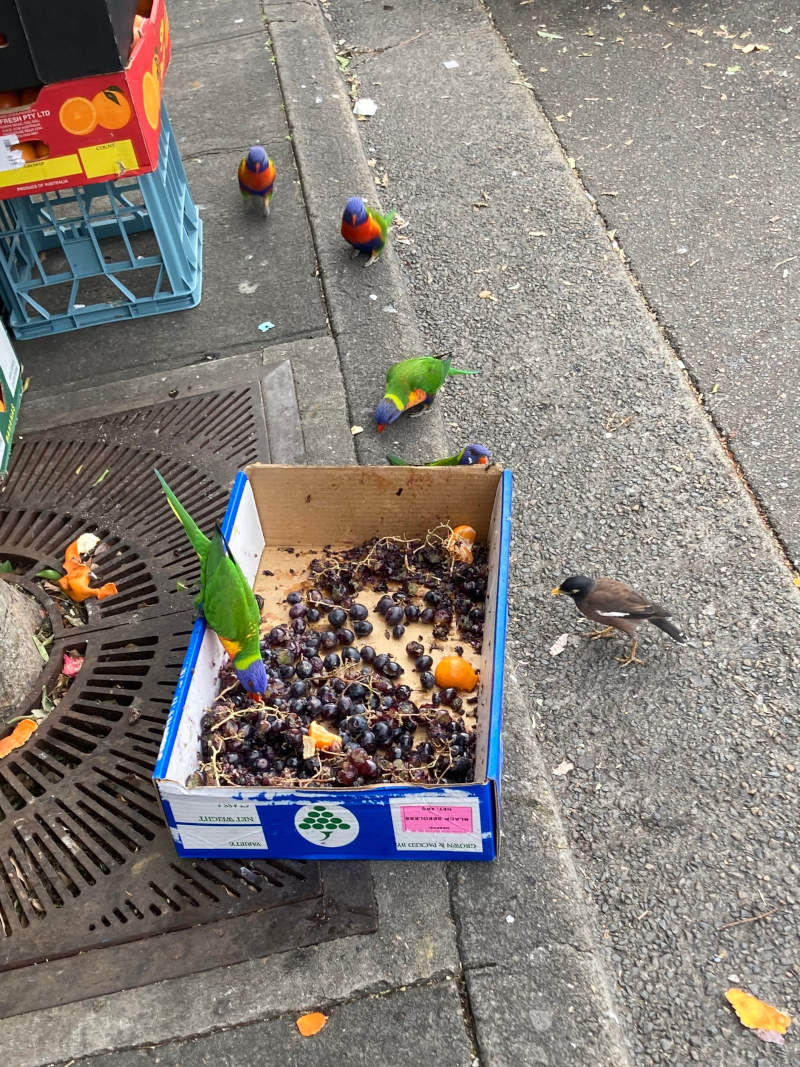
I’m not sure if the owner of a fruit shop in the Sydney suburb of Rockdale leaves leftover fruit out for birds living in the area to feast on, or if these rainbow lorikeets just decided to help themselves.
Whatever, this group of colourful parrots seem to be enjoying a late afternoon meal, even if some of them look as if they’ve eaten enough. An usually subdued common myna bird lurks alone near the fruit box, perhaps hoping the lorikeets will soon move on.
While both species of bird seem cute, both are considered to be pests to some degree. Rainbow lorikeets often descend on orchards and can destroy fruit harvests.
The brown mynas meanwhile, which were introduced to Australia in the nineteenth century, are classified as an invasive pest, and there are concerns they pose a threat to other native birds.
12 July 2025
Ange Lavoipierre, writing for The Australian Broadcasting Corporation:
At the end of June, Australia quietly introduced rules forcing companies such as Google and Microsoft to check the ages of logged-in users, in an effort to limit children’s access to harmful content such as pornography. But experts have warned the move could compromise Australians’ privacy online and may not do much to protect young people.
We’re all for protecting children going online, but this initiative, as it stands, may be way too easy to circumvent. For instance, search engine users could remain logged out of their account, or make use of a VPN, to trick search engines into believing they are outside the country.
But I wouldn’t be surprised if ways to shutdown these options are eventually introduced. In the same way, say, Netflix can make using VPNs difficult. In addition, anyone accessing a search engine in Australia may be forced to actually login to their (age verified) account before they can do searches.
The search engine companies, after all, surely will not want to be in contravention of Australian laws. It seems at some point then, Australian search engine users will need to verify their age. Privacy advocates however are rightly concerned. Certain of the search engines already know enough about our activity online; do we want them knowing our personal details as well?
A sensible solution would be to use a digital identity service. These are independent of search engines, and any other tech companies, who might be required to confirm the age of their users.
One such service I use to both verify my identity, and I imagine age, when dealing with Australian government departments online, is Digital iD, which was developed by Australia Post. (Don’t you be saying the post office is incapable of innovation…)
MyID, created by the Australian Tax Office (ATO), serves a similar purpose.
Of course, we’re having to tell someone our age, and supply a verifying document — an Australian passport, or drivers licence — to do so, but at least the process is handled by an Australian government agency. Perhaps you don’t particularly trust those entities either, but I think they’re a far safer option than an offshore tech company.
In short, identity services such as MyID, or Digital iD, are saying the user is aged eighteen or over. They are not divulging actual ages, or dates of birth.
If the Australian government is so insistent we verify our age to access search engines, and who knows what other apps in the future, then the least they can do is allow us to use an Australian digital identity service to do so.
12 July 2025
Happy birthday to the jays, which clocked the milestone back in January.
To mark the momentous occasion, a special all-time Hottest 100 countdown of Australian songs will be broadcast in a week, on Saturday 26 July 2025. This chart varies from the annual Hottest 100 countdowns, which rank the favourite songs of Triple J listeners, released each calender year, regardless of country of origin.
Voting closes on Thursday 17 July 2025, at 5PM AEST, so if you haven’t participated, time is running out. Now to the thorny question. What would I vote for? After giving the matter some thought, here’s what I came up with:
There are more I’d choose, but I think ten songs is the most you can vote for, as is I’ve listed eleven.