
Does lower sugar consumption reduce cancer risk in some people?
24 August 2026
Research conducted in the UK found people born during World War II and for several years afterwards, were less likely to be afflicted by some forms of cancer, later in life.
During the war years, and for almost a decade afterwards, sugar was rationed in UK.
The prevalence of some types of cancer: breast, prostate, liver, rectal, and lung, rose however in people born after the early 1950’s, once the availability of sugar returned to normal.
RELATED CONTENT
WordPress.com Education, supporting, encouraging younger bloggers
21 August 2026
WordPress.com Education, is an initiative launched earlier week, designed to give school students across the world resources to setup and maintain their own blog:
This isn’t a stripped-down classroom version of WordPress.com. The Student Plan includes plugin support, 6 GB of storage, backups, staging sites, SFTP/SSH, phpMyAdmin, and Studio Sync. Students learn and build with many of the same tools they’ll encounter working with WordPress professionally.
The student plan, which includes everything that comes with the free WordPress.com blogs, together with the subscription personal and premium plans, is free for the first year.
For sure, WordPress has its naysayers, but anything that encourages people, particularly school students, to give social media a rest, and engage more fully with the web, can only be a good thing.
Getting started as a blogger, which is the main thing, is simplified with out-of-the-box products like WordPress.com. Once someone has reached a certain level of proficiency they can always look into other options for publishing blogs and websites.
RELATED CONTENT
blogosphere, blogs, self publishing, technology
AI and apps, the tools used in 2026 to apply for work
20 August 2026
I can’t remember the last time I applied for a permanent full-time job, but it was in the years soon after I left school. I held a couple of these sorts of jobs, but have pretty much worked freelance since. Leads there have come through people I know, or even disassociated.
It’s fair to say I have no idea what the — for want of a better word — formal process is today.
The last time I had what most people would probably consider to a be a “normal” job interview, I sat before a three-person panel. Needless to say things are quite different in 2026, as Millie Muroi writes (in a pay-walled article) for The Sydney Morning Herald.
One-third of Australian companies are said to use AI in their recruiting today. And if the experience of applying for work, in this instance a casual role at a large Australian discount department store chain, is anything to go by, it seems you don’t encounter a single person. At least initially.
The process, which Muroi partly filmed (not pay-walled), involves typing responses to questions posed by an AI chatbot, from wherever you happen to be. No need to show up in person anymore. She later received an email offering some “personalised” insights, which was AI generated.
It is claimed this practice means everyone’s applications are “seen”, and responded to. Is that a plus?
I expect the recruiting stage conducted by the AI chatbot results in a shortlist of candidates, who, following vetting by a person in HR, would then go in for a face-to-face meeting.
I doubt white-collar recruitment occurs in the quite the same fashion, though AI no doubt sifts through applications, which probably have to be lodged through LinkedIn. Fingers crossed my current line of work holds up, as job hunting using LinkedIn is not something I would relish.
RELATED CONTENT
artificial intelligence, technology, trends, work
AI companies using rare books to train agents, while destroying them
19 August 2026
Emanuel Maiberg, writing for 404 Media:
A 404 Media investigation was able to reveal Amazon’s book buying operation, which hasn’t been previously reported, by placing a tracking device in a rare book we suspected would be acquired by an AI company for training data, and following it around the country to its final destination.
It’s one thing to use books to train AI without seeking the author’s permission, nor paying a royalty, but is there any need to destroy them as part of the process?
There is the point that being rare books, they may be older publications, and copyright has lapsed, but that still seems to be beside the point. I was about to suggest these titles be donated to schools or libraries, once no longer needed, but they’ve likely no longer in one piece.
Going further, the process strikes me as being a form of book burning. The AI companies are taking all sorts of liberties with copyrighted material, but destroying books takes bad form to new lows.
RELATED CONTENT
artificial intelligence, books, technology
AI slop exposes fraudulent publishing offer to Australian author Mary Colussi
18 August 2026
Touch Grass, the debut novel of Sydney based Australian author Mary Colussi, was published in June this year. And a fraudulent publishing deal was not too far behind. In this instance though AI slop played a part in giving the scam away.
An email sent to Colussi, apparently from a representative of a well-known publishing house in the UK, was full of praise for Touch Grass. Curiously though comments about the novel’s plot were limited only to what had been published online in its synopsis.
This despite claims by the publishing house rep that they’d read the book. Their AOL (once America Online) email address was also something of a give away, to say nothing of the request for money in exchange for a publishing deal.
While this wasn’t the best executed fraud attempt, as AI agents evolve their efforts will no doubt become more convincing. But asking an author to pay to be published would still arouse suspicion.
Traditional publishing houses do not ask writers for money, rather they pay out in the form of an advance. The objective of these scams though is catch people — particularly newcomers to the industry — off guard, and this is where they might succeed.
RELATED CONTENT
artificial intelligence, Australian literature, books, novels, trends
Is a comeback nigh for the tradie to CEO cappuccino?
18 August 2026
A few years ago I did an online coffee quiz. Highly scientific no doubt. My taste in coffee was — because I’m primarily a cappuccino drinker — adjudged to be “entry level”. Nice.
I occasionally partake of other varieties, like short black or piccolo, but they’re just a little light on coffee (and froth, and chocolate). I was surprised though to lean that Millennials, and Generation X coffee drinkers, are said to be ordering more capps recently. Gen X gets a few things right.
An article in The Sydney Morning Herald’s Good Food section, with a headline proclaiming “cappuccinos won’t give you street cred” is pay-walled — an article about cappuccinos pay-walled, what can I say? — but you can catch the gist on Good Food’s Instagram page.
RELATED CONTENT
AI scrapers use bogus URL tracking tags to make website visits seem legit
17 August 2026
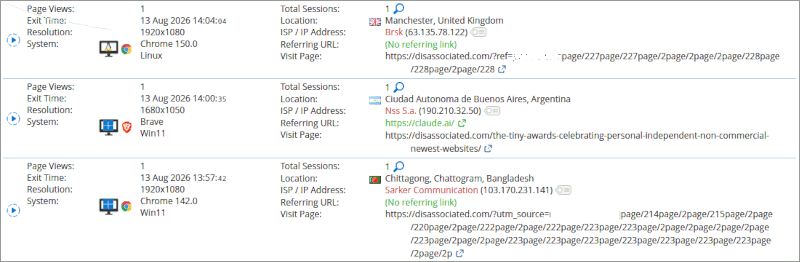
It looks like AI scrapers have been using a surreptitious method of making their marauding presence appear legitimate, this time by appending a bogus query parameter, or tracking tag, to the URL of the webpage they are targeting.
In the last month or so, I have seen a stack of page visit items looking something like this:
https://disassociated.com/?ref=yourwebsitepage/213page/page/page/ 14page/16page/page/2page…
I’ve replaced the actual website name with the generic yourwebsite marker in the above example.
What is particularly insidious though, is the way the crawlers are using the names of reputable websites and blogs that have linked to disassociated in the past.
Initially I thought some of these blogs had mentioned my website again, but after having a closer look at them, this is not the case. There’s also the detail that my web analytics app does not identify a referring page from the website supposedly sending visitors my way.
The frequency of visits doesn’t stack up either. I’m sure the blogs cited in the /?ref= parameter, that are supposed to be linking here, have many (human) readers, but I can’t imagine every last person, sometimes thousands of them, have been clicking through to my website.
Another possibility was my website had been shared in a newsletter. Usually though the URL query, or UTM parameter, I see in newsletters are along the lines of say ?utm_content, or ?utm_source.
One of the query parameters seen in the screenshot from my web analytics app does is ?utm_source though. However, with one exception I think, none the cited websites publish newsletters.
Also, if any of the cited websites were legitimately sending traffic here using a tracking tag, I doubt they’d use such a nonsensical URL path… page/14page/16page/page/2page… what?
It does puzzles me why these scrapers only seem to be targeting the front page of my website. Only a small amount of the total content posted here is visible there. But they’re AI bots, no doubt they know what they’re doing.
In the meantime, I’ll have to get used to seeing these analytics entries until I can figure out a way to block or mask them. That might be easier to say than do though.
But kudos (ironically) to Claude for acknowledging disassociated in response to a query about the Tiny Awards, in the above image. It’s much appreciated, truly, but doesn’t happen often enough.
RELATED CONTENT
artificial intelligence, technology, trends
IC 1101 is the largest galaxy identified, so far, in the universe
14 August 2026
Located one-point-one-five billion light years from Earth, the behemoth galaxy, at one-point-seven-million light in years in length, somewhat dwarfs our home, the Milky Way, which measures in at a mere one-hundred-thousand light years across.
Using kiloparsecs as a metric, the size difference between IC 1101 and the Milk Way, the comparison comes into sharp focus, at five-hundred-and-twenty kiloparsecs versus thirty to fifty, respectively.
For reference, a kiloparsec equates to one-thousand paresecs. A paresec is three-point-two-six light years, not quite the distance from the Sun and Alpha Centauri, the closest star to Earth.
IC 1101 however is minute beside Alcyoneus, a galaxy sixteen million light years in size. Alcyoneus however is a radio galaxy, a body somewhat different to the likes of IC 1101 and the Milk Way.
RELATED CONTENT
Humanity is not a monoculture, and nor is Australia
14 August 2026
I’m still reading through Meta CEO Mark Zuckerberg’s recently published vision of an AI future, but this paragraph jumped out at me:
Humanity is not a monoculture. People’s diverse values represent different tradeoffs they would make on important issues. There is no technological solution that can align with everyone’s opposing interests and values at once. Any singular superintelligence would have to prioritize some values over others and in the process would be incapable of being benevolent to everyone.
In this context, I think Zuckerberg is discussing the challenges of developing a so-called superintelligence that could comprehend the values of the world’s many varied, disparate, cultures.
Superintelligence, sometimes referred to as Artificial Superintelligence (ASI), sits above Artificial General Intelligence (AGI), which in turn sits above AI. A go to example (for me) of AGI is the HAL 9000 computer, AKA Hal, from Stanley Kubrick’s movie 2001: A Space Odyssey.
Hal appears to be conscious, and is capable of thinking and reasoning as a human would.
It seems to me ASI, which is (theoretically) vastly superior to AGI, should be able to extend its “benevolence” to all the people of the Earth, because understanding each of their cultures would surely be something that level of technology is easily capable of. Meta however is developing what they describe as superintelligence, which may vary from ASI.
But I digress.
I doubt Australian politician, and leader of a far-right party called One Nation, Pauline Hanson, would agree with Zuckerberg’s view that humanity is not a monoculture. Because during her recent appearance at the National Press Club, she declared Australia must exist as a “monocultural society”.
Yes, Australia, the place where people from just about every culture in the world, reside.
Surprisingly, Hanson views AI favourably, although she did call for stronger government regulation of the technologies. But technologies that may recognise humanity, and by extension, the people of Australia, are not monocultural? Can that be tolerated?
No doubt Hanson will be calling for the very strict regulation of that sort of technology.
RELATED CONTENT
artificial intelligence, Australia, current affairs, politics
Sydney municipal council wants shop signs to be in English
13 August 2026
Strathfield is a suburb located in the west of Sydney, Australia. I don’t know many people living in the area, so I’m not there often, but have occasionally wandered the streets near the railway station. About a third of residents were born in Australia, while a reasonable number of people hail from Nepal, China, India, South Korea, and Vietnam.
This diversity is reflected in the restaurants, supermarkets, and other shops, located near the train station, where the shop signage of many of these businesses are usually composed in the first language of their respective owners. Something, of course, seen elsewhere in Sydney, and in other English speaking countries across the world.
I can only comprehend some of these shop signs, but the nature of the business is usually quite apparent. The local municipal council, Strathfield City Council, however, does not think this is sufficient, and wants all shop signage to appear in English. I can’t see how this will improve anything, nor do I see a problem with the status quo.
The proposal does not entirely come out of the blue though. In 2018, the council tried doing the same thing, apparently without success. But eight years later the idea has surfaced again. Someone there seems determined to make this happen.
RELATED CONTENT